 |
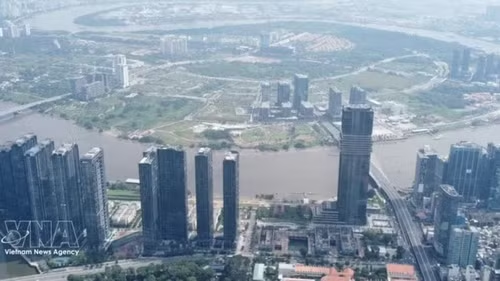
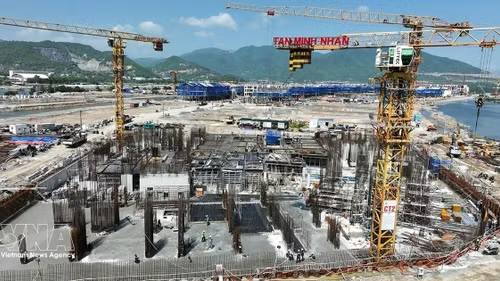
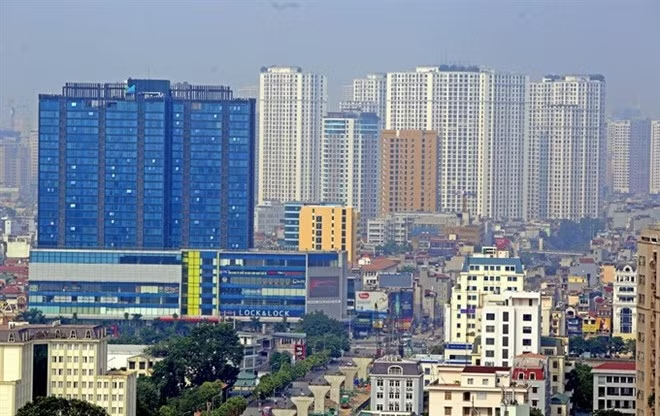
| 2019 is expected to continue to be the year of the middle-end product market. (Photo: VNA) |
“2019 is expected to continue to be the year of the middle-end product market, with a reasonable price that is suitable for the budget of most people,” Duong Duc Hien, Director of Residential Sales at Savills Hanoi, said at a press conference releasing a report on Hanoi’s property market in the fourth quarter of 2018 held in Hanoi this week.
In addition, shop-houses, landed property and products that are built near convenient services will also attract end-users, Hien said. The market still has high demand for those products because of migration trends from other provinces and cities to large cities, the trend of separating households and degraded housing in cities.
The market is not expected to witness new kinds of property, he said. The existing property products will see adjustments to make them more suitable to the demands of customers. For instance, the market will not see 90-sq.m apartments with three bedrooms, because the rooms are too small. Meanwhile, apartment design will expand to balconies, loggia, and windows to catch natural light. These trends are expected to help the housing market achieve sustainable development.
Le Vu Thanh Tam, expert from the Economic and Finance Academy, said positive forecasts on Vietnam’s macroeconomic development indicators would support the stable development of the real estate market this year.
With the free trade agreements (FTAs) that Vietnam has joined and positive impacts from Industry 4.0, Vietnam will receive more foreign investment from funds and new projects, including more capital for the property sector, Tam said.
Accordingly, there will be about 2.5 to 3 million people from rural areas moving to the city, along with tens of thousands of foreign workers and engineers, so housing demand will surge in many segments.
Meanwhile, the supply is expected to drop because there aren’t many available apartments from old projects and the market will not see many new projects due to a lack of land and low financial ability of investors, Tam said. The demand will increase pressure and push prices up.
Tam also said the State has taken action to limit credit for real estate and securities lending but has encouraged banks to increase loans for production and business. Therefore, property projects will find it difficult to approach credit.
Along with that, the State will tighten land use plans and control property projects so the real estate market this year is likely to cool down, meaning property prices are unlikely to increase in many provinces and cities, especially Hanoi and Ho chi Minh City. There are even some projects which may reduce selling prices, Tam said.
With many positive forecasts in macro-economic development and the government’s solutions to control the property market, Tam said, Vietnam’s real estate market will not see a bubble or freeze.
However, Tam said, the property market may face challenges from changes in macro-economic development, market supply and demand and monetary policies of the State Bank.
To reduce negative impacts from those factors, the state management agencies and enterprises in the real estate sector need to ensure macro-economic stability as well as business activities and the state agencies should diversify capital sources for businesses, Tam said.
“This year, mid-end products are expected to keep dominating the Hanoi market with the launch of township developments,” said Nguyen Hoai An, Director, Hanoi branch of CBRE.
“For upscale segments (high-end and luxury), recent progress in prime sites in Hanoi signals the return of the luxury segment after two years without new supply. In terms of location, while more than 50 percent of new launches are expected in the west, the east is forecast to be more active as 30 percent of new supply is located in this area.”
“Before, the position of projects used to be the top priority when choosing property products. However, with upgraded transport infrastructure that is happening at present, the importance of position will reduce,” said Hien from Savills’ Hanoi branch.
Therefore, investors need to have a long-term vision for the project’s potential after 5-10 years, when the infrastructure is developed, on whether the project will still attract buyers or not.
Meanwhile, customers should have a more open mind for housing products, especially when buying for long-term investment, because a disadvantageous location today could become advantageous in the future with more developed surrounding infrastructure. They should study this situation, he said.
In 2018, condominiums for sale in Hanoi continued to see high levels of new launches, with around 30,000 units, according to the CBRE Vietnam’s report on Hanoi market in the fourth quarter 2018 released on January 10.
During 2018, Hanoi’s market has further shifted towards the mid-end segment. The share of this segment in total new launches has expanded to 70 percent from 63 percent in 2017, showing that end-users are still a major source of demand in Hanoi. Noticeably, the market witnessed the launch of large-scale townships including VinCity Ocean Park and VinCity Sporti.
In terms of location, the decentralisation trend continued in 2018 when there was only 2 percent of new supply launched in the four core districts. Additionally, Hanoi’s residential market has expanded to suburban areas with an increasing number of new projects launched in locations outside the 10-km radius from the central business districts (CBD). In 2018, projects in suburban districts such as Thanh Tri, Hoai Duc and Gia Lam accounted for 20 percent of total new launches.
According to Savills Vietnam’s report on Hanoi’sarket in Q4, 2018, transactions on the apartment market rose by 81 percent quarter-on-quarter (QoQ) and 69 percent year-on-year (YoY) whilst the absorption rate increased by 9 percentage points (ppts) QoQ and 5 ppts YoY to 34 percent.
The CBRE report said the pricing level of Hanoi’s condominium market was kept stable given the dominance of the mid-end segment. While Hanoi’s market is still an end-user market, affordability still plays important role for buyers. However, we still observe upward trends in several projects in the high-end segment, especially those in locations such as West Lake and across Ring Road No 3.