- Imports driving Vietnam cattle farmers out of business
- Businesses advised to use legal software to reduce cyberattacks
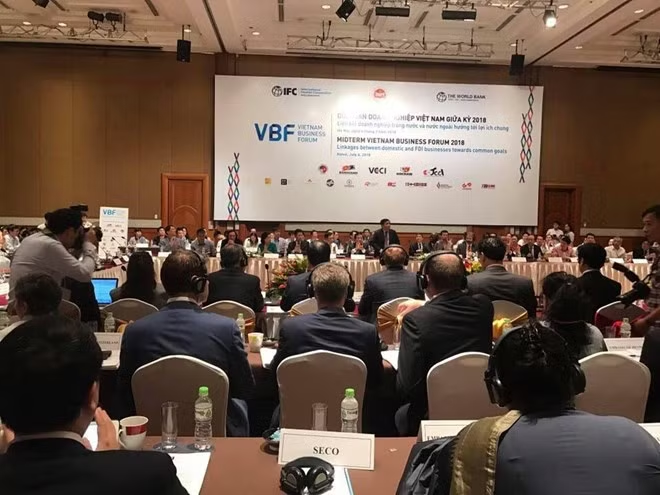 |
| Scene at the mid-term Vietnam Business Forum (VBF) 2018 (Photo: baodautu.vn) |
Co-hosted by the Ministry of Planning and Investment, the World Bank, the International Finance Corporation, and management board of the VBF Alliance, the event featured three sessions, focusing on value chain, response to technological challenges, and financial resources for sustainable development.
In his opening speech, Minister of Planning and Investment Nguyen Chi Dung said the year 2018 marks 30 years of foreign investment attraction in Vietnam. The VBF has supported Vietnam’s efforts in improving business climate over the past 21 years.
The minister noted that the business community in Vietnam, comprising of both foreign-invested and domestic enterprises, have grown over the years in both number and strength, becoming an important driving force for the country’s economic development.
He stressed that the foreign-invested sector has made considerable contributions to Vietnam’s economic achievements. So far 128 countries and territories have invested in about 26,000 projects in Vietnam with a total registered capital of 326 billion USD with more than 180 billion USD disbursed.
The FDI sector has contributed about 25 percent to the total social investment and roughly 20 percent of the GDP. As much as 58 percent of FDI was poured into manufacturing and processing, creating 50 percent of total industrial production value, 72.6 percent of the total export, and 3.6 million direct jobs and 5-6 million indirect jobs.
However, Dung said linkage between foreign-invested and domestic firms remains below expectation while support industry development and technological transfer are limited.
VBF Co-Chair and Chairman of the Vietnam Chamber of Commerce and Industry Vu Tien Loc said Vietnam has made important steps towards trade liberalisation and economic openness via the government’s signing of the Comprehensive and Progressive Agreement for Trans-Pacific Partnership, completion of legal review for the EU-Vietnam Free Trade Agreement and implementation of the World Trade Organisation’s Trade Facilitation Agreement.
In addition, the 10 other FTAs that Vietnam has signed have opened up more doors for Vietnamese goods to many important markets and stimulated its efforts to improve economic institutions and build a sustainable, stable and attractive business environment in the eyes of domestic and foreign investors.
At the same time, Loc voiced several concerns, saying that trade tension is likely to increase, resulting in unforeseeable changes in the world markets, thus complicating competition in Vietnam and other markets. Capital, currency and securities markets are also face the risk of uncertainty.
He also noted that though Vietnam’s export revenue has not reduced, the export growth is dropping over months. Vietnam’s exports, especially aquatic products, are meeting with new barriers in major markets.
The US has imposed anti-dumping tax on Vietnamese tra fish and basa while the EU has issued yellow card warning and inspected all batches of imported Vietnamese aquatic products, he said, adding that timely response is needed before the situation worsens.
The forum serves as a dialogue mechanism between the Government of Vietnam and the national and international business communities to improve business conditions necessary to foster the development of private enterprises, facilitate investment environment, and contribute to sustainable economic growth.
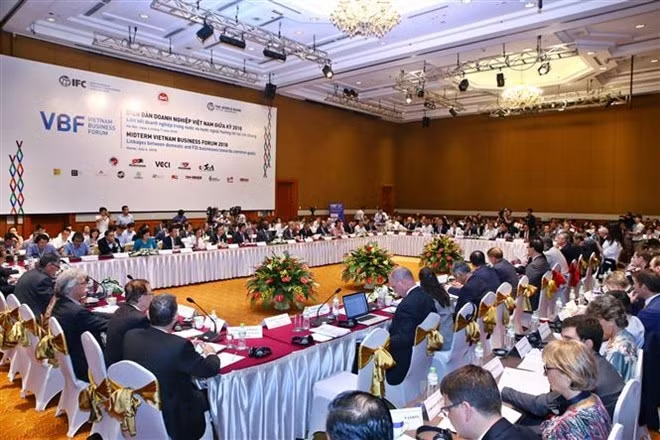 |
Representatives from foreign-invested enterprises and foreign business associations in Vietnam gave their recommendations on fostering linkages between FDI and domestic firms at the mid-term Vietnam Business Forum (VBF) 2018 that opened in Hanoi on July 4.
Kim Heung Soo, President of the Republic of Korea Chamber of Commerce (KOCHAM) in Vietnam, said that the majority of Vietnamese enterprises have yet to produce sufficient support products to supply to FDI firms.
Therefore, the Government of Vietnam and FDI enterprises should focus on dealing with the situation, he said, adding that RoK companies are working hard on growing the support industry in Vietnam and assisting small- and medium-sized enterprises.
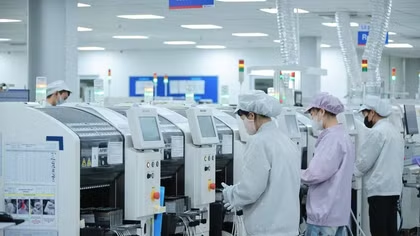
The RoK-invested Samsung Electronics Vietnam has raised its productivity to 85 percent through consultation programmes for their Vietnamese partners and suppliers, said Kim.
He added that Samsung’s programmes have drawn a total of 26 Vietnamese firms since 2015, which have helped the firm improve its operation efficiency by 30 percent and reduce production defect by over 20 percent.
Meanwhile, Koji Ito, President of the Japan Chamber of Commerce and Industry in Vietnam (JCCI), said that forging stronger connections between FDI enterprises and Vietnamese firms is of significant importance for Vietnam in order to raise its position in the global supply chain.
He held the view that one of the responsibilities of the Government is designing regulations to create optimal conditions for enterprises, asserting that it is necessary to connect Vietnamese companies with FDI firms so as to strengthen their access to human resources, capital, and products.
The representative also raised many concerns by Japanese investors and underscored that if the Government keeps the fiscal policies too tight by limiting public debt at below 65 percent of the GDP, it will become a hindrance to infrastructure and construction. Vietnam is in need of investment in this field to ensure middle- and long-term economic growth, he added, stressing that underdeveloped infrastructure will reduce the attraction of Vietnam to foreign enterprises, while also harming the connectivity between existing Vietnamese and FDI businesses.
JCCI proposed that Vietnam roll out measures to reform the structure of its budget expenditure and collection, while reviewing the efficiency of loans.
Participants also showed their hope for improvements in tax and customs policies.
Representatives of Asian and European businesses also asserted that although Vietnam has exerted great efforts in the work, many shortcomings have been seen in its tax and customs policies, including problems on tax exemption and refund, the transparency of tax reports, and the professionality of tax and customs officials in auditing and inspecting, as wells as many obstacles from post-clearance examination and current tax policies.
Nicolas Audier, President of the European Chamber of Commerce (EUROCHAM) in Vietnam, said that tax policies should be renovated to lure more investors.
He said that Europeans are keen on Vietnam’s energy market and wish for the Vietnamese Government’s assurance of transparency and coherence in both its investment attraction policy as well as intellectual property protection.
Ousmane Dione, World Bank Country Director in Vietnam, recommended that local Vietnamese firms should enhance their capacity and competitiveness to become suppliers to foreign businesses, which means engaging deeper with the global value chain.
This is also a stage to make full use of opportunities from the fourth industrial revolution, stated Dione.