Ministry tightens food safety, hygiene controls

The Ministry of Agriculture and Rural Development (MARD) plans to hold more unscheduled inspections of food hygiene and safety in food production and trading this year.

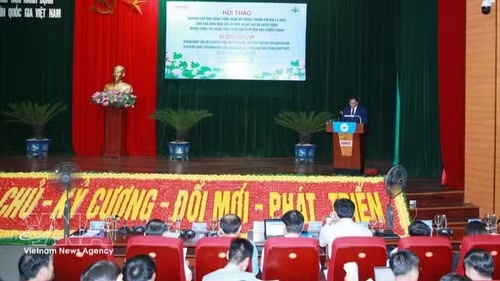
Speaking at a conference on food quality, safety and hygiene in the agricultural sector on February 10, MARD Minister Nguyen Xuan Cuong said that food hygiene and safety is still a problem and directly impacts society.

The ministry plans to prioritise supervising the use of agricultural materials, especially pesticides due to the risk of serious environmental pollution. Any substance containing chemicals that harm people or the environment will be banned.

Last year, the ministry banned 300 kinds of pesticides.

In terms of fertilizer, Minister Cuong said it is necessary to promote switching from inorganic to organic fertilizer.
Each year, up to 12 millions of tonnes of inorganic fertilizer is used for agriculture, causing pollution and reducing the quality of agricultural products.

The ministry will also focus on improving awareness in society about food hygiene and safety regulations.

Nguyen Van Viet, chief inspector of the ministry, said that the inspection teams will keep close watch of drinking water for cattle and chemicals used on shrimps. The teams will also inspect the responsibilities of local authorities in managing agricultural materials and food hygiene.

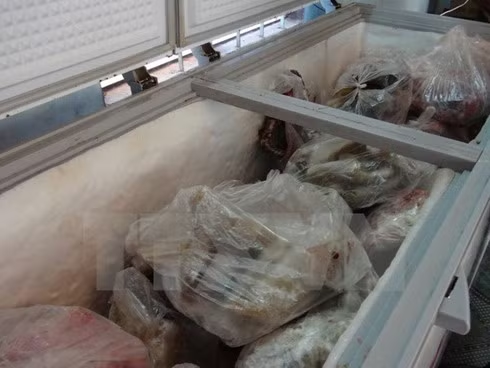
Reports from the ministry showed that last year’s percentage of pork contaminated with Salbutamol, a banned substance to stimulate growth in animals that can affect human health, was 0.44. The percentage of the previous year was 1.07 percent.

In the last six months of last year, no samples were found to contain the banned substance.

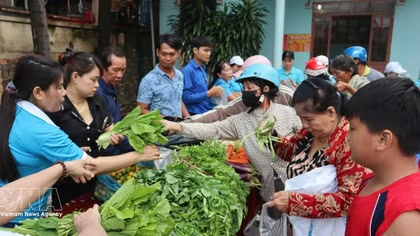
The percentage of vegetables containing pesticides was 4.1 percent, a reduction of 3.66 percent compared to the previous year.

Authorised agencies inspected more than 21,360 businesses in agriculture, forestry and aquaculture and found 1,923 businesses to be in violation of the law.

According to Nguyen Nhu Tiep, head of the Department of Agriculture, Forestry and Fishery Quality Management, this year, the department aims to reduce biological and chemical residues and antibiotics in the production of agriculture, meeting requirements for domestic consumption and the export market.

The rate of samples containing pesticides in vegetables and chemical residue in meat and seafood is expected to be reduced by 10 percent compared to last year by the end of this year.

The department will also improve food chains to ensure food safety for people in all cities and provinces. So far, 50 cities and provinces have built 444 food chains with safe agricultural, forestry and seafood products with clear origins.

In Hanoi alone, 60 food chains were set up with licences from authorised agencies. The number in HCM City was 32.

At the conference, Minister Cuong asked localities to tighten controls and enhance the responsibilities of leaders.

He also urged authorities to increase high-tech application on agriculture and food chain production, encouraging potential enterprises to invest in agricultural production.
VNA

Other News

Hanoi ready to implement Capital Law 2026, unlocking new development momentum

Hanoi ready to implement Capital Law 2026, unlocking new development momentum

The effectiveness of the Capital Law 2026 will be measured not by the number of legal documents issued but by tangible improvements in governance and public administration, better services for people and businesses, faster administrative procedures, stronger investment attraction and higher economic growth.

Vietnamese students earn honours at ROBOG Asia Cup 2026

Vietnamese students earn honours at ROBOG Asia Cup 2026

Three teams from Chu Van An Secondary School in Vietnam’s Thai Nguyen province have earned First Prize honours and advanced to the quarterfinals at the ROBOG Asia Cup 2026, a regional robotics and artificial intelligence (AI) competition for students held in Hong Kong, China.

Hanoi sets out new investment blueprint with century-long development vision

Hanoi sets out new investment blueprint with century-long development vision

As of early June, Hanoi had attracted 74.6 billion USD in foreign direct investment (FDI) through more than 9,250 valid projects. FDI inflows in the first six months were projected at 3.2 billion USD, surpassing the annual target by 116%, while nearly 16,000 new businesses were established in the first five months, up 34.4% year-on-year.

Vietnam promotes legal cooperation and rule of law at global forum

Vietnam promotes legal cooperation and rule of law at global forum

Vietnam’s development and international integration have gone hand in hand with the improvement of its legal system, the incorporation of international commitments into domestic legislation, and legal reforms aimed at fostering development, openness and global integration. The country regards international law as an essential instrument for building fair, mutually beneficial relations among nations.

Hanoi to hold investment promotion event on June 29

Hanoi to hold investment promotion event on June 29

At the event, Hanoi authorities plan to grant investment policy decisions and investment registration certificates to 20 exemplary projects in the fields of transportation infrastructure, industrial parks, urban development, social housing, environment, science and technology, and foreign investment attraction.

Hanoi's Red River urban area development draws widespread attention

Hanoi's Red River urban area development draws widespread attention

Located south of the Red River and extending from the historic inner city to newly developing areas in the south and the west, the central urban area along Red River’s right bank covers approximately 45,317 hectares and is projected to accommodate around 6.365 million residents by 2045 and 6.455 million by 2065.

Hanoi's Red River urban area development draws widespread attention

Hanoi's Red River urban area development draws widespread attention

Located south of the Red River and extending from the historic inner city to newly developing areas in the south and the west, the central urban area along Red River’s right bank covers approximately 45,317 hectares and is projected to accommodate around 6.365 million residents by 2045 and 6.455 million by 2065.

Regional cooperation strengthened to combat cross-border drug crime

Regional cooperation strengthened to combat cross-border drug crime

Vietnam, China, Laos and Myanmar face common challenges as drug syndicates increasingly exploit the Mekong River, cross-border transport networks, e-commerce platforms, international logistics services, cyberspace and cryptocurrencies to organise drug transactions and smuggling operations.