MoH announces priority groups in COVID-19 vaccination plan

PSNews - According to the announcement of the Ministry of Health of Vietnam, there are 11 priority groups in COVID-19 vaccination plan, which were identified based on the outbreak situation and given the current limited supply of vaccines in Vietnam.

They are medical workers; people in the anti-pandemic efforts (COVID-19 prevention and control steering committees of all levels, quarantine facility staff, reporters, etc.); diplomats, customs officers and people working entry and exit procedures; military personnel; public security forces; teachers; elders above 65 years old; essential workers (aviation, transport, tourism staff, utility workers, etc.); people with chronic health issues; people who want to study or work overseas; and people in virus-hit regions.

The priority ranking is evaluated based on criteria such as areas where COVID-19 cases are present, areas with COVID-19 deaths occurred, major cities with high population density and localities considered traffic and transit hubs.
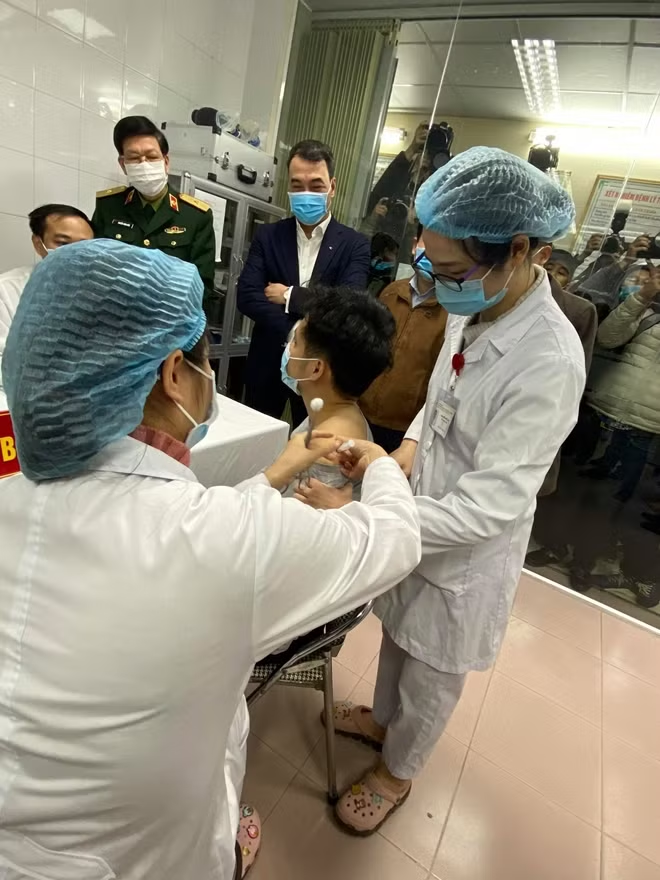
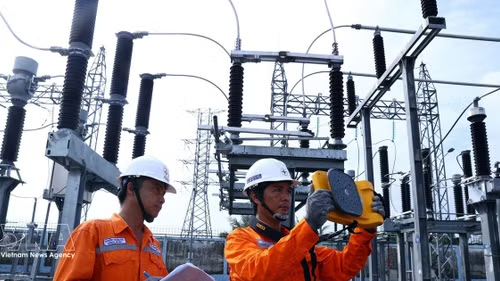
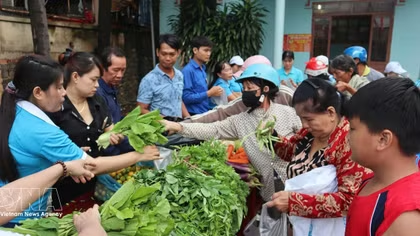
Photo for illustration.
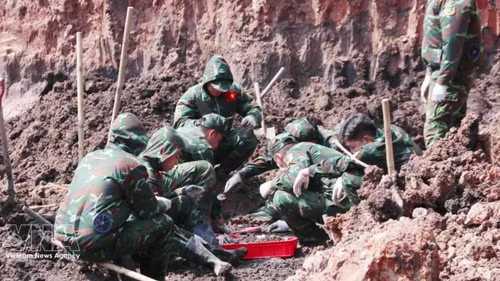
Photo for illustration. 

Deputy Minister of Health Do Xuan Tuyen stated that, the vaccination drive will aim to eventually inoculate 80 per cent of the Vietnamese population against the COVID-19 in a bid to achieve herd immunity.

However, with the current limited supply that they have secured, health authorities are targeting 20 per cent coverage in the 2021-22 period, with 95 per cent of high-risk groups being vaccinated.

The majority of doses from the first batch of 4,886,000 doses  from the COVAX mechanism – 25-35 per cent delivered in the first quarter of 2021, and 65-75 per cent delivered in the second quarter – will be given to medical workers.

In the first quarter, the health ministry expects to inoculate 95 per cent of 500,000 frontline medical workers and 116,000 anti-pandemic staff. 1.2 million doses of COVID-19 vaccine are to be used (each will be given two shots as per recommendations).

In the second quarter, the health ministry aims to inoculate 95 per cent of 9,200 customs officers, 4,080 diplomats, 1,027,000 military officers, 304,000 public security officers, and 550,000 teachers that are considered in high risks categories. All in all, 3.6 million doses are to be used in this period for 1.8 million people.

In the third and fourth quarter, if the promise of COVAX Facility to provide enough doses to cover 20 per cent of each eligible recipient country’s population is fulfilled, Vietnam will inoculate nearly 16.5 million with 33 million doses. 95 per cent of 750,000 teachers, 7,600,000 elders above 65 years old, 1,930,000 essential service workers, and 7,000,000 adults with chronic health issues are to be given the jabs.

By Linh Bui

Other News

Hanoi ready to implement Capital Law 2026, unlocking new development momentum

Hanoi ready to implement Capital Law 2026, unlocking new development momentum

The effectiveness of the Capital Law 2026 will be measured not by the number of legal documents issued but by tangible improvements in governance and public administration, better services for people and businesses, faster administrative procedures, stronger investment attraction and higher economic growth.

Vietnamese students earn honours at ROBOG Asia Cup 2026

Vietnamese students earn honours at ROBOG Asia Cup 2026

Three teams from Chu Van An Secondary School in Vietnam’s Thai Nguyen province have earned First Prize honours and advanced to the quarterfinals at the ROBOG Asia Cup 2026, a regional robotics and artificial intelligence (AI) competition for students held in Hong Kong, China.

Hanoi sets out new investment blueprint with century-long development vision

Hanoi sets out new investment blueprint with century-long development vision

As of early June, Hanoi had attracted 74.6 billion USD in foreign direct investment (FDI) through more than 9,250 valid projects. FDI inflows in the first six months were projected at 3.2 billion USD, surpassing the annual target by 116%, while nearly 16,000 new businesses were established in the first five months, up 34.4% year-on-year.

Vietnam promotes legal cooperation and rule of law at global forum

Vietnam promotes legal cooperation and rule of law at global forum

Vietnam’s development and international integration have gone hand in hand with the improvement of its legal system, the incorporation of international commitments into domestic legislation, and legal reforms aimed at fostering development, openness and global integration. The country regards international law as an essential instrument for building fair, mutually beneficial relations among nations.

Hanoi to hold investment promotion event on June 29

Hanoi to hold investment promotion event on June 29

At the event, Hanoi authorities plan to grant investment policy decisions and investment registration certificates to 20 exemplary projects in the fields of transportation infrastructure, industrial parks, urban development, social housing, environment, science and technology, and foreign investment attraction.

Hanoi's Red River urban area development draws widespread attention

Hanoi's Red River urban area development draws widespread attention

Located south of the Red River and extending from the historic inner city to newly developing areas in the south and the west, the central urban area along Red River’s right bank covers approximately 45,317 hectares and is projected to accommodate around 6.365 million residents by 2045 and 6.455 million by 2065.

Hanoi's Red River urban area development draws widespread attention

Hanoi's Red River urban area development draws widespread attention

Located south of the Red River and extending from the historic inner city to newly developing areas in the south and the west, the central urban area along Red River’s right bank covers approximately 45,317 hectares and is projected to accommodate around 6.365 million residents by 2045 and 6.455 million by 2065.

Regional cooperation strengthened to combat cross-border drug crime

Regional cooperation strengthened to combat cross-border drug crime

Vietnam, China, Laos and Myanmar face common challenges as drug syndicates increasingly exploit the Mekong River, cross-border transport networks, e-commerce platforms, international logistics services, cyberspace and cryptocurrencies to organise drug transactions and smuggling operations.