MONRE highlights severe seawater pollution

The quality of seawater in coastal areas of Vietnam has been on the decline, with a heavy weight of total suspended solids (TSS), according to Vietnam Sea and Islands General Department.

Contaminated seawater, caused by organic chemicals, has reportedly resulted from main land waste released by factories, residential areas, hospitals or agricultural production activities.

Figures from Ministry of Natural Resources and Environment (MONRE) reveal that 70 per cent of waste released to the sea every year comes from the mainland.

This untreated waste, which was pumped directly into the ocean, brings along sediment, plastic, chemicals, metals, oil, and even radioactive substances.

Bai Mon Beach in Phu Yen Province. Experts say The quality of seawater in coastal areas of Vietnam has been on the decline.

Chemical Oxygen Demand or COD, the total measurement of all chemicals (organic & in-organic) in the water, and NH4 level measured during 2011 and 2015 are higher than normal levels.

Pressure from aquaculture activities in coastal areas is also a big problem, MONRE said.

Aquaculture breeding areas in estuaries along the coast have created organic waste, microorganism toxic substances and domestic waste from breeding, resulting in degraded environment quality, disease outbreaks and economic losses.

The ministry showed that one hectare of shrimp breeding area releases, on average, about five tonnes of solid waste, and a large amount of liquid waste in only one season.

Cat Ba National Park in northern Hai Phong City, covering over 5,400 hectares of water surface, is a typical example.

Since tourism activities developed and aquaculture started there, the environment has become seriously polluted.

Side effects of the marine economy

Until September 2014, coastal cities and provinces in Vietnam had 44 sea ports where sensitive and valuable ecosystems are located, bringing huge economic value to the country.

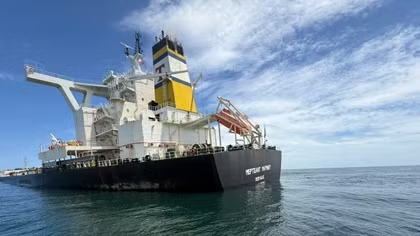
However, the MONRE report reveals oil spills, grease, and waste from ships operating around these ports have caused pollution and created risks for the living environment of animals and plants in the areas.

According to the Environment Observation and Analysis Centre of northern Quang Ninh province, oil and grease pollution along the Hạ Long Bay coast from 2011 to 2015 has reached 0.012 to 0.826 mg per litre, compared to standard statistics of 0.2.

Untreated domestic and industrial waste water has high levels of bacteria. Additionally, the mercury levels at Vung Tau port and Nha Trang port have reached an alarming rate, exceeding the safe limits.

At the National Environment Report launch last month, Hoang Duong Tung, deputy director general of the Vietnam Environmental Administration under MONRE said that coastal seawater has been partially contaminated at several spots due to the impact of economic development activities along the coast.

Many localities prioritise economic goals and underestimate environmental protection, as well as ignore the roles and responsibilities of social organisations, the community and residents, he said.

The report suggests the National Assembly, Government, ministries and local agencies finalise environmental protection legal systems while strengthening State management on the issue.
VNS

Other News

Hanoi ready to implement Capital Law 2026, unlocking new development momentum

Hanoi ready to implement Capital Law 2026, unlocking new development momentum

The effectiveness of the Capital Law 2026 will be measured not by the number of legal documents issued but by tangible improvements in governance and public administration, better services for people and businesses, faster administrative procedures, stronger investment attraction and higher economic growth.

Vietnamese students earn honours at ROBOG Asia Cup 2026

Vietnamese students earn honours at ROBOG Asia Cup 2026

Three teams from Chu Van An Secondary School in Vietnam’s Thai Nguyen province have earned First Prize honours and advanced to the quarterfinals at the ROBOG Asia Cup 2026, a regional robotics and artificial intelligence (AI) competition for students held in Hong Kong, China.

Hanoi sets out new investment blueprint with century-long development vision

Hanoi sets out new investment blueprint with century-long development vision

As of early June, Hanoi had attracted 74.6 billion USD in foreign direct investment (FDI) through more than 9,250 valid projects. FDI inflows in the first six months were projected at 3.2 billion USD, surpassing the annual target by 116%, while nearly 16,000 new businesses were established in the first five months, up 34.4% year-on-year.

Vietnam promotes legal cooperation and rule of law at global forum

Vietnam promotes legal cooperation and rule of law at global forum

Vietnam’s development and international integration have gone hand in hand with the improvement of its legal system, the incorporation of international commitments into domestic legislation, and legal reforms aimed at fostering development, openness and global integration. The country regards international law as an essential instrument for building fair, mutually beneficial relations among nations.

Hanoi to hold investment promotion event on June 29

Hanoi to hold investment promotion event on June 29

At the event, Hanoi authorities plan to grant investment policy decisions and investment registration certificates to 20 exemplary projects in the fields of transportation infrastructure, industrial parks, urban development, social housing, environment, science and technology, and foreign investment attraction.

Hanoi's Red River urban area development draws widespread attention

Hanoi's Red River urban area development draws widespread attention

Located south of the Red River and extending from the historic inner city to newly developing areas in the south and the west, the central urban area along Red River’s right bank covers approximately 45,317 hectares and is projected to accommodate around 6.365 million residents by 2045 and 6.455 million by 2065.

Hanoi's Red River urban area development draws widespread attention

Hanoi's Red River urban area development draws widespread attention

Located south of the Red River and extending from the historic inner city to newly developing areas in the south and the west, the central urban area along Red River’s right bank covers approximately 45,317 hectares and is projected to accommodate around 6.365 million residents by 2045 and 6.455 million by 2065.

Regional cooperation strengthened to combat cross-border drug crime

Regional cooperation strengthened to combat cross-border drug crime

Vietnam, China, Laos and Myanmar face common challenges as drug syndicates increasingly exploit the Mekong River, cross-border transport networks, e-commerce platforms, international logistics services, cyberspace and cryptocurrencies to organise drug transactions and smuggling operations.