More electric buses proposed for HCM City tourists

HCM City’s Department of Transport has proposed to the city’s authority to begin the operation of electric buses to transport tourists from wharfs to hotels or tourism sites.
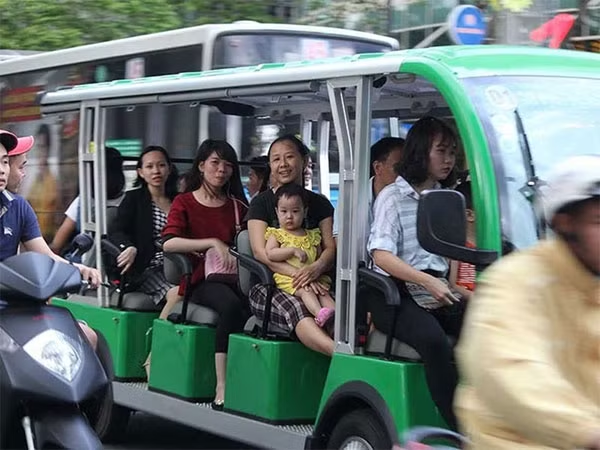
Local residents and tourists use electric buses to visit HCM City. — Photo news.zing.vn

The department suggested that the project be implemented on a trial basis from this month. The move is aimed at promoting waterway transport via eco-friendly vehicles and reducing traffic congestion.

The department said since early this year, three electric bus routes have been put into use as a trial in HCM City centre, Phu My Hung urban area and along Nhieu Loc-Thi Nghe Canal, serving between 800 and 1,000 passengers each day.

As the service has received support from both local residents and tourists, the department has proposed more buses to transport tourists from the city’s wharfs to their hotels or well-known tourism sites.

The bus would pick up passengers from wharfs to some hotels such as New World, Sheraton, Rex and Majestic, as well as Renaissance Riverside, Park Hyatt and Continental Saigon or to tourism sites, including Ben Thanh Market, Fine Art Museum, Nguyen Hue Walking Street and Metro An Phu Supermarket, as well as Minh Dang Quang Institute, Parkson Cantavil Tower and some residential areas.

The department said that it has worked with Thuong Nhat Co Ltd, the company in charge of carrying out the bus routes, to adjust the routes connecting wharfs to hotels and tourism sites to avoid traffic chaos. All the buses would not be allowed to park on the pavement or roads.

The department said that it has got support from the Department of Culture, Sports and Tourism, the city police, the people’s committees of districts 1 and 2, the Urban Traffic Management No 11 and the Centre for Public Transport Management and Operation.

The Department of Transport would guide the implementation of the bus routes this month, if the idea was approved.

Early this year, the city had approved a pilot project using several 12-seat electronic buses on short-distance routes from 5am to 10pm, to serve local residents and tourists.

The first route operates in District 1, connecting 23/9 Park, Pham Ngu Lao, Cong Truong Me Linh and Hai Ba Trung streets, and Sai Gon Zoo. There are 11 electronic buses on this route.

The second route, which consists of five buses, runs in the Phu My Hung urban area in District 7. Buses stop by Pham Van Nghi, Tan Phu, Hoang Van Thai and nearby streets.

Three electronic buses run along Nhieu Loc – Thi Nghe Canal, starting from District 1’s Da Kao Ward and ending in District 3’s Ward 7. 
VNS

Other News

Hanoi ready to implement Capital Law 2026, unlocking new development momentum

Hanoi ready to implement Capital Law 2026, unlocking new development momentum

The effectiveness of the Capital Law 2026 will be measured not by the number of legal documents issued but by tangible improvements in governance and public administration, better services for people and businesses, faster administrative procedures, stronger investment attraction and higher economic growth.

Vietnamese students earn honours at ROBOG Asia Cup 2026

Vietnamese students earn honours at ROBOG Asia Cup 2026

Three teams from Chu Van An Secondary School in Vietnam’s Thai Nguyen province have earned First Prize honours and advanced to the quarterfinals at the ROBOG Asia Cup 2026, a regional robotics and artificial intelligence (AI) competition for students held in Hong Kong, China.

Hanoi sets out new investment blueprint with century-long development vision

Hanoi sets out new investment blueprint with century-long development vision

As of early June, Hanoi had attracted 74.6 billion USD in foreign direct investment (FDI) through more than 9,250 valid projects. FDI inflows in the first six months were projected at 3.2 billion USD, surpassing the annual target by 116%, while nearly 16,000 new businesses were established in the first five months, up 34.4% year-on-year.

Vietnam promotes legal cooperation and rule of law at global forum

Vietnam promotes legal cooperation and rule of law at global forum

Vietnam’s development and international integration have gone hand in hand with the improvement of its legal system, the incorporation of international commitments into domestic legislation, and legal reforms aimed at fostering development, openness and global integration. The country regards international law as an essential instrument for building fair, mutually beneficial relations among nations.

Hanoi to hold investment promotion event on June 29

Hanoi to hold investment promotion event on June 29

At the event, Hanoi authorities plan to grant investment policy decisions and investment registration certificates to 20 exemplary projects in the fields of transportation infrastructure, industrial parks, urban development, social housing, environment, science and technology, and foreign investment attraction.

Hanoi's Red River urban area development draws widespread attention

Hanoi's Red River urban area development draws widespread attention

Located south of the Red River and extending from the historic inner city to newly developing areas in the south and the west, the central urban area along Red River’s right bank covers approximately 45,317 hectares and is projected to accommodate around 6.365 million residents by 2045 and 6.455 million by 2065.

Hanoi's Red River urban area development draws widespread attention

Hanoi's Red River urban area development draws widespread attention

Located south of the Red River and extending from the historic inner city to newly developing areas in the south and the west, the central urban area along Red River’s right bank covers approximately 45,317 hectares and is projected to accommodate around 6.365 million residents by 2045 and 6.455 million by 2065.

Regional cooperation strengthened to combat cross-border drug crime

Regional cooperation strengthened to combat cross-border drug crime

Vietnam, China, Laos and Myanmar face common challenges as drug syndicates increasingly exploit the Mekong River, cross-border transport networks, e-commerce platforms, international logistics services, cyberspace and cryptocurrencies to organise drug transactions and smuggling operations.