- Vietnam remains attractive for investment in 2019: insider
- Binh Duong open for investment
- Phu Quoc boosts investment in socio-economic development

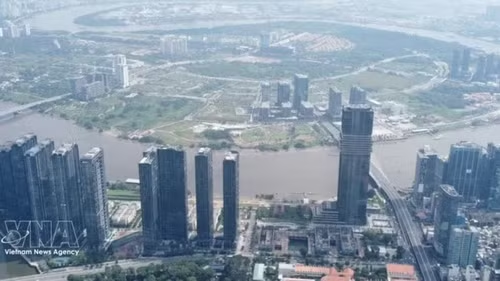
The Southern Key Economic Region includes Ho Chi Minh City and the provinces of Binh Phuoc, Tay Ninh, Binh Duong, Dong Nai, Ba Ria-Vung Tau, Long An and Tien Giang. The region accounts for only 8 percent of the country’s area but plays a leading role in its economic development as it makes up 60 percent of the Government’s revenues.
The region ranks highly in FDI attraction, accounting for 50 percent of the capital and 60 percent of projects of the entire country. However, the region’s technical and social infrastructure has not met socio-economic development needs, experts said.
Dr Du Phuoc Tan, head of the urban management and research division at the HCM City Institute for Development Studies, said the region needed a huge amount of funds each year to develop road infrastructure, but the funds allocated by the government were insufficient. “The Government’s finances are limited, so we need to look for other sources of capital,” he said.
According to statistics from the Ministry of Transport, around 300 trillion VND (12.9 billion USD) is needed to build road infrastructure in the region. Tan said that policies for financing traffic infrastructure linking the city and provinces in the region and elsewhere in the country are limited, and the Government should issue more “breakthrough policies”.
A transport development plan in the region by 2020 envisages building more new expressways such as between Bien Hoa city in Dong Nai province and Vung Tau city in Ba Ria-Vung Tau province, between HCM City and Binh Phuoc province’s Chon Thanh district passing through Binh Duong province’s Thu Dau Mot city, between Long An province’s Ben Luc district and Dong Nai’s Long Thanh district, and between HCM City and the Moc Bai international border gate in Tay Ninh province.
Many other waterway transport projects are expected to be added to the plan. With a leading role in the region, HCM City has proposed many solutions to mobilise capital for socio-economic development not only for the city but also for the whole region.
In 2010, the city government issued a decision on the establishment of the HCM City Financial Investment Company (HFIC). To date, HFIC has attracted investment in major infrastructure projects in the city to ensure efficient use of State capital.
HFIC has provided credit for 131 infrastructure projects in the city with a total investment of more than 14 trillion VND with a credit limit of 6.076 trillion VND in key fields such as technical infrastructure (33 percent), health (22 percent), education (41 percent) and others (4 percent).
HFIC has also managed a number of funds from the city budget such as a power grid renovation project; science and technology development fund; information technology human resources development fund; and pollution reduction fund.
It has also given loans to social and political organisations with total disbursement value of 2.064 trillion VND, while ensuring debt collection in a timely manner.
Le Thi Huynh Mai, deputy director of HCM City Department of Planning and Investment, said the city government should issue government bonds to mobilise investment capital. The department will seek funds from the private sector for infrastructure projects, she said.
She said the department would continue to seek potential investors for all sectors through public-private partnerships (PPP). The department will also connect investors with banks and credit institutions, and help businesses access loans and simplify administrative procedures.
Binh Duong province has proposed solutions to attract local and foreign investment by creating a favourable investment environment.
The province has improved road infrastructure significantly to enhance connections with HCM City and surrounding provinces, developed concentrated industrial zones (IPs), and attracted labour resources from provinces and cities in the country.
As of the end of 2018, the industry-service sector had accounted for 88.2 percent of Binh Duong province’s economic structure, while budget revenue collection had reached 50 trillion VND and per capita income 130.8 million VND per year.
The province has no poor households, according to national criteria. Meanwhile, Dong Nai province has shifted to attracting FDI from big corporations, investment projects in high-tech fields, and supporting industries instead of projects using outdated technology.
Improved infrastructure and consistent land planning have helped Dong Nai attract investors. In the past five years, Dong Nai has attracted more than 1.7 billion USD of FDI each year. In 2018, Dong Nai had 27 trillion VND of domestic investment and 1.85 billion USD worth of FDI.
Mai Van Nhon , deputy head of the Dong Nai Industrial Zone Authority, said the province has provided many solutions to support businesses.
Every year the province organises many dialogues to solve obstacles for businesses. Dong Nai also works with other localities with large labour resources to support enterprises to recruit workers. Dong Nai has also furthered administrative reform to attract more investment in the province.
In Binh Duong, in the 2011-15 period, total investment for road infrastructure reached more than 98 trillion VND, accounting for 37.3 percent of the total capital, of which the budget capital accounted for only 24.8 percent with the rest coming from other economic sectors.
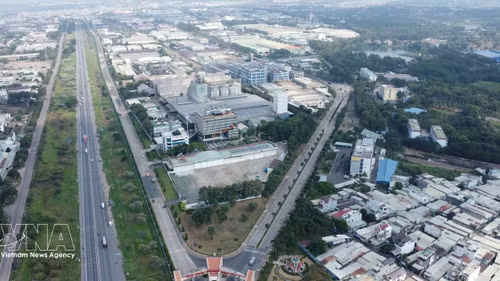
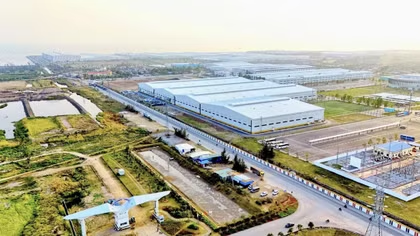
The capital source is primarily for investment in transport infrastructure and construction of industrial parks. Currently, Binh Duong province has 29 IPs with a total area of 12,7ha, of which 27 IPs are operating with leasing area of 80.8 percent.
Phu Huu Minh, deputy director of the province’s Department of Planning and Investment, said mobilising investment from the private sector in transport infrastructure and industrial parks had helped attract more investment.
To date, the province has 36,379 domestic enterprises with a total registered capital of 296.989 trillion VND and 3,509 FDI projects with a total investment of 32.2 billion USD, contributing greatly to the province’s socio-economic development.
Recently, Binh Duong hosted the Horasis Asia Meeting 2018 to promote its potential with international partners, improve its management capacity, and apply advanced technologies to implement its smart city.
The event offered local enterprises an opportunity to network with international partners who are senior founders, general directors and CEOs of leading companies from around the world.
Binh Duong was also chosen to host the 2018 World Technopolis Association Summit in 2018. Long An province has attracted about 11,748 enterprises investing in the province, including 951 FDI projects. In 2018, the province’s economic growth reached 10.36 percent; per capita GRDP reached 61 million VND per year; and the poverty rate fell to less than 2.92 percent.
The province’s total State budget revenue in 2018 reached 13.83 trillion VND, topping the Mekong Delta region.
According to a Government master plan, the Southern Key Economic Region needs total capital of 6.54 quadrillion VND for its economic development in the 2015-20 period. Total budget revenue of the region accounted for 41.3 percent of the country’s total budget revenue.
In 2016, localities in the region had an economic growth rate of 1.5 times the average level of the country, contributing 60 percent of the national budget revenue.