National economy showing gradual signs of recovery

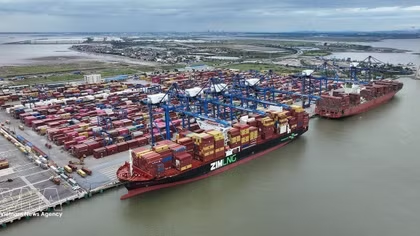
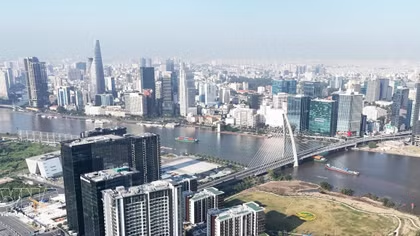
The ailing Vietnamese economy, which has been hit hard by the prolonged impact of COVID-19, is showing positive signs of recovery thanks to impressive levels of exports and FDI attraction making a huge contribution to economic growth.

Business production moving at full steam
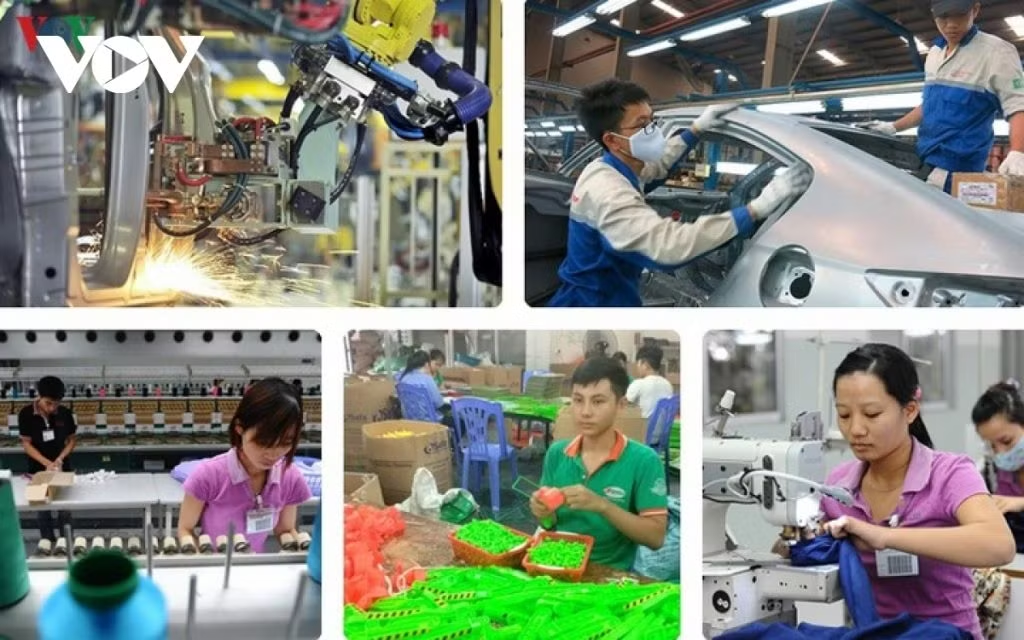
The national economy is showing signs of recovery following a long hiatus caused by COVID-19.

The national economy is showing signs of recovery following a long hiatus caused by COVID-19.

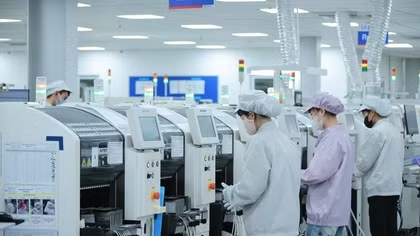
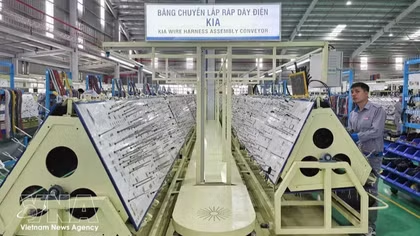
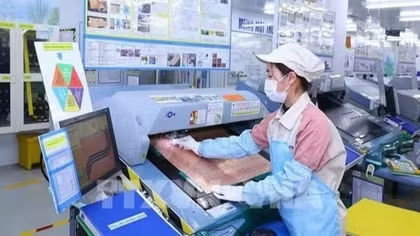
Immediately after the country moved into the post-pandemic period in early October, a number of local garment makers have begun to gather momentum to fulfil orders. Since the beginning of October, Viet Thang Jean Co., Ltd. has exported approximately 150,000 products, a threefold increase compared to the entire month of September.

Pham Van Viet, managing director of Viet Thang, states that his company is racing against time in order to meet partners’ orders. Its export turnover is expected to increase by 60% quarter-on-quarter by the end of December, and approximately 8% year-on-year.

According to the executive, Vietnamese garments are enjoying strong sells in the global market, despite the impact of the COVID-19 pandemic. In contrast, China and Bangladesh, both of which are Vietnamese rivals, are encountering several difficulties.

The Vietnam Textile and Apparel Association (VITAS) reports that the country’s total garment and textile export turnover during the opening nine months of the year reached US$29 billion, an annual rise of 13.2%. The industry’s export value for the year is anticipated to rise to US$37.5 - 38 billion providing that the latest COVID-19 outbreak is brought under control in October, and to US$36 - 36.5 billion if the outbreak remains complicated.

Meanwhile, wood processing businesses have enjoyed impressive growth, despite the impact of COVID-19. Indeed, the export turnover of wood and wood products fetched US$11.11 billion during the past nine months, an annual surge of 30.6%.

Since official implementation of the EU-Vietnam Free Trade Agreement (EVFTA) in August 2020, the local wood industry has expanded its market share to many EU member states, therefore fuelling its export growth.

Vu Quang Huy, CEO of TEKCOM Joint Stock Company, says his firm was hit hard by the impact of COVID-19 in the third quarter of the year, although its overall export value for the entire year is poised to leap by 50%. He predicts that the global economic recovery moving into 2022 will certainly offer brilliant prospects for the local wood industry to increase its exports.

According to Nguyen Chanh Phuong, general secretary of the Ho Chi Minh City Handicraft and Wood Processing Association, over 60% of businesses have now returned to work, with the figure set to gradually increase to roughly 75% by the end of the year.

The industry is anticipated to rake in US$14.5 - 15 billion from exports this year, or nearly US$3 billion more than last year’s figure. In addition, the increasing global demand for wood and wood products moving into the post-pandemic period will prompt Vietnamese wood export value to rise to US$18 - 19 billion next year, predicts Phuong.

Bright prospects ahead
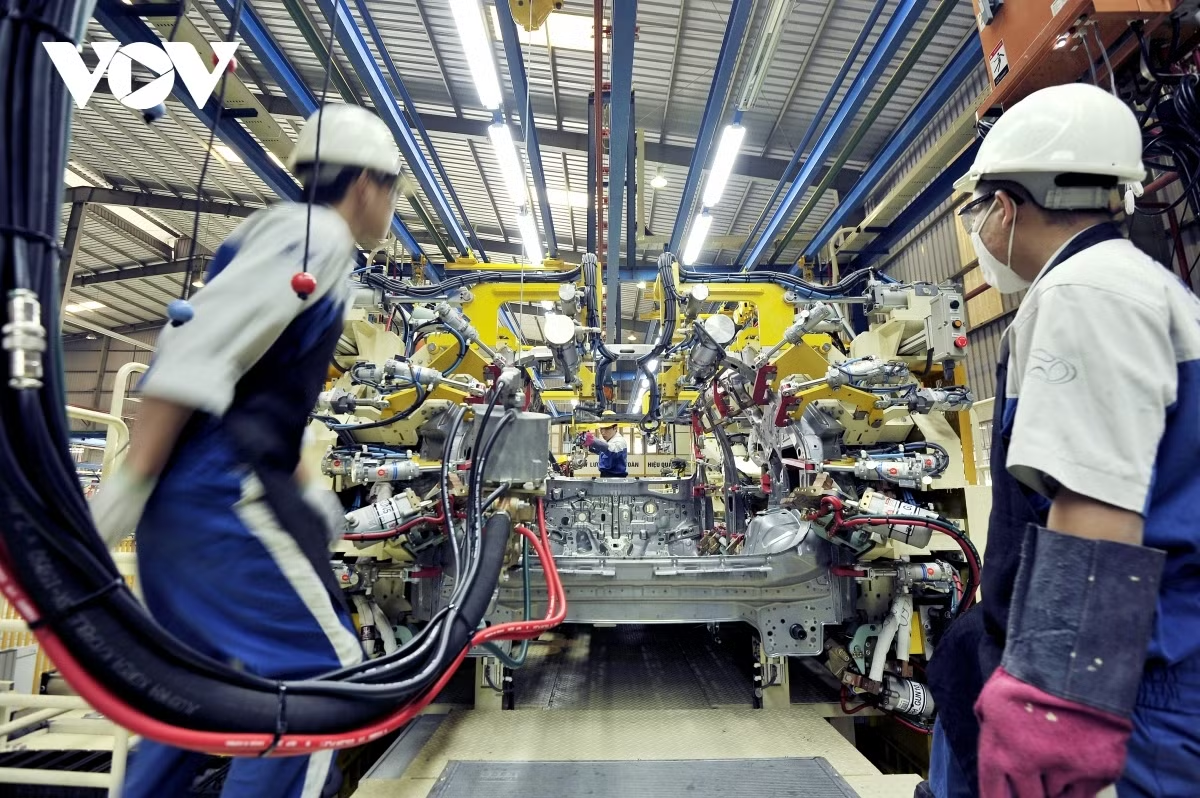
FDI capital has enjoyed growth despite the COVID-19 impact. 

FDI capital has enjoyed growth despite the COVID-19 impact. 

The resurgence of the SARS-CoV-2 virus in late April cast a shadow over Vietnamese economic outlook following its successful control of outbreaks in 2020. However, FDI attraction has become a bright spot in the overall gloomy picture for the domestic economy.

The Ministry of Planning and Investment reports that the country attracted US$22.15 billion worth of FDI capital over the opening nine months of the year, an annual increase of 4.4%. Most notably, newly-registered capital surged by 20.6% to US$12.5 billion, while additional registered capital also rose by 25.6% to reach US$6.4 billion.

Dr. Oliver Massmann, general director of Duane Morris LLC, one of the 100 largest law firms globally, notes that the country will soon regain its position as one of the friendliest investment destinations in Asia once the COVID-19 outbreak is fully brought under control over the next six months.

Vietnam is benefitting from bilateral and multilateral free trade agreements, while economic recovery policies introduced by the central government are so far proving to be effective, the expert explains.

During a meeting held among FDI businesses in September, Choi Joo-ho, CEO of Samsung Vietnam, also stated that the country remains an attractive destination for foreign investors over the long run.

Choi stated that Samsung supports the Vietnamese Government’s ongoing policy relating to effective pandemic control and economic growth. He therefore believes  that the prolonged outbreak will soon be brought under control nationwide, especially in Ho Chi Minh City and other industrial clusters located in the south.

Experts believe that Vietnam will quickly secure positive economic growth in the fourth quarter of the year after suffering a contraction in the third quarter, helping the economy get back on track moving into 2022.
VOV

Other News

Vietnam accelerates innovation to boost growth, competitiveness

Vietnam accelerates innovation to boost growth, competitiveness

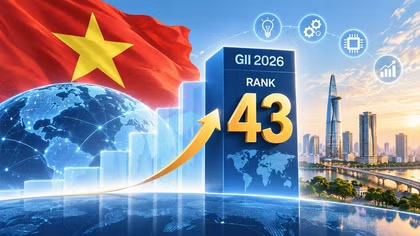
By 2030, Vietnam aims to rank among the world’s top 40 in the GII; raise total social investment in R&D to at least 2% of GDP, with non-State funding accounting for over 60%; increase international scientific publications by an average of 10% annually; and raise the number of patent applications and granted patents by an average of 16-18% annually.

Vietnam sees high growth prospects

Vietnam sees high growth prospects

Experts from the Institute of Vietnam and World Economy under the Vietnam Academy of Social Sciences noted the quality of recent growth as the high growth rate has been recorded against an increasingly higher comparative base.

Vietnam seeks bigger share of global Halal market

Vietnam seeks bigger share of global Halal market

Vietnam's Halal exports remain modest at around 900 million USD a year, accounting for less than 1% of the global market. Most exports are still raw agricultural and seafood products. Only around 1,000–1,300 Vietnamese businesses obtained or maintained Halal certification during 2024–2026.

Hanoi sets up inter-agency mechanism to operate carbon market

Hanoi sets up inter-agency mechanism to operate carbon market

Under a decision of the municipal People’s Committee on establishing an inter-agency working group, departments and agencies are responsible for identifying facilities subject to greenhouse gas inventories, developing emissions-reduction plans and studying projects capable of generating carbon credits.

Shrimp exports reach 3.3 billion USD in eight months

Shrimp exports reach 3.3 billion USD in eight months

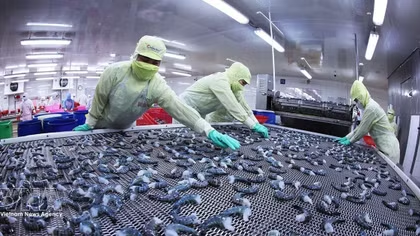
According to data from the Vietnam Customs cited by the Vietnam Association of Seafood Exporters and Producers (VASEP), shrimp exports reached 478.5 million USD in August, up 4.2% from the same month last year. The eight-month total stood at 3.3 billion USD, representing a year-on-year increase of 12%.

Russian investors explore opportunities in Vietnam's real estate market

Russian investors explore opportunities in Vietnam's real estate market

Vietnam is seen as a potential market, with considerable room for growth in real estate, particularly commercial property, compared with some regional markets. Strong Vietnam-Russia ties and opportunities to establish foreign-invested enterprises are also considered favourable for Russian investors.

Phu Quoc airport planning adjusted to serve APEC 2027

Phu Quoc airport planning adjusted to serve APEC 2027

For 2021-2030, the Civil Aviation Authority of Vietnam proposed bringing forward the investment in a parallel taxiway system and a connecting taxiway north of Runway No. 2 at Phu Quoc International Airport, in order to connect with the aircraft maintenance and repair facility (hangar) planned for the northern area of ​​the airport.

Policy, infrastructure emerge as new advantages in FDI attraction

Policy, infrastructure emerge as new advantages in FDI attraction

From policy and infrastructure to industrial real estate, Vietnam’s FDI advantages are broadening towards a more integrated production ecosystem, offering investors a stronger combination of conditions for high-value, technology-intensive and long-term projects.

Logistics upgrade vital to 1-trillion-USD trade target: experts

Logistics upgrade vital to 1-trillion-USD trade target: experts

As trade expands, systemic bottlenecks across transport networks, warehousing, ports, border gates, and industrial zones are becoming more apparent. Experts emphasise the need to shift from a fragmented, project-by-project approach toward strategic management structured around trade corridors and integrated supply chains.

Ample room for Vietnam, US to deepen cooperation

Ample room for Vietnam, US to deepen cooperation

Do Ngoc Hung, Trade Counsellor and head of the Vietnam Trade Office in the US, said what stands out is not only the growth in trade volume but also the increasingly deep economic ties between the two countries.

Flexible fiscal policy helps drive economic growth

Flexible fiscal policy helps drive economic growth

According to the Ministry of Finance, State budget revenue in the first eight months of 2026 was estimated at 2.02 quadrillion VND (77.7 billion USD), equivalent to 80% of the annual estimate and up 16% year-on-year. Domestic revenue reached 1.75 quadrillion VND, accounting for 86.6% of total revenue and rising 16.6%.

Electronic components are produced at a factory in Hanoi. (Photo: VNA)

Hanoi's imports surge 41% in first eight months of 2026

Hanoi aims to achieve average annual export growth of at least 12% during 2026-30, with the city seeking to diversify export markets, boost high-tech and value-added products and reduce reliance on traditional markets.