Nearly 3,300 qualified helmets given to primary students in Gia Lai

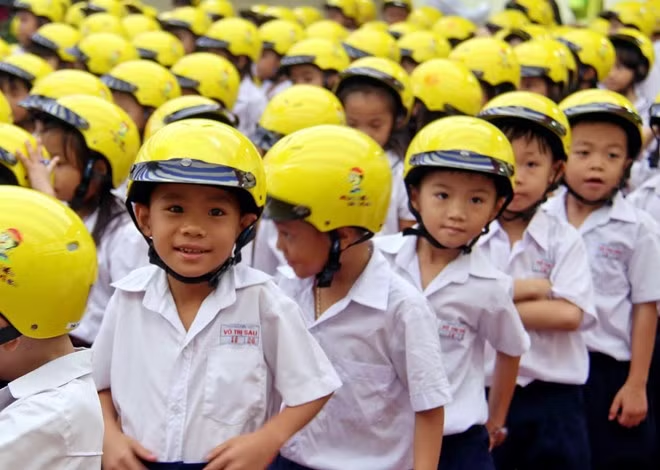
Almost 3,300 qualified helmets have been presented to primary students in the Central Highlands province of Gia Lai in the 2017 – 2018 academic year.
"Helmets for Kids” project gifted almost 3,300 quality helmets to primary students in the Central Highlands province of Gia Lai in the 2017 – 2018 academic year. Illustrative image. (Photo: AIP Foundation)

"Helmets for Kids” project gifted almost 3,300 quality helmets to primary students in the Central Highlands province of Gia Lai in the 2017 – 2018 academic year. Illustrative image. (Photo: AIP Foundation)

The figure was announced at a conference to review the “Helmets for Kids” project led by the Asia Injury Prevention Foundation (AIP Foundation) in Pleiku city, Gia Lai, on May 18.

The helmets were gifted to students from nine primary schools in the districts of Chu Pah, Mang Yang, Kong Chro, Chu Se and Dak Doa and Ayun Pa town. 

According to a survey by local authorities, 96 percent of primary students in Gia Lai province wore quality helmets and 100 percent had a correct use of the helmets thanks to the project. The students have also reportedly had better sense of compliance with road safety rules. These have contributed to the reduction of brain injuries and fatality due to traffic accidents.

The “Helmets for Kids” project is expected to bring 2,000 helmets to pupils of 12 other primary schools in Gia Lai in the 2018 – 2019 school year.

The AIP Foundation was founded by Greig Craft in 1999 to raise awareness about the social, economic, and human impact of the rising number of road crash injuries and fatalities in developing countries, beginning with Vietnam.

Former US President Bill Clinton launched the “Helmets for Kids”, the AIP Foundation’s first school-based program, on November 19, 2000 in Ho Chi Minh City and the project is now active across Vietnam, Cambodia and Thailand. 

The motorcycle safety initiative provides school children and teachers with quality helmets and road safety education through funding support from numerous private sector partners.

According to the National Traffic Safety Committee, in 2017, the country witnessed a total of 20,000 accidents, claiming the lives of nearly 8,300 people and injuring 17,000 others.

Over the last five years, the figure of fatalities has shown a gradual downward trend, but still never dropped below 8,000. Vietnam’s traffic fatality rate of 24.5 per 100,000 is Southeast Asia’s second-highest, following Thailand, according to the World Health Organisation (WHO). In 2016, the number of deaths even went up by 14 compared to 2015, with most accidents involved motorbikes.

VNA

Other News

Hanoi ready to implement Capital Law 2026, unlocking new development momentum

Hanoi ready to implement Capital Law 2026, unlocking new development momentum

The effectiveness of the Capital Law 2026 will be measured not by the number of legal documents issued but by tangible improvements in governance and public administration, better services for people and businesses, faster administrative procedures, stronger investment attraction and higher economic growth.

Vietnamese students earn honours at ROBOG Asia Cup 2026

Vietnamese students earn honours at ROBOG Asia Cup 2026

Three teams from Chu Van An Secondary School in Vietnam’s Thai Nguyen province have earned First Prize honours and advanced to the quarterfinals at the ROBOG Asia Cup 2026, a regional robotics and artificial intelligence (AI) competition for students held in Hong Kong, China.

Hanoi sets out new investment blueprint with century-long development vision

Hanoi sets out new investment blueprint with century-long development vision

As of early June, Hanoi had attracted 74.6 billion USD in foreign direct investment (FDI) through more than 9,250 valid projects. FDI inflows in the first six months were projected at 3.2 billion USD, surpassing the annual target by 116%, while nearly 16,000 new businesses were established in the first five months, up 34.4% year-on-year.

Vietnam promotes legal cooperation and rule of law at global forum

Vietnam promotes legal cooperation and rule of law at global forum

Vietnam’s development and international integration have gone hand in hand with the improvement of its legal system, the incorporation of international commitments into domestic legislation, and legal reforms aimed at fostering development, openness and global integration. The country regards international law as an essential instrument for building fair, mutually beneficial relations among nations.

Hanoi to hold investment promotion event on June 29

Hanoi to hold investment promotion event on June 29

At the event, Hanoi authorities plan to grant investment policy decisions and investment registration certificates to 20 exemplary projects in the fields of transportation infrastructure, industrial parks, urban development, social housing, environment, science and technology, and foreign investment attraction.

Hanoi's Red River urban area development draws widespread attention

Hanoi's Red River urban area development draws widespread attention

Located south of the Red River and extending from the historic inner city to newly developing areas in the south and the west, the central urban area along Red River’s right bank covers approximately 45,317 hectares and is projected to accommodate around 6.365 million residents by 2045 and 6.455 million by 2065.

Hanoi's Red River urban area development draws widespread attention

Hanoi's Red River urban area development draws widespread attention

Located south of the Red River and extending from the historic inner city to newly developing areas in the south and the west, the central urban area along Red River’s right bank covers approximately 45,317 hectares and is projected to accommodate around 6.365 million residents by 2045 and 6.455 million by 2065.

Regional cooperation strengthened to combat cross-border drug crime

Regional cooperation strengthened to combat cross-border drug crime

Vietnam, China, Laos and Myanmar face common challenges as drug syndicates increasingly exploit the Mekong River, cross-border transport networks, e-commerce platforms, international logistics services, cyberspace and cryptocurrencies to organise drug transactions and smuggling operations.