New anti-pandemic plan underway as southern localities take brunt of COVID-19 wave

The latest wave of COVID-19 is anticipated to last longer than previous outbreaks, thereby adversely affecting the livelihoods of citizens and socio-economic development, particularly in the southern region, said Minister of Health Nguyen Thanh Long.
Minister of Health Nguyen Thanh Long at the meeting

Minister of Health Nguyen Thanh Long at the meeting

In his remarks during a regular meeting on nationwide COVID-19 prevention and control efforts, Minister Long warned of the growing number of new local infections and fatalities regarding COVID-19 in Ho Chi Minh City. The southern city, currently the nation’s largest hotspot for the epidemic, along with eastern and southwestern provinces, is seeing the pandemic evolve in a very complicated manner.

According to the Minister of Health, the previous outbreaks lasted for only up to eight weeks, but the ongoing wave may last longer due to the Delta variant spreading rapidly, with the infection rate up to three times higher than previous outbreaks.

“Due to the adhesion speed of the Delta mutant to host cells, the ability to multiply rapidly in large numbers in cells leads to the destruction of cells and the spread of pathogens to the surrounding environment in a short time.  The current infection cycle is only two days, not five days like before," Minister Long analysed.

New anti-pandemic strategy

The Ministry of Health has made changes to its anti-pandemic strategy regarding isolation, testing, and treatment to fall in line with the actual pandemic situation.

Minister Long went on to say that shortening the isolation period, despite the potential risks, can be accepted as a low level of danger. Simultaneously, F1 isolation at home can be applied according to the guidance of the Ministry of Health, providing relevant criteria are met during its pilot run.

Regarding COVID-19 treatment, the Ministry of Health has set up treatment areas for mild and asymptomatic patients, while those with symptoms will be transferred to medical facilities for treatment. In terms of severe and critically-ill patients, they will be sent to general hospitals or field hospitals with intensive care units (ICU).
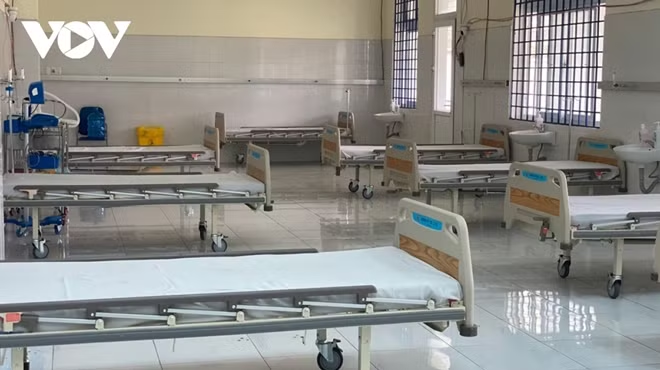
More hospital beds are provided to serve COVID-19 treatment

 More hospital beds are provided to serve COVID-19 treatment

If asymptomatic patients have twice tested negative for SARS-CoV-2 or twice tested positive, but their virus concentration index is low, they can be discharged from hospital because the possibility of community transmission will be virtually nonexistent. However, these cases will still be subject to medical observation and supervision at places of residence for a 14-day period.

The Ministry of Health has also noted that more than 400 relapse cases following hospital discharge had led to no cases of community transmission. Therefore, relapse cases in the community must continue undergoing medical monitoring.

"These changes reduce the length of hospital stay for asymptomatic and mild patients in order to focus on treating severe patients at treatment facilities,” Minister Long added.


VOV

Other News

Hanoi ready to implement Capital Law 2026, unlocking new development momentum

Hanoi ready to implement Capital Law 2026, unlocking new development momentum

The effectiveness of the Capital Law 2026 will be measured not by the number of legal documents issued but by tangible improvements in governance and public administration, better services for people and businesses, faster administrative procedures, stronger investment attraction and higher economic growth.

Vietnamese students earn honours at ROBOG Asia Cup 2026

Vietnamese students earn honours at ROBOG Asia Cup 2026

Three teams from Chu Van An Secondary School in Vietnam’s Thai Nguyen province have earned First Prize honours and advanced to the quarterfinals at the ROBOG Asia Cup 2026, a regional robotics and artificial intelligence (AI) competition for students held in Hong Kong, China.

Hanoi sets out new investment blueprint with century-long development vision

Hanoi sets out new investment blueprint with century-long development vision

As of early June, Hanoi had attracted 74.6 billion USD in foreign direct investment (FDI) through more than 9,250 valid projects. FDI inflows in the first six months were projected at 3.2 billion USD, surpassing the annual target by 116%, while nearly 16,000 new businesses were established in the first five months, up 34.4% year-on-year.

Vietnam promotes legal cooperation and rule of law at global forum

Vietnam promotes legal cooperation and rule of law at global forum

Vietnam’s development and international integration have gone hand in hand with the improvement of its legal system, the incorporation of international commitments into domestic legislation, and legal reforms aimed at fostering development, openness and global integration. The country regards international law as an essential instrument for building fair, mutually beneficial relations among nations.

Hanoi to hold investment promotion event on June 29

Hanoi to hold investment promotion event on June 29

At the event, Hanoi authorities plan to grant investment policy decisions and investment registration certificates to 20 exemplary projects in the fields of transportation infrastructure, industrial parks, urban development, social housing, environment, science and technology, and foreign investment attraction.

Hanoi's Red River urban area development draws widespread attention

Hanoi's Red River urban area development draws widespread attention

Located south of the Red River and extending from the historic inner city to newly developing areas in the south and the west, the central urban area along Red River’s right bank covers approximately 45,317 hectares and is projected to accommodate around 6.365 million residents by 2045 and 6.455 million by 2065.

Hanoi's Red River urban area development draws widespread attention

Hanoi's Red River urban area development draws widespread attention

Located south of the Red River and extending from the historic inner city to newly developing areas in the south and the west, the central urban area along Red River’s right bank covers approximately 45,317 hectares and is projected to accommodate around 6.365 million residents by 2045 and 6.455 million by 2065.

Regional cooperation strengthened to combat cross-border drug crime

Regional cooperation strengthened to combat cross-border drug crime

Vietnam, China, Laos and Myanmar face common challenges as drug syndicates increasingly exploit the Mekong River, cross-border transport networks, e-commerce platforms, international logistics services, cyberspace and cryptocurrencies to organise drug transactions and smuggling operations.