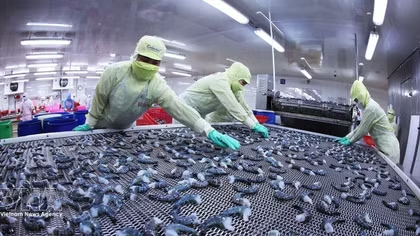
- Local shrimp exports enjoy vigorous growth in second quarter
- First batch of Vietnamese lychees from 2021 crop exported to Japan
- US attractive to Vietnamese exporters
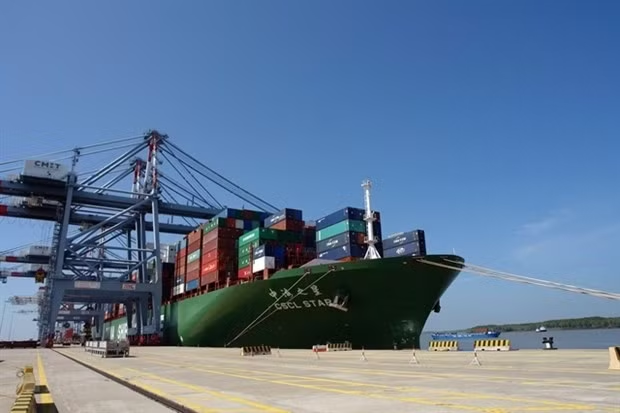
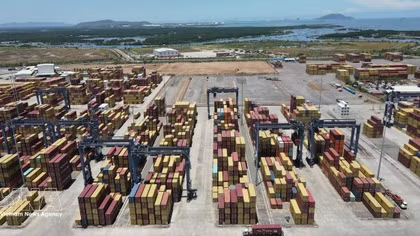
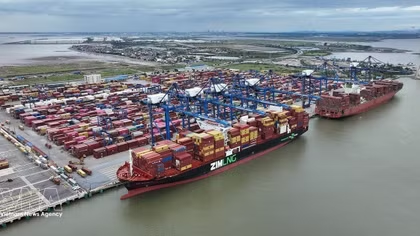
A container ship anchored at Cai Mep - Thi Vai Port in Ba Ria - Vung Tau province
With a coastline stretching over 3,000 km, Vietnam has a maritime and inland waterway transport system that plays an important role in the country. Every year, the seaport system handles up to 90% of import and export cargo, contributing significantly to economic growth.
The seaport system saw the volume of containers transported increase by more than 15 times in the 2001-19 period and was entering a new phase with new requirements for development.
According to Nguyen Duc Kien, head of the Prime Minister’s Economic Advisory Council, around 80% of the volume of goods traded between countries was handled by sea transport. Similarly, the percentage in Vietnam was 90%, meaning that most of the country’s annual import and export goods were through the seaport system.
“Just look at the operation of the seaport system, one can see that country’s economic development,” Kien said.
He pointed out a number of advantages of maritime transport, including that it could handle large quantities and long distance at low costs. “The economic development will affect the development of maritime transport and vice versa, when sea transport develops well, it will promote economic growth.”
Chu Quang Thu, former Director of the Vietnam Maritime Administration, said the seaport system saw significant development over the past two decades.
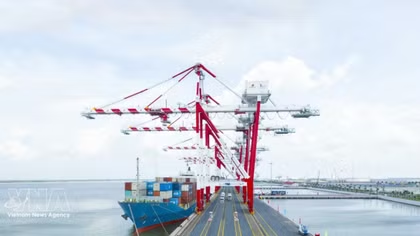
As of the end of April, there were 286 ports across the country with a total wharf length of 96 km, more than 4.5 times longer than in 2000. The seaport system handled a total cargo volume of more than 692 million tonnes in 2020, 8.4 times higher than 2000.
The seaport system was developed in association with the the country’ economic hubs and regions, such as Quang Ninh and Hai Phong ports for the northern key economic region, Thua Thien – Hue, Da Nang, Dung Quat and Quy Nhon for the central key economic region, HCM City, Ba Ria – Vung Tau and Dong Nai for the Southeast region and Can Tho and An Giang for Cuu Long (Mekong) Delta region.
Vietnam has set up 32 maritime transportation routes, 25 of which are international.
With open investment policies, Vietnam has attracted many global port operators and shipping lines to invest in the seaport system, such as the UAE’s DP World, the US’ SSA Marine, PS from Singapore, APMT from Denmark, and Hutchison Port Holding from Hong Kong.
However, there was a lack of consistency between seaport planning and socio-economic development planning of localities and other industries, Nguyen Xuan Sang, Director of the Vietnam Maritime Administration, said.
The transport infrastructure system was becoming overloaded and outdated, which together with rapid urbanisation, industrialisation, coastal urban areas and tourism areas development resulted in congestion at some ports.
“It is necessary to develop new master planning for the seaport system of Vietnam to ensure synchronous development and meet the country’s requirements for industrialisation and modernisation,” Sang said.
Le Tan Dat, deputy director of the Construction Consultation Joint Stock Company for Maritime Building, said that the seaport master plan for the next period should take advantage of the favourable geographical locations and natural conditions combined with science and technology advancements to ensure comprehensive development and contribute to improving competitiveness of the system.
The new planning should focus on investment in key seaports to become pillars for the maritime economy and promote the development of the logistics industry.
The seaport planning in the next period should give priority to the development of international gateways and transshipment ports in Hai Phong city in the North and Ba Ria – Vung Tau province in the South and for the central economic region. Seaport clusters would also be developed to serve socio-economic development, including Hai Phong – Quang Ninh, Nghi Son (Thanh Hoa) –Dong Hoi (Nghe An), Da Nang – Quang Nam – Dung Quat (Quang Ngai), Quy Nhon (Binh Dinh) – Van Phong (Khanh Hoa) and HCM City – Cai Mep Thi Vai.
Minister of Transport Nguyen Van The asked the Vietnam Maritime Administration to evaluate the current situation of the seaport system to raise development orientations in line with forecasts.
The said that special attention would be attached to developing the seaport system for the Mekong Delta region which had abundant sources of agricultural products for export but the seaport system remained poorly developed.
He said the Mekong Delta region needed a deep-water seaport which together with Can Tho Airport would promote the economic development of the region.