Nicolas Maduro Wins Venezuelan Presidential Election - Preliminary Data

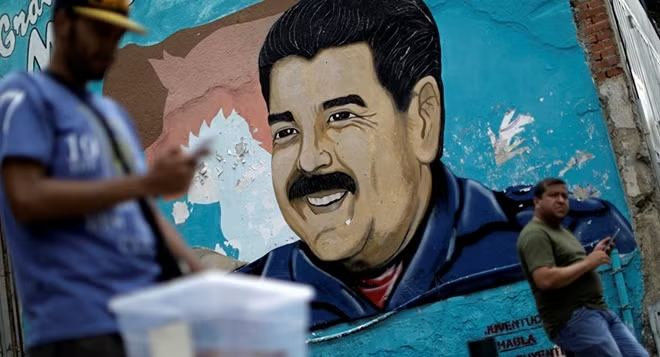
Incumbent Venezuelan president Nicolas Maduro has won the country's presidential election, according to the first official data.

Photo: Reuters
Photo: Reuters 

Nicolas Maduro was re-elected the president of Venezuela with a voter turnout of 46.01 percent, head of the National Electoral Council Tibisay Lucena said after the body had processed 92.6 percent of ballots.

"With 92.6 percent of ballots processed and a 46.01-percent turnout, we can say that Nicolas Maduro obtained 5,823,718 votes, Henri Falcon got 1,820,552 and Javier Bertucci 952,000 votes," Lucena said.

Lucena said that Maduro had been re-elected the Venezuelan president having received 68 percent of votes.

Venezuela held presidential elections on Sunday. This year four candidates ran for the presidency: incumbent President Nicolas Maduro, Reinaldo Quijada, who supported Maduro's predecessor Hugo Chavez but is dissatisfied with the current government, opposition leader Falcon and Evangelical pastor Javier Bertucci.

Opposition leader Henri Falcon announced earlier that he does not recognize the results of the vote due to alleged mass electoral violations.

In his turn, Nicolas Maduro urged other candidates to reestablish communication, also adding, that foreign states had to give up their interference in the situation.
Sputnik

Other News

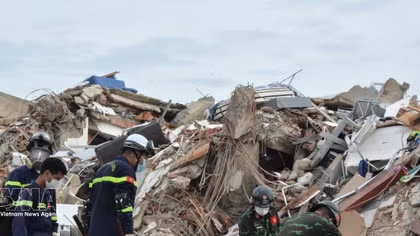
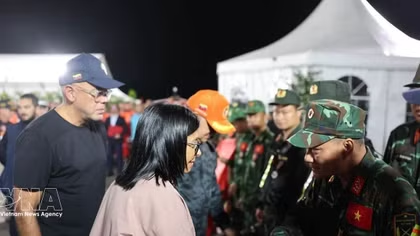
Vietnamese community in Venezuela backs rescue team on humanitarian mission

Vietnamese community in Venezuela backs rescue team on humanitarian mission

All members of the Vietnamese rescue team in Venezuela have maintained strict discipline, a strong sense of responsibility and unwavering focus when carrying out search, rescue and disaster recovery tasks, with the determination to successfully fulfil the international humanitarian mission entrusted by the Party, State and military.

Key issues ex high agenda at the ASEAN Future Forum 2026

Key issues ex high agenda at the ASEAN Future Forum 2026

PSNews - Nearly six decades after its founding, ASEAN is entering a new phase of transformation. Geopolitical turbulence, intensifying competition among major powers, non-traditional security challenges, and rapid technological change are raising fundamental questions about the region’s future trajectory. In this context, the ASEAN Future Forum (AFF) 2026 is more than a platform for regional countries to discuss current issues; it is designed to identify strategic pathways for ASEAN in the years ahead.

Malaysia bans social media accounts for children under 16

Malaysia bans social media accounts for children under 16

Under the new rules, social media platforms are required to implement age-verification systems and prevent users under 16 from creating accounts. The regulations apply to platforms with at least eight million users in Malaysia, including Facebook, Instagram, TikTok and YouTube.

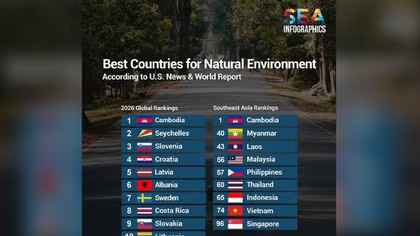
Cambodia ranked world's top country for natural environment in 2026

Cambodia ranked world's top country for natural environment in 2026

Cambodia currently manages 73 protected natural areas covering more than seven million hectares, equivalent to about 41% of the country’s total land area. These protected areas play a vital role in forest conservation, wildlife habitat protection and biodiversity preservation through stricter law enforcement and conservation measures.

ASEAN chief spotlights Vietnam’s role in shaping bloc’s future

ASEAN chief spotlights Vietnam’s role in shaping bloc’s future

Vietnam is expected to maintain active contributions across ASEAN’s three pillars - the political-security community, the economic community, and the socio-cultural community; while further enhancing regional connectivity through infrastructure projects and stronger economic linkages.

Vietnam supports UNESCO's people-centred approach, multilateral cooperation: official

Vietnam supports UNESCO's people-centred approach, multilateral cooperation: official

Van affirmed Vietnam’s support for the UNESCO80 reform roadmap, focusing on the organisation’s core mandate, priority areas, interdisciplinary approach, and the special status of the Vietnam National Commission for UNESCO, and UNESCO representative offices, alongside efforts to diversify resources and strengthen global partnerships to enhance the organisation’s effectiveness.

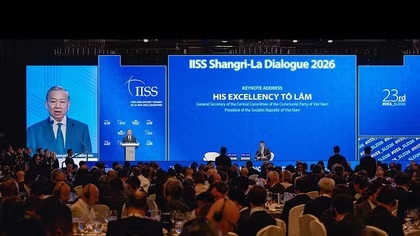
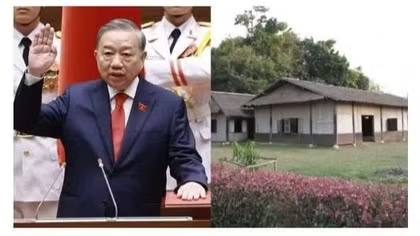
Regional media highlight significant step in Vietnam’s leadership structure

Regional media highlight significant step in Vietnam’s leadership structure

Under General Secretary and President Lam’s leadership, Vietnam is expected to maintain a balanced foreign policy, strengthen its regional standing and accelerate economic development, thereby improving living standards and creating new opportunities for international investors, according to the India-based platform Devdiscourse.

Laos identifies 10 key tasks to build independent, self-reliant economy

Laos identifies 10 key tasks to build independent, self-reliant economy

Laos will step up agricultural production to ensure food security, meet domestic demand and expand exports; encourage the development of agro-processing industries, including those related to rubber, aquatic products, cassava and sugarcane, as well as fertiliser and animal feed production, in order to increase added value and create jobs in rural areas.