 |
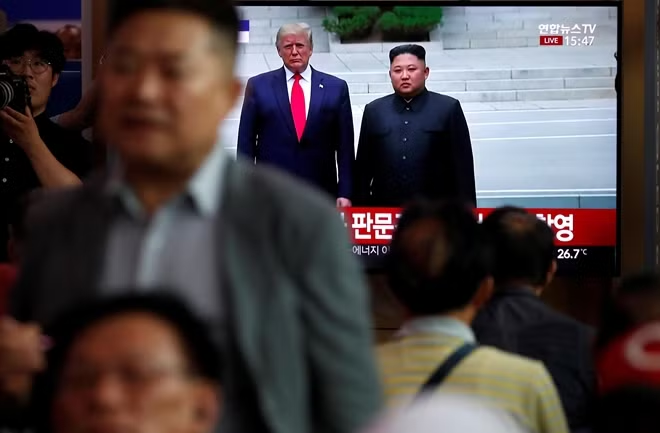
| South Korean people watch a live TV broadcast on a meeting between North Korean leader Kim Jong Un and U.S. President Donald Trump at the truce village of Panmunjom inside the demilitarised zone separating the two Koreas, in Seoul, South Korea, June 30, 2019. REUTERS/Kim Hong-Ji/File Photo. |
South Korea, which supports efforts by North Korea and the United States to end years of hostility, urged the North to stop acts that are unhelpful to easing tension, saying the tests posed a military threat on the Korean peninsula.
The South’s National Security Council said it believed the missiles were a new type of ballistic missile but it would make a final assessment with the United States.
Firing a ballistic missile would be a violation of U.N. Security Council resolutions that ban the North from the use of such technology. North Korea has rejected the restriction as an infringement of its sovereign right to self-defense.
North Korea launched the missiles from the east coast city of Wonsan with one flying about 430 km (267 miles) and the other 690 km (428 miles) over the sea. They both reached an altitude of 50 km (30 miles), an official at South Korea’s Defense Ministry said.
Some analysts said the North appeared to have retested missiles it fired in May, but two South Korean military officials said the missiles appeared to be a new design.
The launch casts new doubt on efforts to restart stalled denuclearisation talks after Trump and Kim met at the demilitarized zone (DMZ) between the two Koreas at the end of June.
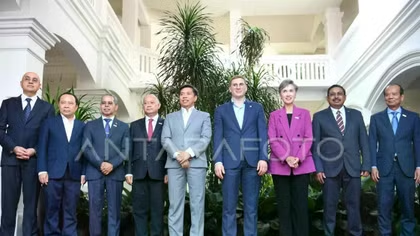
U.S. Secretary of State Mike Pompeo and North Korean Foreign Minister Ri Yong Ho had been expected to meet on the sidelines of a Southeast Asian security forum in Bangkok next week.
But a diplomatic source told Reuters on Thursday that Ri had canceled his trip to the conference.
The White House, Pentagon and U.S. State Department did not immediately respond to requests for comment.
Japanese Prime Minister Shinzo Abe said the test had no immediate impact on Japan’s security, according to Kyodo News.
U.S. national security adviser John Bolton, who has taken a hard line toward North Korea, made no mention of the launches in a tweet on Thursday after a visit to South Korea. He said he had “productive meetings” on regional security.
South Korea’s nuclear envoy, Lee Do-hoon, had phone calls with his U.S. counterpart, Stephen Biegun, and his Japanese counterpart, Kenji Kanasugi, to share their assessment, South Korea’s foreign ministry said in a statement.
Chinese foreign ministry spokeswoman Hua Chunying told a briefing that Beijing had noted the launch, and called for North Korea and the United States to reopen negotiations “as early as possible”.
‘CLEAR MESSAGE’
After Trump and Kim met last month, the United States and North Korea vowed to hold a new round of working-level talks soon, but Pyongyang has since sharply criticized upcoming joint military drills by U.S. and South Korean troops.
North Korea’s foreign ministry accused Washington this month of breaking a promise by holding military exercises with South Korea. On Tuesday, Kim inspected a large, newly built submarine from which ballistic missiles could be launched.
“By firing missiles, taking issue with military drills and showing a new submarine, the North is sending one clear message: there might be no working-level talks if the United States doesn’t present a more flexible stance,” said Kim Hong-kyun, a former South Korean nuclear envoy.
Kim Dong-yup, a former navy officer who teaches at Kyungnam University in Seoul, said the weapons tested on Thursday appeared to be the same as the ones tested in May, which were less of a challenge than long-range missiles but “enough to subtly pressure” Washington.
But the South Korean military believes they may be new, because they traveled further. In North Korea’s previous missile test in May, the projectiles flew only 420 km (260 miles) and 270 km (168 miles) though they reached the same altitude of about 50 km (30 miles).
“We’re very cautious because it’s difficult to extend the range within such a short time,” said one military official, who asked not to be identified due to the sensitivity of the issue.
Nuclear talks between North Korea and the United States stalled after a second summit between Trump and Kim in Vietnam in February broke down.
Trump has repeatedly lauded the North’s freeze in weapons testing as he is keen for a big foreign policy win as he campaigns for re-election in 2020.