📝OP-ED: New thinking and action drive Vietnam's fight against 'internal enemies'

In response to the country’s development requirements in the new era, the campaign against the “internal enemies” remains resolute, with no forbidden zones and no exceptions. However, its objective has evolved beyond addressing misconduct to building a national governance system founded on integrity, transparency and modernity.

Building a nation that develops rapidly and sustainably requires a clean, transparent and modern national governance system. Given this, work on internal affairs and the prevention and combat of corruption, wastefulness and other negative phenomena is no longer aimed solely at detecting and handling violations.

It must also help remove institutional bottlenecks, unlock development resources, improve institutions, strengthen the control of power, and foster a transparent and efficient environment conducive to national development.
1.jpg
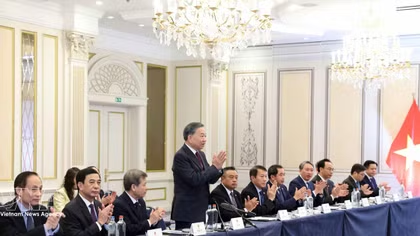
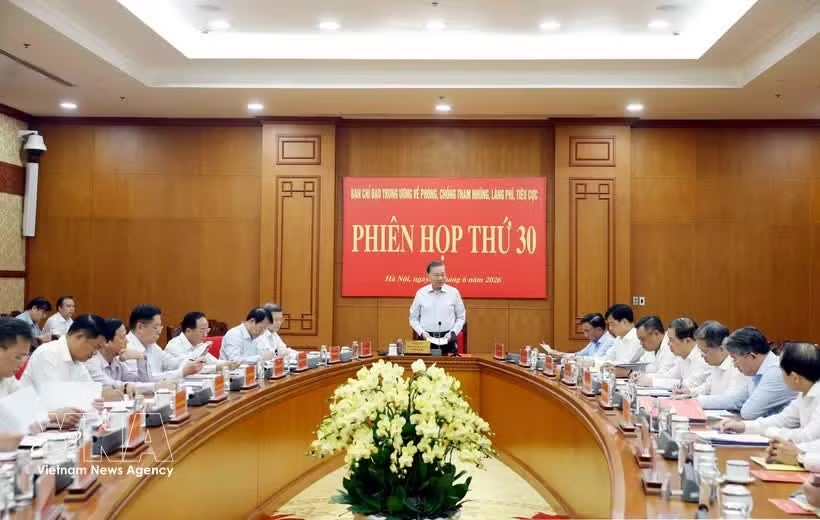
Party General Secretary and State President To Lam, who is Head of the Central Steering Committee for the Prevention and Control of Corruption, Wastefulness and Negative Phenomena, chairs the committee’s 30th meeting at the Party Central Committee headquarters in Hanoi on June 18. (Photo: VNA)

The year 2026 has continued to mark an important shift in the Party’s leadership and governance thinking, including its approach to these affairs. In response to the country’s development requirements in the new era, the campaign against the “internal enemies” remains resolute, with no forbidden zones and no exceptions. However, its objective has evolved beyond addressing misconduct to building a national governance system founded on integrity, transparency and modernity. At the same time, it seeks to unleash constrained resources, remove institutional barriers, and protect those who dare to think big, act bold, carry out innovation, and work for the common good.

This new approach has been translated into a series of concrete policies and decisions. During the first six months of 2026, the Party Central Committee and its Politburo and Secretariat issued more than 30 resolutions, directives, regulations and conclusions on Party and political system building, socio-economic development, and the prevention and combat of corruption, wastefulness and negative practices.

Meanwhile, the National Assembly (NA) and the Government accelerated the review, amendment, supplementation and promulgation of nearly 300 legal normative documents to promptly institutionalise the Party’s new policies, address legal loopholes and shortcomings, unclog institutional bottlenecks, enhance decentralisation and delegation of authority in tandem with stronger power control, and prevent corruption, wastefulness and other negative practices.

These figures reflect notable new developments. Most importantly, the focus of the fight has shifted towards improving institutions, strengthening power control, and preventing violations at an early stage and from afar. As Party General Secretary and State President To Lam stressed, the country must make a fundamental shift from dealing with consequences to preventing violations from the root, at an early stage and from afar; from handling individual cases to consolidating institutions; from reviewing and compiling statistics to resolving outstanding issues once and for all; and from recovering assets at the final stage to supervising them through data.

This also explains why internal affairs are now increasingly intertwined with legal reform, digital transformation and efforts to enhance national governance capacity. That role is particularly evident in the handling of long-delayed and stalled projects. During the first six months of this year, the Government, ministries, sectors and localities reviewed and updated an additional 1,501 projects, bringing the total number of pending projects nationwide to 4,492, of which 1,531 have already been resolved.

At the same time, authorities identified 30,595 surplus public offices and land facilities following the restructuring of the organisational apparatus, with 14,992 of them having been brought back into operation and use.

Whereas anti-corruption efforts in the past mainly focused on preventing financial losses to the State, combating wastefulness, addressing stalled projects and putting idle public assets back into productive use have now become urgent development priorities. Significant resources for national development must not remain "frozen" because of institutional barriers, administrative delays or misallocation for any reason.

Therefore, the Party’s requirement to complete the resolution of all projects on hold, surplus public offices and land facilities resulting from organisational restructuring within 2026, and clearly assign accountability to those responsible for removing obstacles is intended to return valuable resources to the economy, unlock new drivers of growth and improve the effectiveness of national governance in the new development phase.

Strictly handling violations remains a prerequisite for upholding discipline, strengthening public trust and laying a solid foundation for sustainable development. Since the beginning of the year, Party committees at all levels and their inspection commissions have disciplined 65 Party organisations and 3,375 Party members. Through inspections and audits, authorities recommended the recovery of 799.4 billion VND (30.4 million USD) and 31 hectares of land, proposed administrative sanctions against 356 organisations and 1,192 individuals, and transferred 13 cases showing signs of criminal offences to investigation agencies. Judicial authorities initiated legal proceedings in 1,985 new cases involving 4,671 defendants, prosecuted 1,886 cases with 4,520 defendants, and concluded first-instance trials in 1,721 cases involving 4,415 defendants related to corruption, economic and official-duty crimes.

At the same time, the focus of internal affairs work is steadily shifting from dealing with consequences to preventing violations at their source. Prevention is no longer confined to communication campaigns, education or improving internal regulations. Instead, it is increasingly built upon stronger power control, digital transformation and data-driven governance. The implementation of the Politburo’s five regulations on power control and the prevention of corruption, wastefulness and other negative practices, particularly in personnel work, is being supervised from the grassroots level. National databases are being connected and integrated to support more effective oversight. Administrative reform and digital transformation are also being accelerated to reduce time and costs, minimise direct contact between officials and citizens, and curb bureaucratic harassment and unnecessary inconvenience for both people and businesses.
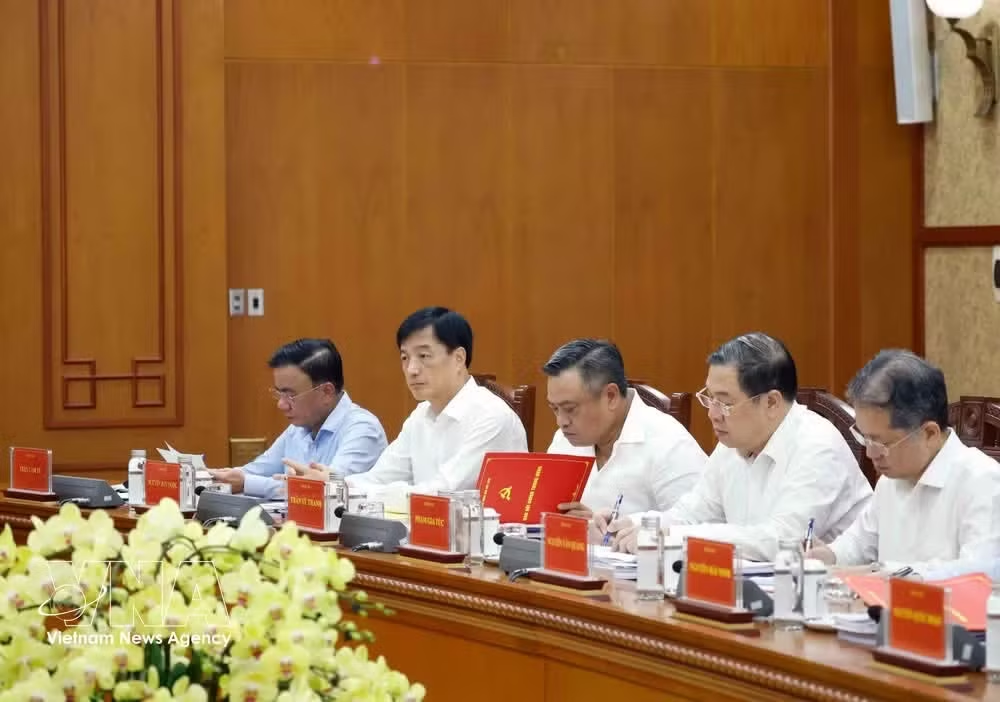
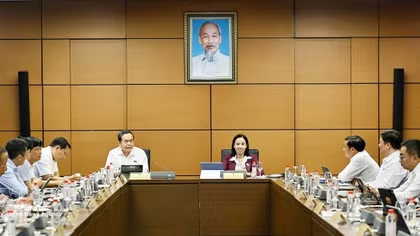
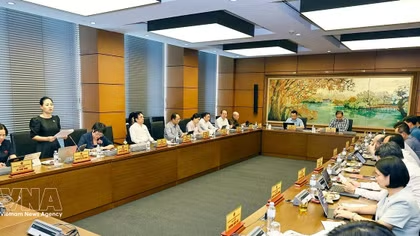
Delegates attend the 30th meeting of the Central Steering Committee for the Prevention and Control of Corruption, Wastefulness and Negative Phenomena. (Photo: VNA)

At the 30th meeting of the Central Steering Committee for the Prevention and Control of Corruption, Wastefulness and Negative Phenomena, General Secretary and President Lam reaffirmed that the fight must serve socio-economic development, and such efforts must not discourage officials from taking action or lead them to shift responsibility, avoid duties or fear accountability.

This reflects an approach that places internal affairs in an organic relationship with development—one that upholds discipline while protecting officials who dare to think big, act bold, conduct reforms, and act for the common good. It also explains why the Steering Committee has called for a comprehensive review of the legal system to fully identify institutional bottlenecks and legal loopholes that give rise to corruption, wastefulness and other negative practices, with priority given to revising key laws, including the Land Law and those governing construction.

A modern governance system must not only punish those who commit violations but also close the loopholes that allow such violations to occur. It must not only recover assets after losses but also safeguard national resources from being wasted in the first place. It must not only deal firmly with wrongdoings but also protect those who do the right thing, encourage innovation and foster a willingness to take responsibility for the common good. These are also the requirements of the country's new stage of development and a measure of the Party's leadership capacity, strategic vision and political resolve./.
en.vietnamplus.vn

Other News

Vietnam calls for stronger int'l cooperation in combating terrorism, violent extremism

Vietnam calls for stronger int'l cooperation in combating terrorism, violent extremism

Reaffirming Vietnam’s consistent position of condemning terrorism in all forms, manifestations and motivations, Minister Counsellor Nguyen Hai Luu, Deputy Permanent Representative of Vietnam to the UN, called on UN member states to strengthen cooperation in investigating, prosecuting and bringing to trial individuals and organizations responsible for planning, carrying out or financing terrorist acts, including those linked to terrorist incidents in Vietnam in recent years.

JBIC pledges continued support for Vietnam's strategic development goals

JBIC pledges continued support for Vietnam's strategic development goals

Prime Minister Le Minh Hung said there remains ample room to expand bilateral cooperation, stressing JBIC's important role in mobilising financial resources and advancing strategic infrastructure projects to support Vietnam's long-term development goals, particularly its green transition.

Prime Minister urges military to enhance strategic advisory role, forecasting capacity

Prime Minister urges military to enhance strategic advisory role, forecasting capacity

Prime Minister Le Minh Hung noted that the military has demonstrated strong strategic awareness and responsiveness, accurately assessed developments, and effectively advised the Party and State on military and defence matters. These efforts have enabled the flexible and effective handling of emerging situations, maintained a proactive posture, prevented surprises and firmly safeguarded national sovereignty and territorial integrity.

Top leader attends ceremony marking 50 years of Saigon-Gia Dinh bearing late President's name

Top leader attends ceremony marking 50 years of Saigon-Gia Dinh bearing late President's name

Ho Chi Minh City has every reason to take pride in its remarkable achievements over the past half-century. From a war-ravaged urban centre facing enormous post-war difficulties, it gradually restored production, stabilised people's livelihoods, consolidated the achievements of the revolution, built an effective system of governance, and safeguarded national defence and security, thereby laying a solid foundation for long-term development.

Top leader demands concrete output under Resolution 57

Top leader demands concrete output under Resolution 57

Top leader To Lam stressed that while the 14th National Party Congress’s Resolution serves as the strategic blueprint for the country's next growth stage, Resolution 57 is one of the key engines for turning that blueprint into reality.

Politburo sets six priorities for implementing Resolution No. 57

Politburo sets six priorities for implementing Resolution No. 57

After 18 months of implementing Resolution No. 57, ministries, sectors and localities have adopted innovative and effective approaches that have generated positive momentum, while winning broad support from businesses, the scientific community and the public for policies on science, technology, innovation and digital transformation.

Foreign affairs should better serve national development: Top leader

Foreign affairs should better serve national development: Top leader

Party General Secretary and State President To Lam underscored that Vietnam’s development goals for 2030, with a vision to 2045, require foreign affairs and international integration to become more proactive, with stronger forecasting capacity, timely and accurate policy advice, and swift action.

Conference reviews one-year implementation of three-tier administration model

Conference reviews one-year implementation of three-tier administration model

The event was held in a hybrid format, with the main venue at the Dien Hong Hall of the National Assembly building and online connection to 3,651 venues across ministries, central agencies, socio-political organisations, and headquarters of provincial, municipal, commune, ward and special-zone administrations nationwide.

Top leader calls for modern artillery-missile force capable of meeting new challenges

Top leader calls for modern artillery-missile force capable of meeting new challenges

He urged the Artillery-Missile Command to develop a force that is strong in political, ideological and organisational foundations, with absolute loyalty to the Party, the nation and the people, thorough understanding of the Party's military and defence guidelines and directives on safeguarding the Fatherland and building a revolutionary, regular, elite and modern army.

NA Chairman calls on Hanoi to turn master plan vision into tangible development projects

NA Chairman calls on Hanoi to turn master plan vision into tangible development projects

Chairman Man described the publication of the master plan as more than the unveiling of a development blueprint. It sends a strong message of action and demonstrates the city's determination to translate the resolutions of the 14th National Party Congress and the 18th Hanoi Party Congress into reality, in line with Party General Secretary and State President To Lam’s directive that “Hanoi must do what it commits to do, do it quickly, correctly, effectively and thoroughly.”

Deputy PM receives special advisor to Japan-Vietnam parliamentary friendship alliance

Deputy PM receives special advisor to Japan-Vietnam parliamentary friendship alliance

Deputy Prime Minister Le Tien Chau highly valued Special Advisor to the Japan-Vietnam Parliamentary Friendship Alliance Takebe's more than three decades of contributions to promoting Vietnam-Japan friendship and cooperation, particularly in people-to-people exchanges, local-level cooperation, education and human resource development, with the Vietnam-Japan University (VJU) project standing out as a flagship initiative.

Viet Nam stand ready to support Venezuela after earthquake

Viet Nam stand ready to support Venezuela after earthquake

PSNews - During the press briefing of Viet Nam’s Ministry of Foreign Affairs held on June 25, spokeswoman Pham Thu Hang provided updates on measures to protect Vietnamese citizens affected by the earthquake in Venezuela and a fire at Moscow’s Sadovod market, while reiterating support for victims of Agent Orange/dioxin.

Vietnam, Cambodia foster defence cooperation

Vietnam, Cambodia foster defence cooperation

Vietnam is ready to share training expertise, dispatch delegations to Cambodia for exchanges, and welcome Cambodian delegations to Vietnam for study visits and experience sharing.

Top leader calls on youth to think bigger, learn faster, make more contributions

Top leader calls on youth to think bigger, learn faster, make more contributions

Addressing the opening session of the 13th Ho Chi Minh Communist Youth Union National Congress for the 2026–2031 term in Hanoi on June 25, the Party and State leader told 788 delegates representing more than 5.1 million HCYU members and nearly 22 million young people nationwide that the country is entering a new stage of development in which young people are not only inheritors of the revolutionary cause but also direct architects of the future.