Outsider wins El Salvador presidency, breaking two-party system

A former mayor campaigning on an anti-corruption ticket swept to victory in El Salvador’s presidential election on Sunday, bringing an end to a two-party system that has held sway over the violence-plagued Central American country for three decades.
Presidential candidate Nayib Bukele of the Great National Alliance (GANA) and his wife Gabriela de Bukele gesture as they celebrate with supporters after the first official presidential election results were released in San Salvador, El Salvador, February 3, 2019. REUTERS

Nayib Bukele, the 37-year-old former mayor of the capital, San Salvador, won 54 percent of votes with returns counted from 88 percent of polling stations, said Julio Olivo, the head of the electoral tribunal.

Bukele won more votes than all other candidates combined in his first-round sweep, highlighting deep voter frustration over the failure of the two main parties to tackle violence and corruption.

“This day is historic for our country. This day El Salvador destroyed the two-party system,” Bukele told hundreds of Salvadorans who danced, waved flags and blew whistles in a San Salvador plaza that Bukele revitalized when he was mayor from 2015 to 2018.

His two rivals from the mainstream political parties conceded defeat.

Bukele must now contend with U.S. President Donald Trump’s frequent threats to cut aid to El Salvador - as well as neighboring Guatemala and Honduras - if they do not do more to curb migration to the United States.

At home, supporters hope that a third-party politician will usher in changes to improve a sluggish economy and widespread poverty.

“Let’s see if he can do what he’s promised for us,” said a jubilant supporter, Baltazar Sanchez, 30, at Bukele’s victory speech.

“After 30 years of two parties, we’ve been dealt the best hand.”

‘WE DID IT’

Gang violence has made tiny El Salvador one of the world’s most murderous countries in the past few years, driving Salvadorans to flee to the north.

Among his campaign promises, Bukele, an avid social media user who snapped a selfie with supporters before declaring his win, said he would push infrastructure projects to limit such migration.

Since the end of its civil war in 1992, El Salvador has been governed by the ruling leftist Farabundo Marti National Liberation Front (FMLN) and its rival, conservative Nationalist Republican Alliance (ARENA).

Though he describes himself as from the left and was expelled from the FMLN, Bukele has formed a coalition including a right-wing party that together has just 11 seats in the legislature, which consists of 84 people.

Outside the hotel in San Salvador where Bukele waited for the results, a group of supporters set off fireworks, beat drums and danced as early figures came in.

“Yes, we did it! Yes, we did it!” they chanted.

FMLN candidate Hugo Martinez conceded defeat shortly after Bukele’s victory speech while ARENA candidate Carlos Calleja said he recognized the election results and would call Bukele to offer congratulations.

Definitive results would be announced within two days, Olivo said.

‘CORRUPT CAN’T HIDE’

Along with the goal of modernizing government, Bukele, who is set to take office in June, has proposed creating an international anti-corruption commission with the support of the United Nations, following similar committees in Guatemala and Honduras.

“We’ll create a (commission) ... so that the corrupt can’t hide where they always hide, instead they’ll have to give back what they stole,” Bukele said in January.

Growing up, Bukele’s relatively wealthy family was sympathetic to the FMLN, the former leftist guerrilla army that became a political party at the end of the civil war.

But Bukele has turned away from Latin America’s traditional left, branding Venezuelan leader Nicolas Maduro and Nicaragua’s Daniel Ortega as well as conservative Honduran Juan Orlando Hernandez as dictators.

“A dictator is a dictator, on the ‘right’ or the ‘left’,” Bukele wrote last week on Twitter.
Reuters

Other News

Vietnam, US strengthen cooperation to ease suffering of AO/dioxin victims

Vietnam, US strengthen cooperation to ease suffering of AO/dioxin victims

A delegation from the Vietnam Association for Victims of Agent Orange/dioxin's chapter in Ho Chi Minh City (VAVA HCMC) visited the US directly inform American friends about the long-term consequences of AO/dioxin in Vietnam and seek the support of progressive groups, veterans, legal experts and youth organisations in efforts to care for the victims.

Indonesia earthquake death toll rises, 2,000 evacuated

Indonesia earthquake death toll rises, 2,000 evacuated

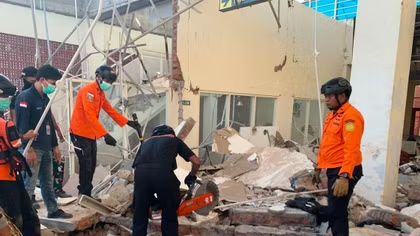
The earthquake struck off Flores Island near Mbay town in Nagekeo district, East Nusa Tenggara province, triggering strong aftershocks. Several houses and other structures were damaged, while landslides disrupted roads in some areas.

Indian Embassy thanks Vietnam for support after Phu Quoc boat tragedy

Indian Embassy thanks Vietnam for support after Phu Quoc boat tragedy

The embassy said on its official X account that the flight carrying the victims' mortal remains departed Ho Chi Minh City on July 13 and arrived in Mumbai later the same day. Authorities in the Indian states of Andhra Pradesh, Kerala and Tamil Nadu coordinated the transportation of the remains to their final destinations.

Vietnamese community in Venezuela backs rescue team on humanitarian mission

Vietnamese community in Venezuela backs rescue team on humanitarian mission

All members of the Vietnamese rescue team in Venezuela have maintained strict discipline, a strong sense of responsibility and unwavering focus when carrying out search, rescue and disaster recovery tasks, with the determination to successfully fulfil the international humanitarian mission entrusted by the Party, State and military.

Key issues ex high agenda at the ASEAN Future Forum 2026

Key issues ex high agenda at the ASEAN Future Forum 2026

PSNews - Nearly six decades after its founding, ASEAN is entering a new phase of transformation. Geopolitical turbulence, intensifying competition among major powers, non-traditional security challenges, and rapid technological change are raising fundamental questions about the region’s future trajectory. In this context, the ASEAN Future Forum (AFF) 2026 is more than a platform for regional countries to discuss current issues; it is designed to identify strategic pathways for ASEAN in the years ahead.

Malaysia bans social media accounts for children under 16

Malaysia bans social media accounts for children under 16

Under the new rules, social media platforms are required to implement age-verification systems and prevent users under 16 from creating accounts. The regulations apply to platforms with at least eight million users in Malaysia, including Facebook, Instagram, TikTok and YouTube.

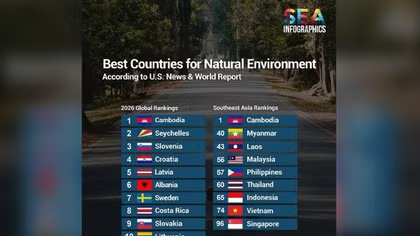
Cambodia ranked world's top country for natural environment in 2026

Cambodia ranked world's top country for natural environment in 2026

Cambodia currently manages 73 protected natural areas covering more than seven million hectares, equivalent to about 41% of the country’s total land area. These protected areas play a vital role in forest conservation, wildlife habitat protection and biodiversity preservation through stricter law enforcement and conservation measures.

ASEAN chief spotlights Vietnam’s role in shaping bloc’s future

ASEAN chief spotlights Vietnam’s role in shaping bloc’s future

Vietnam is expected to maintain active contributions across ASEAN’s three pillars - the political-security community, the economic community, and the socio-cultural community; while further enhancing regional connectivity through infrastructure projects and stronger economic linkages.

Vietnam supports UNESCO's people-centred approach, multilateral cooperation: official

Vietnam supports UNESCO's people-centred approach, multilateral cooperation: official

Van affirmed Vietnam’s support for the UNESCO80 reform roadmap, focusing on the organisation’s core mandate, priority areas, interdisciplinary approach, and the special status of the Vietnam National Commission for UNESCO, and UNESCO representative offices, alongside efforts to diversify resources and strengthen global partnerships to enhance the organisation’s effectiveness.