Pandemic has little impact on Vietnam’s shrimp exports

The domestic shrimp industry has not faced a great impact from the novel coronavirus-caused acute respiratory disease (COVID-19) because now this industry is under production and Vietnam will enter its shrimp harvesting crop in August.
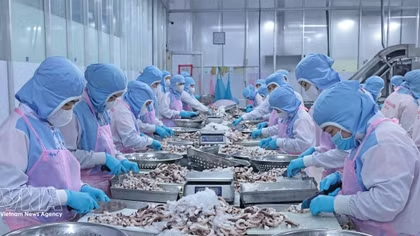
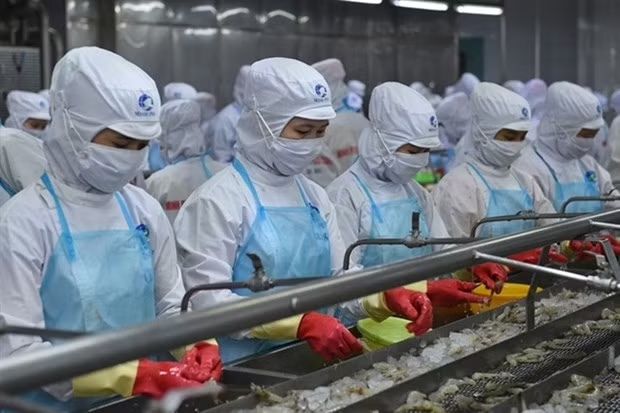
Vietnam has targeted to gain a total export value of 4-4.2 billion USD from shrimp exports this year. (Photo: nhandan.com.vn)

Vietnam has targeted to gain a total export value of 4-4.2 billion USD from shrimp exports this year. (Photo: nhandan.com.vn)

The domestic shrimp industry has not faced a great impact from the novel coronavirus-caused acute respiratory disease (COVID-19) because now this industry is under production and Vietnam will enter its shrimp harvesting crop in August.

According to the Vietnam Association of Seafood Exporters and Producers (VASEP), many large markets have reduced shrimp imports from China due to the COVID-19 outbreak in this country. That has brought an opportunity for Vietnamese shrimp enterprises to increase their exports to those markets.

With the current difficulties due to the pandemic, especially in China, VASEP said shrimp production, processing and export enterprises have changed their business plans to expand export markets.

Now, the local businesses focus on improving their competitiveness and producing shrimp for export after the pandemic, said VASEP.

Ho Quoc Luc, Chairman of the Board of Directors and General Director of the Sao Ta Food Joint Stock Company, said in the long term, Vietnam will take a lot of advantages from the EU-Vietnam Free Trade Agreement (EVFTA) to increase shrimp exports to the EU.

The EU is Vietnam's largest shrimp export market, accounting for 20.5 percent of the total shrimp export value, the association said.

According to the EVFTA, the tariffs of most raw shrimp, including fresh, frozen and chilled products, imported from Vietnam into the EU will be reduced from the basic rate of 12-20 percent to zero as soon as the agreement comes into effect, expected this year. Meanwhile, import tariffs on processed shrimp will fall to zero after seven years.

The reduction of anti-dumping tariffs in the US market to zero would promote growth in Vietnamese shrimp exports to this market. Now, the US is the second largest export market of Vietnamese shrimp, accounting for 19.4 percent of total export value, it said.

Bui Ba Su, Deputy General Director of the Vietnam-Australia Seafood Corporation, said farmers should rear shrimp at present to meet higher demand after the pandemic.

At the same time, the farmers should produce clean shrimp and ensure traceability for their product to enjoy preferential tariffs under the EVFTA and increase exports to Europe, he said.

Mai Ngoc Son, Director of Quy Nhon Frozen Joint Stock Company also noted that to take advantage of the EVFTA, local businesses must renew technology and improve product quality.

Besides that, the Import-Export Department under the Ministry of Industry and Trade noted that Vietnam's shrimp industry will continue to face fierce competition in the world market because more countries have produced shrimp so the price will not see strong growth.

Importing countries have more strict requirements on quality and food safety and those will also affect Vietnam's seafood exports, including shrimp.

When the EU removes tariffs for Vietnamese exported shrimp to this market, it would set up non-tariff barriers. Of which, the EU has a new regulation on banning the use of Ethoxyquin in all kinds of aquatic feed from March 31, 2020.

Local enterprises also need to promote attraction of foreign investment and join regional supply chains so they could take full advantage of the EVFTA, according to the VASEP.

Vietnam has targeted to gain a total export value of 10 billion USD from seafood exports this year, including 4-4.2 billion USD from shrimp exports.

VNA

Other News

Policy, infrastructure emerge as new advantages in FDI attraction

Policy, infrastructure emerge as new advantages in FDI attraction

From policy and infrastructure to industrial real estate, Vietnam’s FDI advantages are broadening towards a more integrated production ecosystem, offering investors a stronger combination of conditions for high-value, technology-intensive and long-term projects.

Logistics upgrade vital to 1-trillion-USD trade target: experts

Logistics upgrade vital to 1-trillion-USD trade target: experts

As trade expands, systemic bottlenecks across transport networks, warehousing, ports, border gates, and industrial zones are becoming more apparent. Experts emphasise the need to shift from a fragmented, project-by-project approach toward strategic management structured around trade corridors and integrated supply chains.

Ample room for Vietnam, US to deepen cooperation

Ample room for Vietnam, US to deepen cooperation

Do Ngoc Hung, Trade Counsellor and head of the Vietnam Trade Office in the US, said what stands out is not only the growth in trade volume but also the increasingly deep economic ties between the two countries.

Flexible fiscal policy helps drive economic growth

Flexible fiscal policy helps drive economic growth

According to the Ministry of Finance, State budget revenue in the first eight months of 2026 was estimated at 2.02 quadrillion VND (77.7 billion USD), equivalent to 80% of the annual estimate and up 16% year-on-year. Domestic revenue reached 1.75 quadrillion VND, accounting for 86.6% of total revenue and rising 16.6%.

Electronic components are produced at a factory in Hanoi. (Photo: VNA)

Hanoi's imports surge 41% in first eight months of 2026

Hanoi aims to achieve average annual export growth of at least 12% during 2026-30, with the city seeking to diversify export markets, boost high-tech and value-added products and reduce reliance on traditional markets.

New opportunities for Vietnam's seafood exports

New opportunities for Vietnam's seafood exports

The Vietnam-EFTA Free Trade Agreement brings together two groups of highly complementary economies. EFTA members Switzerland, Norway, Iceland and Liechtenstein have strengths in technology, innovation, finance, clean energy and sustainable development, while Vietnam is one of Asia’s most dynamic economies and is emerging as a major regional manufacturing, trade and investment hub.

Ho Chi Minh City targets third-quarter growth of over 11%

Ho Chi Minh City targets third-quarter growth of over 11%

Ho Chi Minh City will continue to implement drastic measures to achieve double-digit growth, targeting GRDP growth of at least 11.07% in the third quarter of 2026, 9.43% in the first nine months and 12.3% in the fourth quarter, with a view to completing the full-year goal of 10% or more.

Vietnamese experts abroad join efforts to advance nuclear power development at home

Vietnamese experts abroad join efforts to advance nuclear power development at home

Held both in person and online, the seminar focused on the current status and opportunities for Vietnam’s nuclear power programme, human resources development, global trends in small modular reactors (SMRs), experience in ensuring safety and extending the operational life of nuclear power plants, and ways to mobilise Vietnamese experts abroad to contribute to the programme.

Port throughput in Hai Phong exceeds eight-month target

Port throughput in Hai Phong exceeds eight-month target

The strong performance followed a series of measures to optimise port capacity and improve the competitiveness of the city’s seaport system, with a focus on maximising the efficiency of the Lach Huyen international gateway port as new berths came into operation.

Vietnam, Mercosur begin trade negotiations

Vietnam, Mercosur begin trade negotiations

During the session, both sides reaffirmed their determination to advance the negotiations in a spirit of goodwill, with a view to reaching a balanced agreement that aligns with the interests of both Vietnam and Mercosur.