Petrol price hike deals blow to business recovery efforts

Domestic petrol prices have hit an eight-year record high following the latest price adjustments made on February 21, dealing a heavy blow to ongoing recovery efforts of firms that have borne the brunt of the prolonged COVID-19 pandemic.

Transport firms face loss as they have to pay all fees while petrol prices rise and few people choose to travel these days amid COVID-19 fears.

Transport firms face loss as they have to pay all fees while petrol prices rise and few people choose to travel these days amid COVID-19 fears.

According to the latest adjustment, petrol prices rose approximately VND1,000 to VND26,285 per litre for RON95, a popular petrol for consumers, and to VND25,531 for E5RON92 biofuel. This marked the fifth consecutive price hike and the fourth increase this year.

Businesses in dire straits

Enterprises have complained that price hikes would make it difficult for them to recover from the enormous impact caused by the COVID-19 pandemic.

Nguyen Hai Cuong, director of Hai Cuong transport firm in Dak Lak province, told VTC News that almost all operations of the firm have been forced to come to a grinding halt over the past two years due to strict COVID-19 prevention and control measures. Now, with the Government relaxing travel restrictions, the firm has received very few passengers.

“We have to lower fares by one fourth to stimulate consumer demand, but fuel prices have constantly edged up, causing losses to pile up,” Cuong said, adding that the firm is on the brink of bankruptcy unless the situation improves as he must still pay interest on bank loans, road tolls, and other fees.

“The Government and ministries soon have policies to control petrol prices so that businesses can operate with peace of mind,” Cuong suggested.

This view was shared by Phan Huy Su, who runs a transport firm of 7,000 vehicles and approximately 7,000 staff in Dong Nai province. According to his calculation, input fuel, road toll, and fees account for 50% of the overall transportation cost, and any increase in petrol prices will immediately impact the firm’s operations.

“We are in dire straits. We want to sell vehicles, but no one dares to buy. We have now managed to run several hundreds of vehicles to meet the travel need of workers working in industrial zones in the locality,” said Su.

This is not only confined to transport enterprises, but there are also many production enterprises and fishermen feeling the pinch amid the hike in petrol prices.

Duong Van Le, a fisherman in Thanh Hoa province, said that his family has four fishing boats, but he has been forced to suspend the boats setting sail since the Lunar New Year due to unfavourable weather conditions coupled with rising petrol prices.

“The more I go fishing, the more I face loss, so I and many other families don't dare to set sail at this time," Le confided.

Similarly, Tran Ngoc Hieu, director of a sugar joint stock company in Son La province, shared that every day he hires dozens of vehicles in order to transport sugar cane to the factory for processing. Rising petrol prices hitting an eight-year record high have therefore prompted transportation and logistics costs to go up, putting new pressure on the firm.

“As raw materials and input costs rise by 9% to 12%, the price of refined sugar will inevitably increase in the time to come,” Hieu explained.

Flexible price management mechanism in need
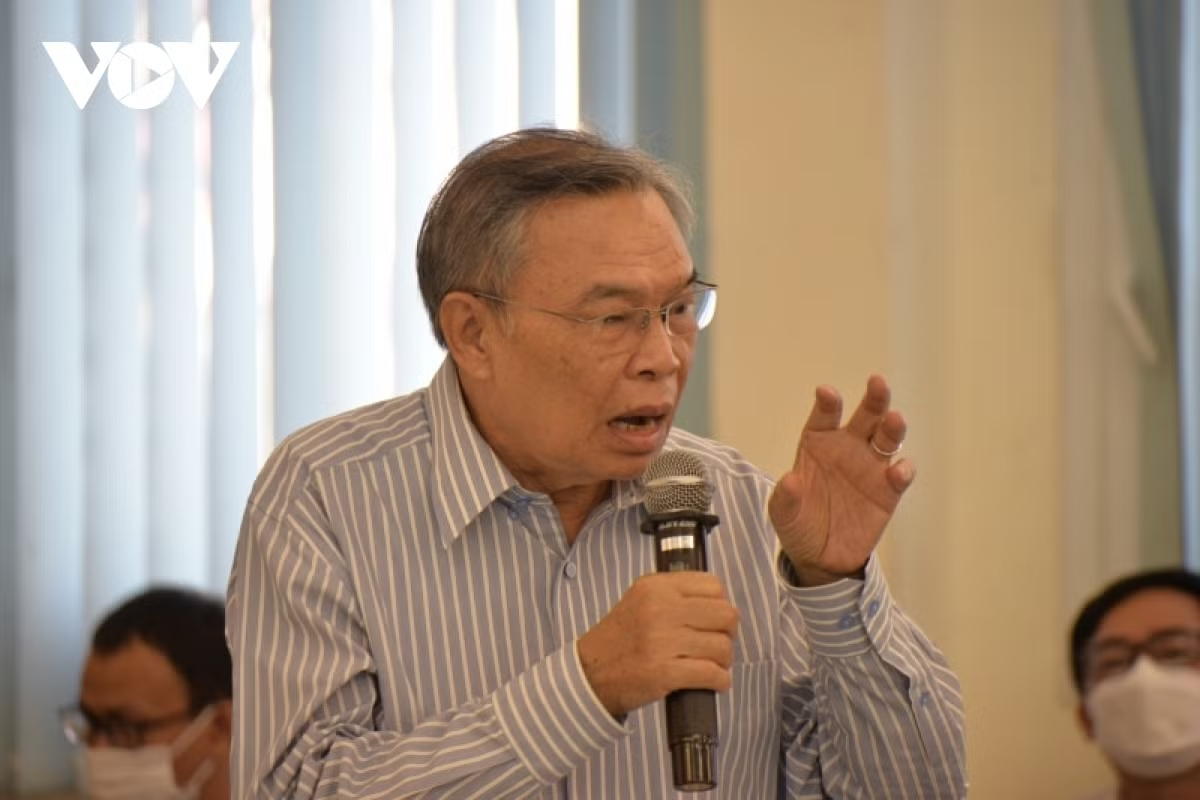
Le Trung Tinh, chairman of the Ho Chi Minh City Intercity Passenger Transport and Tourism Association

Le Trung Tinh, chairman of the Ho Chi Minh City Intercity Passenger Transport and Tourism Association

Le Trung Tinh, chairman of the Ho Chi Minh City Intercity Passenger Transport and Tourism Association, pointed out that passengers will bear the burden for the petrol prices hike. However, he explained that with the economy beginning to recover from the COVID-19 impact, transport enterprises will not be able to raise prices immediately because such a move would ultimtaely jeopardize their recovery efforts. 

Furthermore, people are hesitant to travel due to the COVID-19 outbreak evolving in a complicated manner, not to mention the emergence of the Omicron variant and other mutated strains of the virus.

Therefore, Tinh suggested that the Ministry of Industry and Trade and the Ministry of Finance consider and calculate the appropriate Petroleum Stabilization Fund.

“Given the current context, it is not appropriate to hike ticket prices, so the only way is that the State should intervene by using the Petroleum Stabilization Fund to make up for losses in order to reduce petrol prices and help the transportation industry to keep up with its recovery efforts. Only when the transportation industry recovers, will the economy recover," he said.

Petrol represents a strategic commodity governed by the State, and any changes in petrol prices will impact all socio-economic affairs, including the operation of transport firms. With taxes and fees currently accounting for more than 60% of the cost per litre of petrol, any adjustment to petrol prices should be weighed in to minimise its impact and facilitate business recovery.

In her opinion, senior economic expert Pham Chi Lan welcomed the Government’s current policies aimed at removing business difficulties such as reducing VAT by 2% and lending capital for production. However, she suggested that the Government axe some taxes and fees to stabilise petrol prices to help keep businesses, as well as the national economy, afloat.
VOV

Other News

SBV raises short-term capital lending cap to 40%

SBV raises short-term capital lending cap to 40%

The new circular will help credit institutions have more room to provide capital to businesses and investment projects to support high economic growth in the next few years, while increasing flexibility in the SBV’s monetary policy management.

Business confidence in Vietnam rebounds strongly: UOB

Business confidence in Vietnam rebounds strongly: UOB

The study found that 85% of Vietnamese enterprises reported positive business sentiment, a sharp increase from 48% in 2025, when business confidence was weighed down by uncertainties surrounding US tariff policies and related trade developments.

Bac Ninh seeks high-quality foreign investment for sustainable growth

Bac Ninh seeks high-quality foreign investment for sustainable growth

According to Vice Chairman of the provincial People’s Committee Pham Van Thinh, the province aims to maintain stable and sustainable growth, improve the competitiveness of both the economy and local businesses, and make better use of free trade agreements (FTAs) to expand and diversify export markets.

Green building trend flourishes in Ho Chi Minh City's real estate landscape

Green building trend flourishes in Ho Chi Minh City's real estate landscape

The International Finance Corporation (IFC) highlighted the city's dominance in green-certified building floor space in Vietnam, reflecting the rapid expansion of the green building market with 780 completed green buildings encompassing over 18.69 million sq.m by 2025, predominantly certified by EDGE and LEED.

UK supports Vietnam in wind power and green finance development

UK supports Vietnam in wind power and green finance development

The United Kingdom officially announced two new climate cooperation initiatives to support Vietnam in its energy transition and green growth journey. These programs focus on offshore wind power development and the creation of a sustainable green financial ecosystem.

Ample room remains for Vietnam–India logistics cooperation

Ample room remains for Vietnam–India logistics cooperation

The GTTCI expert noted that alongside logistics and integrated warehousing, e-commerce is expected to be a particularly high-growth sector in the coming years. He described it as a multi-billion-dollar market with significant untapped opportunities for cooperation between Vietnam and India.

Exports gain momentum from high-tech growth drivers

Exports gain momentum from high-tech growth drivers

According to the Ministry of Industry and Trade, Vietnam’s exports reached 215.66 billion USD in the first five months of 2026, up 19.5% year-on-year. Twenty-six export items generated more than 1 billion USD in revenue each, including seven with turnover exceeding 10 billion USD.

Vietnam–China crossings see spike in ASEAN fresh produce

Vietnam–China crossings see spike in ASEAN fresh produce

Since the start of the summer harvest season, China's two major border gates with Vietnam, Youyi Guan in Pingxiang and Beilun 2 Bridge in Dongxing, have entered their peak period for handling imports of fresh agricultural and seafood products from member states of the Association of Southeast Asian Nations (ASEAN).

Cargo handling operations at Berths 3 and 4 of the Hai Phong International Gateway Port. (Photo: VNA)

AI reshapes logistics, raising bar for workforce skills

According to the Vietnam Logistics Business Association (VLA), the logistics sector will require around 2.2 million workers by 2030, including 1.6 million employees for logistics service providers and nearly 600,000 personnel supporting logistics operations in manufacturing and trading enterprises.

Robust dispute resolution framework key to Vietnam's IFC ambitions

Robust dispute resolution framework key to Vietnam's IFC ambitions

The development strategy for VIFC-HCMC envisions a comprehensive financial ecosystem encompassing green finance, carbon credits, financial technology (fintech), blockchain technology, digital assets, digital banking and other innovative business models. These highly internationalised sectors involve complex cross-border transactions and sophisticated legal structures.