PM stresses businesses’ role in improving labourers’ skills

The country’s biggest-ever forum on vocational training took place in Hanoi on November 16 with a focus on ways to promote Vietnamese labourers’ skills.
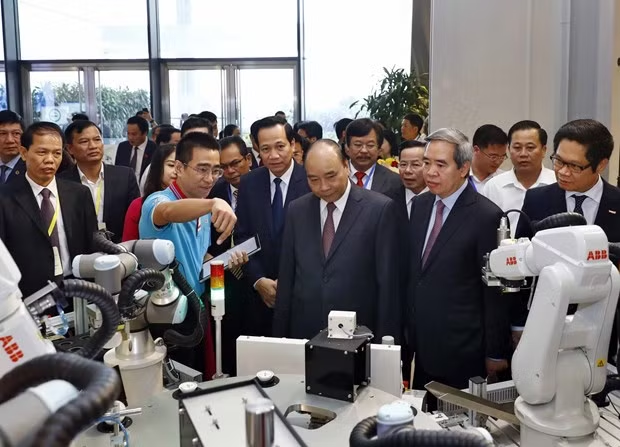
Prime Minister Nguyen Xuan Phuc (front, third, right) visits an exhibition on the sidelines of the forum on vocational training in Hanoi on November 16 (Photo: VNA)

Prime Minister Nguyen Xuan Phuc (front, third, right) visits an exhibition on the sidelines of the forum on vocational training in Hanoi on November 16 (Photo: VNA)

The country’s biggest-ever forum on vocational training took place in Hanoi on November 16 with a focus on ways to promote Vietnamese labourers’ skills.

Addressing more than 1,500 participants, Minister of Labours, Invalids and Social Affairs Dao Ngoc Dung said in the next 10 – 15 years, about one-third of current occupations will change under the impact of the Fourth Industrial Revolution, information technology, robot, automation, and artificial intelligence. About 40 percent of labourers around the globe will not have skills necessary for their jobs when robots replace human.

Therefore, making changes, especially in labour intensive industries like textile-garment, footwear and electronics, is an urgent need, he noted.

In his speech, Prime Minister Nguyen Xuan Phuc repeated his recent statement at the National Assembly’s session that resources for national development are not forests or seas but the nearly 100 million Vietnamese people.

He said over the last 30 years, the expansion of population and workforce has been an important driving force for GDP growth. However, since 2013, the size of Vietnam’s labour force has begun to approach its limit compared to the size of the economy. Therefore, raising productivity plays a decisive role in economic growth and economic restructuring.

PM Phuc noted expanding the scale and improving the quality of vocational training form the decisive factor in creating skilled human resources, which are critical to boosting productivity. In that work, businesses’ participation is important to align training curricula with the economy’s demand.

The Government leader pointed out that although Vietnam has the third largest population in ASEAN, after Indonesia and the Philippines, the percentage of trained labourers in the country is just above 25 percent, equivalent to one-third of the rates in the Republic of Korea, Taiwan (China) and Singapore. In many countries, this figure is 50 percent.

Despite certain improvements, vocational training has yet to meet the market’s demand, the PM said.

According to him, to sustain and promote economic growth and strengthen national competitiveness, it is necessary to reform and improve the quality of vocation training, and this process needs to be associated with businesses and the labour market.

PM Phuc stressed that only when vocational training in Vietnam can catch up with the level in developed nations in the region and the world, can the country move up in global value chains.

He also asked the Ministry of Labour, Invalids and Social Affairs to design a social agreement with the participation of schools, businesses and the Government in vocational training so as to create highly skilled human resources for the economy.

VNA

Other News

Hanoi ready to implement Capital Law 2026, unlocking new development momentum

Hanoi ready to implement Capital Law 2026, unlocking new development momentum

The effectiveness of the Capital Law 2026 will be measured not by the number of legal documents issued but by tangible improvements in governance and public administration, better services for people and businesses, faster administrative procedures, stronger investment attraction and higher economic growth.

Vietnamese students earn honours at ROBOG Asia Cup 2026

Vietnamese students earn honours at ROBOG Asia Cup 2026

Three teams from Chu Van An Secondary School in Vietnam’s Thai Nguyen province have earned First Prize honours and advanced to the quarterfinals at the ROBOG Asia Cup 2026, a regional robotics and artificial intelligence (AI) competition for students held in Hong Kong, China.

Hanoi sets out new investment blueprint with century-long development vision

Hanoi sets out new investment blueprint with century-long development vision

As of early June, Hanoi had attracted 74.6 billion USD in foreign direct investment (FDI) through more than 9,250 valid projects. FDI inflows in the first six months were projected at 3.2 billion USD, surpassing the annual target by 116%, while nearly 16,000 new businesses were established in the first five months, up 34.4% year-on-year.

Vietnam promotes legal cooperation and rule of law at global forum

Vietnam promotes legal cooperation and rule of law at global forum

Vietnam’s development and international integration have gone hand in hand with the improvement of its legal system, the incorporation of international commitments into domestic legislation, and legal reforms aimed at fostering development, openness and global integration. The country regards international law as an essential instrument for building fair, mutually beneficial relations among nations.

Hanoi to hold investment promotion event on June 29

Hanoi to hold investment promotion event on June 29

At the event, Hanoi authorities plan to grant investment policy decisions and investment registration certificates to 20 exemplary projects in the fields of transportation infrastructure, industrial parks, urban development, social housing, environment, science and technology, and foreign investment attraction.

Hanoi's Red River urban area development draws widespread attention

Hanoi's Red River urban area development draws widespread attention

Located south of the Red River and extending from the historic inner city to newly developing areas in the south and the west, the central urban area along Red River’s right bank covers approximately 45,317 hectares and is projected to accommodate around 6.365 million residents by 2045 and 6.455 million by 2065.

Hanoi's Red River urban area development draws widespread attention

Hanoi's Red River urban area development draws widespread attention

Located south of the Red River and extending from the historic inner city to newly developing areas in the south and the west, the central urban area along Red River’s right bank covers approximately 45,317 hectares and is projected to accommodate around 6.365 million residents by 2045 and 6.455 million by 2065.

Regional cooperation strengthened to combat cross-border drug crime

Regional cooperation strengthened to combat cross-border drug crime

Vietnam, China, Laos and Myanmar face common challenges as drug syndicates increasingly exploit the Mekong River, cross-border transport networks, e-commerce platforms, international logistics services, cyberspace and cryptocurrencies to organise drug transactions and smuggling operations.