Population administrative procedures simplified

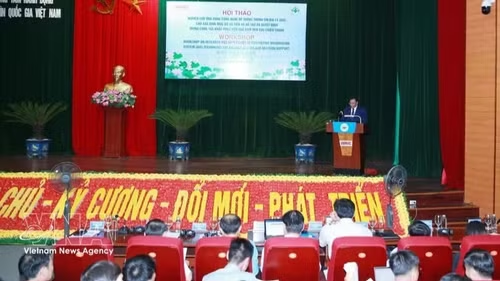
Ministries and agencies have proposed simplifying 1,126 out of 1,934 administrative procedures related to population management, heard a meeting held last week to review a master plan on simplifying administrative procedures, citizenship papers and the population management database for 2013-2020.
The master plan, known as Programme 896, was approved by former Prime Minister Nguyen Tan Dung in 2015 as part of the development of e-government in Vietnam.

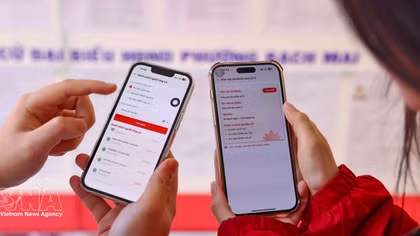
The plan aims to increase the use of IT in administrative procedures, reduce paperwork and streamline processes related to population management.

Under the plan, basic information on every citizen will be included in a national database on population using personal identification numbers by the end of 2020.

Regarding issuing personal identification numbers, the Ministry of Public Security reported that it co-ordinated with the Ministry of Justice to install birth certificate registration software on a trial basis at population registration and management agencies in 12 provinces and cities, including Hanoi, Hai Phong, Da Nang, HCM City, An Giang, Dong Thap, Sac Trang, Ha Nam, Ha Tinh, Quang Ninh, Vinh Long and Nghe An.  

By February 5, 335,371 newborns had their birth certificates registered and were issued citizen identification numbers.

The scheme will be rolled out nationwide in April.

Many participants at the meeting proposed granting personal identification numbers to Vietnamese people who return to Vietnam from abroad.

The national population management database plan was approved and is ready to be built, according to Deputy Prime Minister Truong Hoa Binh, who is also Head of the Programme Steering Committee.

Regarding the implementation of the programme in 2017, the deputy PM urged ministries and agencies to intensify efforts to build technical infrastructure for the national database.

The database will be decisive to the success of the national scheme to simplify administrative procedures, citizenship documents and population management, he said.

Bình asked the ministries and agencies to review difficulties and obstacles in granting personal identification numbers to those in remote and mountainous areas and people working and studying abroad.

The 2017 tasks will focus on completing the construction of the national database on population, expanding the granting of personal identification numbers nationwide and submitting a resolution on administrative procedures simplification to the Government.
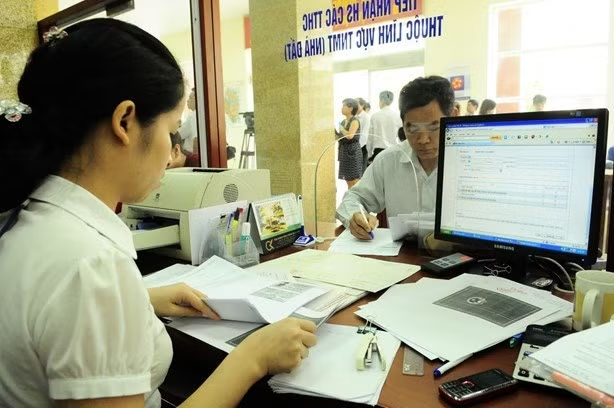
Illustrative image (Photo: baodauthau.vn)
VNA

Other News

Hanoi ready to implement Capital Law 2026, unlocking new development momentum

Hanoi ready to implement Capital Law 2026, unlocking new development momentum

The effectiveness of the Capital Law 2026 will be measured not by the number of legal documents issued but by tangible improvements in governance and public administration, better services for people and businesses, faster administrative procedures, stronger investment attraction and higher economic growth.

Vietnamese students earn honours at ROBOG Asia Cup 2026

Vietnamese students earn honours at ROBOG Asia Cup 2026

Three teams from Chu Van An Secondary School in Vietnam’s Thai Nguyen province have earned First Prize honours and advanced to the quarterfinals at the ROBOG Asia Cup 2026, a regional robotics and artificial intelligence (AI) competition for students held in Hong Kong, China.

Hanoi sets out new investment blueprint with century-long development vision

Hanoi sets out new investment blueprint with century-long development vision

As of early June, Hanoi had attracted 74.6 billion USD in foreign direct investment (FDI) through more than 9,250 valid projects. FDI inflows in the first six months were projected at 3.2 billion USD, surpassing the annual target by 116%, while nearly 16,000 new businesses were established in the first five months, up 34.4% year-on-year.

Vietnam promotes legal cooperation and rule of law at global forum

Vietnam promotes legal cooperation and rule of law at global forum

Vietnam’s development and international integration have gone hand in hand with the improvement of its legal system, the incorporation of international commitments into domestic legislation, and legal reforms aimed at fostering development, openness and global integration. The country regards international law as an essential instrument for building fair, mutually beneficial relations among nations.

Hanoi to hold investment promotion event on June 29

Hanoi to hold investment promotion event on June 29

At the event, Hanoi authorities plan to grant investment policy decisions and investment registration certificates to 20 exemplary projects in the fields of transportation infrastructure, industrial parks, urban development, social housing, environment, science and technology, and foreign investment attraction.

Hanoi's Red River urban area development draws widespread attention

Hanoi's Red River urban area development draws widespread attention

Located south of the Red River and extending from the historic inner city to newly developing areas in the south and the west, the central urban area along Red River’s right bank covers approximately 45,317 hectares and is projected to accommodate around 6.365 million residents by 2045 and 6.455 million by 2065.

Hanoi's Red River urban area development draws widespread attention

Hanoi's Red River urban area development draws widespread attention

Located south of the Red River and extending from the historic inner city to newly developing areas in the south and the west, the central urban area along Red River’s right bank covers approximately 45,317 hectares and is projected to accommodate around 6.365 million residents by 2045 and 6.455 million by 2065.

Regional cooperation strengthened to combat cross-border drug crime

Regional cooperation strengthened to combat cross-border drug crime

Vietnam, China, Laos and Myanmar face common challenges as drug syndicates increasingly exploit the Mekong River, cross-border transport networks, e-commerce platforms, international logistics services, cyberspace and cryptocurrencies to organise drug transactions and smuggling operations.