Prices of herbal medicines to be standardised

The supply, price and use of herbal medicines will be tightened by strengthening policies on quality assessment at medical facilities, Minister of Health Nguyen Thi Kim Tien has stressed. 

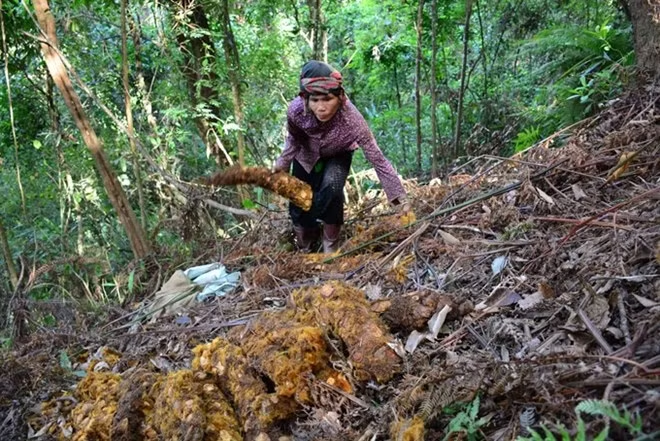
A farmer collects herbal plants

Speaking at a recent conference, Tien said that for a long time, prices of medicines in Vietnam have been higher than in other regional countries, putting a huge burden on the social insurance fund.

The difference in prices of traditional herbal medicines reflects the distinguished quality of medicinal plants, according to Tran Van On, head of the Department of Botany under Hanoi University of Pharmacy. Since Vietnam has a rich biodiversity, one herbal species includes different types with various sizes.

“Consumers may buy poor-quality herbal medicines at high prices if we do not set a common standard for these products,” said On.

With the aim of addressing the issue, he recommended the Ministry of Health (MoH) to carry out a comprehensive review of herbal medicines and establish a standard based on quality and types of herbal plants. The standard will help to set prices at drug biddings in the market, benefiting customers.

On the other hand, Nguyen Ta Tinh, head of the Department of Medicines and Medical Supplies under Vietnam Social Security (VSS), told Vietnam News Agency that there was a vast range in prices of herbal medicines. Therefore, in the near future, the agency in collaboration with MoH will evaluate and adjust prices of these products.

“In reality, it is impossible to have a huge difference in prices of herbal medicines supplied by different distributors,” he said.

To avoid wastage of the social insurance fund, VSS and the Department of Traditional Medicine Management under MoH will collaborate to work towards solutions to pricing management. 

Besides, they call for cooperation of Customs and Market Surveillance Agency in checking herbal medicines’ certificates of origin and quality as well as of MoH in post-investigating medical facilities.

According to the Department of Traditional Medicine Management, there is no regulation on price declaration of herbal plants and medicines as they depend heavily on crops and imports. The price range and quality of these products differ among localities.

The department, therefore, sets reference prices of herbal medicines for medical facilities, helping them to approach high qualities of products at reasonable prices.

In 2013, then Prime Minister Nguyen Tan Dung approved a plan to develop the herbal medicine sector by 2020, creating a solid foundation for applying high-tech activities to accelerate the industry in Vietnam.

To that point, Vietnamese herbal medicines are expected to be competitive in regional and world markets.


VNA

Other News

Hanoi ready to implement Capital Law 2026, unlocking new development momentum

Hanoi ready to implement Capital Law 2026, unlocking new development momentum

The effectiveness of the Capital Law 2026 will be measured not by the number of legal documents issued but by tangible improvements in governance and public administration, better services for people and businesses, faster administrative procedures, stronger investment attraction and higher economic growth.

Vietnamese students earn honours at ROBOG Asia Cup 2026

Vietnamese students earn honours at ROBOG Asia Cup 2026

Three teams from Chu Van An Secondary School in Vietnam’s Thai Nguyen province have earned First Prize honours and advanced to the quarterfinals at the ROBOG Asia Cup 2026, a regional robotics and artificial intelligence (AI) competition for students held in Hong Kong, China.

Hanoi sets out new investment blueprint with century-long development vision

Hanoi sets out new investment blueprint with century-long development vision

As of early June, Hanoi had attracted 74.6 billion USD in foreign direct investment (FDI) through more than 9,250 valid projects. FDI inflows in the first six months were projected at 3.2 billion USD, surpassing the annual target by 116%, while nearly 16,000 new businesses were established in the first five months, up 34.4% year-on-year.

Vietnam promotes legal cooperation and rule of law at global forum

Vietnam promotes legal cooperation and rule of law at global forum

Vietnam’s development and international integration have gone hand in hand with the improvement of its legal system, the incorporation of international commitments into domestic legislation, and legal reforms aimed at fostering development, openness and global integration. The country regards international law as an essential instrument for building fair, mutually beneficial relations among nations.

Hanoi to hold investment promotion event on June 29

Hanoi to hold investment promotion event on June 29

At the event, Hanoi authorities plan to grant investment policy decisions and investment registration certificates to 20 exemplary projects in the fields of transportation infrastructure, industrial parks, urban development, social housing, environment, science and technology, and foreign investment attraction.

Hanoi's Red River urban area development draws widespread attention

Hanoi's Red River urban area development draws widespread attention

Located south of the Red River and extending from the historic inner city to newly developing areas in the south and the west, the central urban area along Red River’s right bank covers approximately 45,317 hectares and is projected to accommodate around 6.365 million residents by 2045 and 6.455 million by 2065.

Hanoi's Red River urban area development draws widespread attention

Hanoi's Red River urban area development draws widespread attention

Located south of the Red River and extending from the historic inner city to newly developing areas in the south and the west, the central urban area along Red River’s right bank covers approximately 45,317 hectares and is projected to accommodate around 6.365 million residents by 2045 and 6.455 million by 2065.

Regional cooperation strengthened to combat cross-border drug crime

Regional cooperation strengthened to combat cross-border drug crime

Vietnam, China, Laos and Myanmar face common challenges as drug syndicates increasingly exploit the Mekong River, cross-border transport networks, e-commerce platforms, international logistics services, cyberspace and cryptocurrencies to organise drug transactions and smuggling operations.