"Proposal to move Hanoi railway station requires discussion"

Rail tracks located in the inner city have caused problems for Ha Noi’s traffic, however, this will be addressed in the future when city planning is completed.
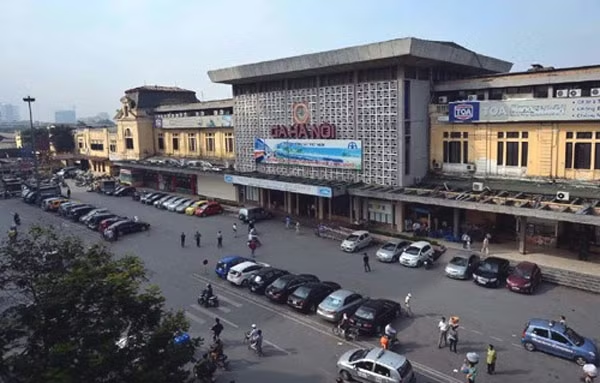
Ha Noi Railway Station.— VNA/VNS Photo

Transport Deputy Minister Nguyen Ngoc Dong made this comment referring to the proposal to move Ha Noi railway station out of the inner city.

“Traffic congestion (caused by the railways) is indeed taking place, at present. In the future, the rail tracks will not cause traffic jams. The Cat Linh-Ha Dong rail route will run on an elevated rail track or the Nhon-Ha Noi rail route will be underground. We will address the problem,” he said, indicating he was not in favour of the proposal.

He said the Ha Noi transport development, including Ha Noi railway planning, has been scheduled.

According to the Viet Nam Railway Corporation, there are 5,564 crossings between rail tracks and roads nationwide. Ha Noi has the highest number of crossings. There are also a large number of national rail tracks running parallel with Ha Noi’s main roads, such as Le Duan and Giai Phong, and crossings between rail tracks and the city’s main transport routes, including densely-populated intersections such as Kham Thien, Dai Co Viet-Dao Duy Anh, Truong Chinh and Linh Dam peninsula.

As a result, trains are banned from entering and moving out of the inner city during the rush hour, which is when there are maximum passengers. This has limited profits of the railway sector.

Vu Anh Minh, chairman of the Viet Nam Railways Corporation, said worldwide, railways has two advantages -- safety and location in the inner city to meet travel demand.

He said major cities such as Paris, Tokyo, and Frankfurt have their national railways located in the city centre, which is connected with inner cities’ railways.

He said if the railways were not located in the city centre, small-sized vehicles carrying passengers to the suburbs would increase.

“Hundreds of other vehicles replacing a train carrying 700 to 1,000 passengers still put pressure on the inner city’s traffic,” he said.

In early August, the Ha Noi Police Department proposed to move the Ha Noi Railway Station and all inter-provincial rail tracks to the suburbs to avoid traffic congestion and fatal accidents in the inner city.

Figures from the city’s Traffic Safety Steering Committee show that in the first seven months of this year, as many as 14 traffic accidents occurred on railroads, leaving 13 dead and many injured.

Most of the accidents occurred at intersection points or crossings between rail tracks and streets as drivers and pedestrians failed to observe or obey railway signals.

The Ministry of Transport is also collecting opinions on its website to draft criteria to determine “black spots” of railway accidents.

The criteria proposed to determine potential spots of railway accidents are quality of railways and safety railway barriers, as well as the number of traffic accidents in a year.


VNS

Other News

Hanoi ready to implement Capital Law 2026, unlocking new development momentum

Hanoi ready to implement Capital Law 2026, unlocking new development momentum

The effectiveness of the Capital Law 2026 will be measured not by the number of legal documents issued but by tangible improvements in governance and public administration, better services for people and businesses, faster administrative procedures, stronger investment attraction and higher economic growth.

Vietnamese students earn honours at ROBOG Asia Cup 2026

Vietnamese students earn honours at ROBOG Asia Cup 2026

Three teams from Chu Van An Secondary School in Vietnam’s Thai Nguyen province have earned First Prize honours and advanced to the quarterfinals at the ROBOG Asia Cup 2026, a regional robotics and artificial intelligence (AI) competition for students held in Hong Kong, China.

Hanoi sets out new investment blueprint with century-long development vision

Hanoi sets out new investment blueprint with century-long development vision

As of early June, Hanoi had attracted 74.6 billion USD in foreign direct investment (FDI) through more than 9,250 valid projects. FDI inflows in the first six months were projected at 3.2 billion USD, surpassing the annual target by 116%, while nearly 16,000 new businesses were established in the first five months, up 34.4% year-on-year.

Vietnam promotes legal cooperation and rule of law at global forum

Vietnam promotes legal cooperation and rule of law at global forum

Vietnam’s development and international integration have gone hand in hand with the improvement of its legal system, the incorporation of international commitments into domestic legislation, and legal reforms aimed at fostering development, openness and global integration. The country regards international law as an essential instrument for building fair, mutually beneficial relations among nations.

Hanoi to hold investment promotion event on June 29

Hanoi to hold investment promotion event on June 29

At the event, Hanoi authorities plan to grant investment policy decisions and investment registration certificates to 20 exemplary projects in the fields of transportation infrastructure, industrial parks, urban development, social housing, environment, science and technology, and foreign investment attraction.

Hanoi's Red River urban area development draws widespread attention

Hanoi's Red River urban area development draws widespread attention

Located south of the Red River and extending from the historic inner city to newly developing areas in the south and the west, the central urban area along Red River’s right bank covers approximately 45,317 hectares and is projected to accommodate around 6.365 million residents by 2045 and 6.455 million by 2065.

Hanoi's Red River urban area development draws widespread attention

Hanoi's Red River urban area development draws widespread attention

Located south of the Red River and extending from the historic inner city to newly developing areas in the south and the west, the central urban area along Red River’s right bank covers approximately 45,317 hectares and is projected to accommodate around 6.365 million residents by 2045 and 6.455 million by 2065.

Regional cooperation strengthened to combat cross-border drug crime

Regional cooperation strengthened to combat cross-border drug crime

Vietnam, China, Laos and Myanmar face common challenges as drug syndicates increasingly exploit the Mekong River, cross-border transport networks, e-commerce platforms, international logistics services, cyberspace and cryptocurrencies to organise drug transactions and smuggling operations.