- Shooter kills 11, himself in Brazil New Year's party rampage
- Nigerian air force kills 52 in strike on refugee camp
- Iraq war veteran accused of killing five at Ft. Lauderdale airport
- Gunman kills 39 in Istanbul nightclub attack, manhunt under way
Court documents identified the gunman in the attack on Sunday evening prayers as Alexandre Bissonnette, 27, and charged him with six murder counts and five counts of attempted murder with a restricted weapon. The slightly-built Bissonnette made a brief appearance in court under tight security wearing a white prison garment and looking downcast.
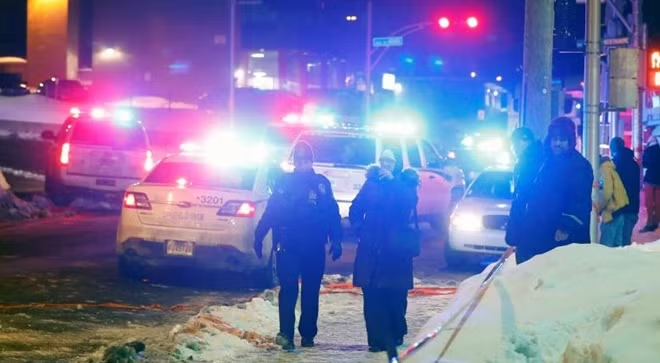 |
| Police officers are seen near a mosque after a shooting in Quebec City, January 29, 2017. REUTERS/Mathieu Belanger |
Prosecutors said all of the evidence was not yet ready and Bissonnette, a student at Université Laval, was set to appear again on Feb. 21. No charge was read in court and Bissonnette did not enter a plea.
"The charges laid correspond to the evidence available," said Thomas Jacques, a representative of the prosecutor's office, when asked why Bissonnette was not charged with terrorism-related offences.
Among the six men killed were a butcher, a university professor, a pharmacist and an accountant, according to police and Canadian media.
The government of Guinea said in a statement that two of its citizens were among those killed in the mosque attack.
Police declined to discuss possible motives for the shooting at the Centre Culturel Islamique de Québec.
"They consider this a lone wolf situation," a Canadian source familiar with the situation said.
In Washington, U.S. government security experts were leaning to the view that the gunman most likely was motivated by hatred for Muslims, a U.S. government source familiar with official reporting said.
Trudeau, who has made a point of welcoming refugees and immigrants from Muslim-majority countries, told parliament in Ottawa: "Make no mistake, this was a terrorist attack."
"Last night this community experienced something that no community should ever have to know: Unspeakable cruelty and violence perpetrated on those who came together in friendship and in faith," Trudeau said later at a vigil attended by hundreds who braved frigid temperatures in Quebec City.
He added a personal message to Canada's 1 million Muslims:
"We stand with you. We love you and we support you and we will always defend and protect your right to gather together and pray today and every day," Trudeau added.
The attack was out of character for Quebec City, a city of just over 500,000 which reported just two murders in all of 2015. Mass shootings are rare in Canada, where gun control laws are stricter than in the United States.
Incidents of Islamophobia have increased in Quebec in recent years. The face-covering, or niqab, became an issue in the 2015 Canadian federal election, especially in Quebec, where the majority of the population supported a ban on it at citizenship ceremonies.
In addition to the six killed, five people were critically injured and 12 were treated for minor injuries, a spokeswoman for the Quebec City University Hospital said.
Federal Safety Minister Ralph Goodale told reporters in Ottawa there was no change to "the national terrorism threat level" from medium because "there is no information known to the government of Canada that would lead to a change at this time."
U.S. President Donald Trump called Trudeau to express his condolences "and offered to provide any assistance as needed," said Trudeau spokesman Cameron Ahmad.
Over the weekend, Trudeau said Canada would welcome refugees, his response to an executive order by Trump on Friday to halt the U.S. refugee program and to temporarily bar citizens from seven Muslim-majority countries from entering the United States.
Trump's action, which the president said was "not about religion - this is about terror and keeping our country safe," was widely condemned in the United States and abroad as targeting Muslims.
On Monday, White House spokesman Sean Spicer told reporters that the Quebec shooting was "a terrible reminder of why we must remain vigilant, and why the president is taking steps to be proactive, rather than reactive, when it comes to our nation's safety and security."