Resolution 68 expected to spur growth model renewal

Dr. Ly Dai Hung from the Institute of Vietnam and World Economy under the Vietnam Academy of Social Sciences (VASS) described Resolution 68 as a key policy framework to mobilise and allocate resources more effectively.

 As Vietnam strives to become a developing country with modern industry and upper-middle income by 2030 and a high-income, developed nation by 2045, Resolution No. 68-NQ/TW dated May 4, 2025 of the Politburo on private sector development is expected to provide fresh momentum for growth model renewal.

Experts said achieving these goals requires not only rapid expansion but also deeper institutional reform, improved human resources and innovation in development governance.
Resolution 68 expected to spur growth model renewal -0
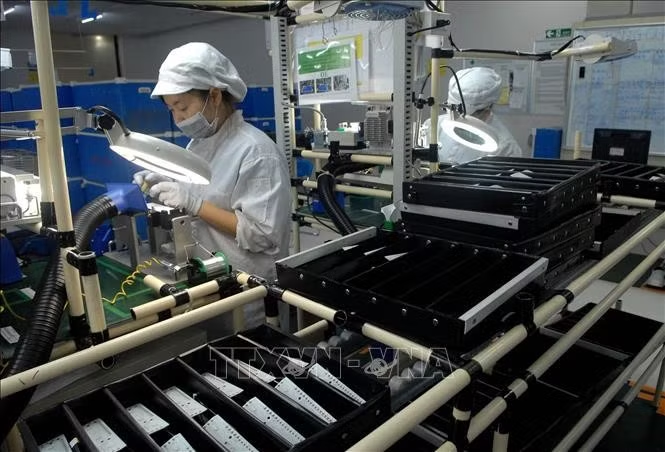
A production line for electronic devices and automotive and motorcycle lighting equipment at Vietnam Stanley Electric Co., Ltd, a Japanese-invested company in Hanoi. (Photo: VNA)

High growth targets

Dr. Ly Dai Hung from the Institute of Vietnam and World Economy under the Vietnam Academy of Social Sciences (VASS) noted that the 2030 target is measured by gross national income (GNI) per capita in current US dollars.

According to the World Bank, the upper-middle income threshold ranges from 4,496 USD to 13,935 USD, while Vietnam’s GNI per capita reached about 4,490 USD in 2024. Although the gap is narrowing, crossing the threshold will require sustained high growth over many years.

Since the adoption of the Doi moi (Renewal) process, Vietnam’s highest growth rate was 9.45% in 1995, close to the 10% mark, according to the National Statistics Office. Maintaining an average annual growth rate of around 10% in the coming period would therefore signal a major shift in economic structure and growth drivers.

Hung said the foundation for pursuing this target lies in Vietnam’s strong potential, ongoing economic restructuring and deepening international integration. However, the “window of opportunity” is narrowing as population ageing accelerates, making effective use of the remaining demographic dividend crucial to boosting income and productivity.

To sustain high growth, the investment-to-GDP ratio must remain high. Over the past three decades, the ratio averaged over 32%, supporting annual growth of more than 6%. Yet, meeting new targets will require improved capital efficiency and a shift from expansion to productivity gains.

Human resources are equally decisive, he stressed. Workforce quality determines the economy’s ability to absorb technology and drive innovation. Aligning education and training with market demand is essential to translate resources into tangible growth.

Hung described Resolution 68 as a key policy framework to mobilise and allocate resources more effectively. Removing bottlenecks in institutions, infrastructure and human resources would create a stronger foundation for sustained expansion, he said.

Reforming development governance model

Dr. Nguyen Cao Duc, Deputy Director of the Institute of European and American Studies under VASS, emphasised that reforming the development governance model is central to breakthrough growth.

Amid rapid digital transformation and global volatility, traditional governance approaches are no longer sufficient, he said, proposing a multi-layered integrated model based on “optimal institutional layering” to balance stability and innovation.

The model comprises four functional layers, from ensuring administrative discipline and efficiency to enhancing connectivity and reinforcing the State’s strategic leadership in development.

Vietnam has made progress in consolidating governance foundations through administrative reform, apparatus streamlining and regulatory improvements, contributing to a more favourable business environment and stronger enforcement.

Greater coordination among ministries, sectors and localities would reduce policy fragmentation and improve resource allocation, enabling more synchronised mobilisation of social resources, according to the scholar.

A core feature of the new model is the State’s enabling role. Beyond regulation, it is expected to guide long-term development, foster innovation, promote technology adoption and create conditions for private sector expansion, thereby raising total factor productivity and deepening the growth model.

Duc said Resolution 68 not only sets ambitious targets but also calls for upgrading governance capacity as Vietnam enters a new stage. Initial reforms have laid the groundwork for a more transparent, efficient and data-driven system, enhancing resilience to external shocks.

When governance operates effectively, resources will be better connected, helping lift productivity, strengthen economic resilience and move Vietnam closer to the goal of becoming a high-income developed nation by 2045.


VNA

Other News

Private economic sector poised for breakthrough growth

Private economic sector poised for breakthrough growth

More than a year after the Politburo's Resolution No. 68-NQ/TW on private sector development came into effect, expectations now extend beyond increasing the number of enterprises. The goal is to build a stronger business community with greater resilience, larger ambitions and the capacity to compete in global supply chains.

Vietnam remains ASEAN growth leader in 2026 despite global headwinds: WB

Vietnam remains ASEAN growth leader in 2026 despite global headwinds: WB

Vietnam is expected to remain one of ASEAN’s fastest-growing economies in 2026, supported by resilient exports, strong investment inflows and an ambitious reform agenda, despite mounting global uncertainties, according to the World Bank’s latest Vietnam Economic Update released on May 15.

Ministry establishes monitoring framework for carbon market

Ministry establishes monitoring framework for carbon market

Under a new circular, the exchange of greenhouse gas emission quotas and carbon credits is conducted on the domestic carbon credit exchange through the carbon trading system, which is interconnected with the national registration system.

Biofuel ready for nationwide rollout

Biofuel ready for nationwide rollout

For biofuels, particularly E10, to develop successfully, stronger and more coordinated policies are needed, especially pricing mechanisms capable of creating a sufficiently attractive gap between E10 and mineral-based petrol, an expert has said.

Vietnamese farm produce promoted at African investment, trade forum

Vietnamese farm produce promoted at African investment, trade forum

The 12th Africa Forum for Investment & Commerce (AFIC 12) opened in Algiers, the capital of Algeria, on May 9, drawing around 2,000 participants, including officials, economists, businesses, financial and development organizagtions from 43 African countries and international partners, including Vietnam.

Int'l medical, pharmaceutical expo opens in Hanoi

Int'l medical, pharmaceutical expo opens in Hanoi

The exhibition, which runs until May 9 at the Hanoi International Centre for Exhibition, showcases advanced products and technologies across a range of fields, including pharmaceuticals, drug manufacturing machinery and equipment, medical devices, hospital and clinic services and dental equipment.

Mega projects to transform Ho Chi Minh City urban landscape

Mega projects to transform Ho Chi Minh City urban landscape

Leading the charge in this massive building spree is the new central city square in the core of the Thu Thiem new urban area. Spanning more than 20 ha, it’s the crown jewel of the Central Square and new administrative center complex.

Vietnam establishes itself as one of region’s most dynamic manufacturing and supply bases

Vietnam establishes itself as one of region’s most dynamic manufacturing and supply bases

The country’s stable political and economic environment provides a critical foundation for long-term sourcing strategies. At the same time, Vietnam has demonstrated a strong ability to scale up manufacturing, supported by a continuously expanding industrial base capable of meeting both high-volume demand and increasingly complex technical and quality requirements.

Vietnamese pomelos gain broader access to Australian market

Vietnamese pomelos gain broader access to Australian market

The update by Australia’s Department of Agriculture, Fisheries and Forestry to its Biosecurity Import Conditions system (BICON) on April 10, officially setting out import conditions for Vietnamese pomelos, is regarded as a major milestone in market access efforts.

Vietnam's industry spearheads transition to circular economy

Vietnam's industry spearheads transition to circular economy

The circular economy is no longer just a policy choice. It has become an inevitable trend for delivering sustainable and green growth, sharpening competitiveness at home and abroad, and meeting Vietnam’s net-zero emissions target by 2050. It is now a prerequisite to sustain long-term economic expansion, particularly in industrial production and supporting industries.

Nearly 100 tonnes of Vietnamese fruits, vegetables airlifted to UAE

Nearly 100 tonnes of Vietnamese fruits, vegetables airlifted to UAE

Vietnamese fresh produce and processed foods are increasingly recognised for their quality, with items such as cashew nuts, coffee and spices gaining popularity among Middle East consumers. In 2025, Vietnam’s farm produce exports to the UAE exceeded 445 million USD, up nearly 24% year-on-year.