Russia accepts passports issued by east Ukraine rebels

President Vladimir Putin has announced that Russia is temporarily recognising passports and other identity documents issued by the self-proclaimed rebel republics in eastern Ukraine.

Clashes between pro-Russian rebels and the Ukrainian army flared up again in recent weeks, leaving many dead.

Ukraine's President, Petro Poroshenko, condemned the decision to recognise separatist passports.

But Russia's foreign minister said it was a humanitarian decision.

Sergei Lavrov also announced that heavy military hardware would be withdrawn from the region, and said a ceasefire would come into force on Monday.
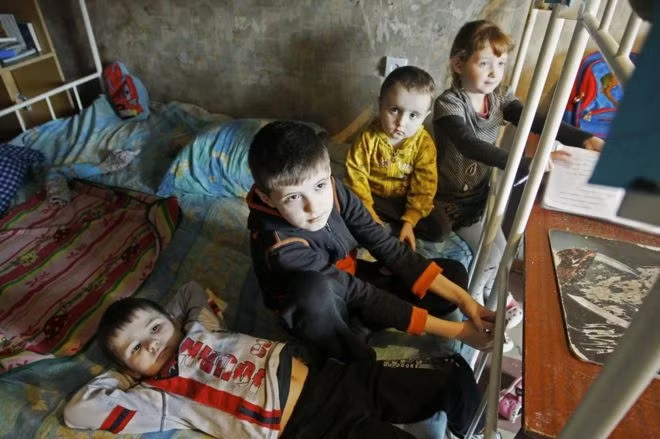
Civilians in both rebel-held areas (pictured) and areas under government control have been vulnerable to shelling. Photo: AP

He is currently in Munich for a Nato conference. US Vice-President Mike Pence, also in Munich, said the US would "continue to hold Russia accountable" and would demand that Russia honour the 2015 ceasefire deal signed in Minsk, one of the provisions of which is the removal of heavy weapons.

The Russian decree (in Russian) covers the self-declared Donetsk People's Republic and Luhansk People's Republic.

"Identity papers, school or professional diplomas, birth and death certificates... issued by the competent bodies in the zones mentioned are recognised as valid by Russia," it reads.

Tens of thousands of people from eastern Ukraine have sought refuge in Russia since the fighting began. 

Government officials in Ukraine reacted angrily to Russia's decision on passports, with one calling it a "deliberate escalation".

Foreign minister Pavlo Klimkin said: "This decree fundamentally contravenes the logic of the Minsk agreements."

And the former acting President, Oleksandr Turchynov, now the head of Ukraine's national security and defence council, echoed this, saying the Kremlin had "completely ruled out" a return to the ceasefire agreement.

Mr Turchynov said: "The Minsk process provides for the de-occupation of eastern Ukraine and its restitution to the legal force of the state. 

"By signing this decree, Putin has legally recognised the quasi-state terrorist groups which cover Russia's occupation of part of Donbas."

More than 9,700 people have died since the Ukraine conflict erupted in 2014 after Russia annexed Ukraine's southern Crimea peninsula. Pro-Russian rebels later launched an insurgency in the east.

A ceasefire was agreed in February 2015 but there have been frequent violations. The latest truce began on 23 December.

Ukrainian forces say the fresh outbreak of fighting began when rebels launched an attack on Avdiivka, a flashpoint town held by the army that borders land controlled by the separatists.

The rebels say they were attacked by Ukrainian government forces.
BBC

Other News

Vietnamese community in Venezuela backs rescue team on humanitarian mission

Vietnamese community in Venezuela backs rescue team on humanitarian mission

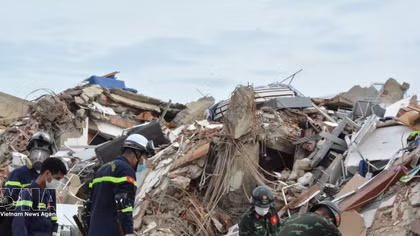
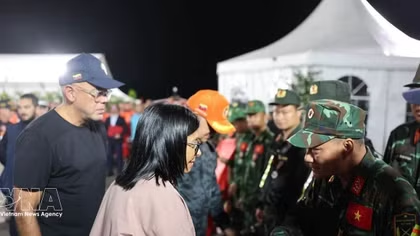
All members of the Vietnamese rescue team in Venezuela have maintained strict discipline, a strong sense of responsibility and unwavering focus when carrying out search, rescue and disaster recovery tasks, with the determination to successfully fulfil the international humanitarian mission entrusted by the Party, State and military.

Key issues ex high agenda at the ASEAN Future Forum 2026

Key issues ex high agenda at the ASEAN Future Forum 2026

PSNews - Nearly six decades after its founding, ASEAN is entering a new phase of transformation. Geopolitical turbulence, intensifying competition among major powers, non-traditional security challenges, and rapid technological change are raising fundamental questions about the region’s future trajectory. In this context, the ASEAN Future Forum (AFF) 2026 is more than a platform for regional countries to discuss current issues; it is designed to identify strategic pathways for ASEAN in the years ahead.

Malaysia bans social media accounts for children under 16

Malaysia bans social media accounts for children under 16

Under the new rules, social media platforms are required to implement age-verification systems and prevent users under 16 from creating accounts. The regulations apply to platforms with at least eight million users in Malaysia, including Facebook, Instagram, TikTok and YouTube.

Cambodia ranked world's top country for natural environment in 2026

Cambodia ranked world's top country for natural environment in 2026

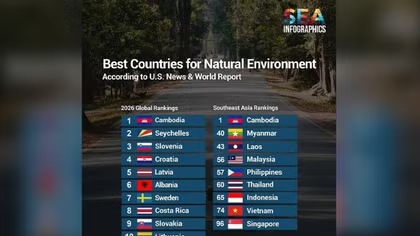
Cambodia currently manages 73 protected natural areas covering more than seven million hectares, equivalent to about 41% of the country’s total land area. These protected areas play a vital role in forest conservation, wildlife habitat protection and biodiversity preservation through stricter law enforcement and conservation measures.

ASEAN chief spotlights Vietnam’s role in shaping bloc’s future

ASEAN chief spotlights Vietnam’s role in shaping bloc’s future

Vietnam is expected to maintain active contributions across ASEAN’s three pillars - the political-security community, the economic community, and the socio-cultural community; while further enhancing regional connectivity through infrastructure projects and stronger economic linkages.

Vietnam supports UNESCO's people-centred approach, multilateral cooperation: official

Vietnam supports UNESCO's people-centred approach, multilateral cooperation: official

Van affirmed Vietnam’s support for the UNESCO80 reform roadmap, focusing on the organisation’s core mandate, priority areas, interdisciplinary approach, and the special status of the Vietnam National Commission for UNESCO, and UNESCO representative offices, alongside efforts to diversify resources and strengthen global partnerships to enhance the organisation’s effectiveness.

Regional media highlight significant step in Vietnam’s leadership structure

Regional media highlight significant step in Vietnam’s leadership structure

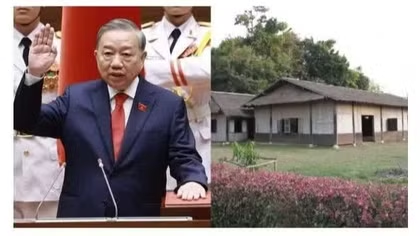
Under General Secretary and President Lam’s leadership, Vietnam is expected to maintain a balanced foreign policy, strengthen its regional standing and accelerate economic development, thereby improving living standards and creating new opportunities for international investors, according to the India-based platform Devdiscourse.

Laos identifies 10 key tasks to build independent, self-reliant economy

Laos identifies 10 key tasks to build independent, self-reliant economy

Laos will step up agricultural production to ensure food security, meet domestic demand and expand exports; encourage the development of agro-processing industries, including those related to rubber, aquatic products, cassava and sugarcane, as well as fertiliser and animal feed production, in order to increase added value and create jobs in rural areas.