- Russian scientists finish aircraft 'nervous system' to improve flight safety
- Moscow says preparing ‘tough response’ to US closure of Russian diplomatic compounds
- Internationally wanted Russian drug dealer arrested Vietnam
- Ex-FBI chief Comey tells U.S. senators Trump pressured him on Russia probe
Alexei Kudrin told Reuters that the current proposed tightening of sanctions in Washington should not have any serious impact. But he called for a major structural reform program after the 2018 presidential election.
He said that was the only way for Russia to return to growth of more than 2 percent a year.
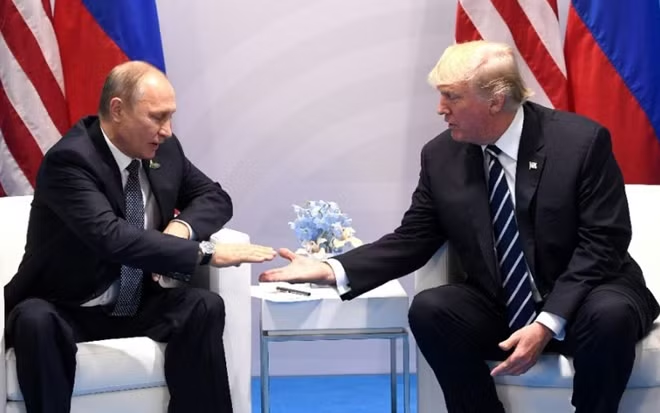 |
| President Vladimir Putin and his American counterpart Donald Trump during their first meeting. |
Putin has not yet said whether he will run for re-election next year, but is widely expected to do so and to win what would be a fourth term as president.
Putin has tasked Kudrin, who has known Putin since they worked together in the St Petersburg Mayor's Office in the 1990s, with devising a strategy to lift Russian economic growth after 2018.
Whereas Putin oversaw several years of growth in excess of 5 percent in his early presidential terms, the Russian economy suffered two years of contraction in 2015 and 2016 and is forecast to grow by a little over 1 percent this year. In May GDP rose by 3.1 percent year on year, but that pace is not expected to last.
The slowdown has put Putin under pressure.
U.S. lawmakers earlier this week voted to impose new sanctions on Russia -- on top of earlier penalties over its role in the Ukraine conflict -- and Kudrin said the mood in Washington meant it would be difficult for U.S. President Donald Trump to ease sanctions in future.
"In its current form the tightening of sanctions under discussion wouldn't seriously affect the Russian economy, there aren't serious changes with the version that exists. But the hope that sanctions would be canceled in the coming years has now faded," Kudrin said.
"We are likely to end up with the story with the old Jackson-Vanik amendment -- even when all the conditions had already changed, they couldn't cancel it," he said.
Jackson-Vanik, a 1974 provision to a U.S. federal law that punished former Communist bloc countries for restricting human rights, was only repealed in 2012 under previous U.S. President Barack Obama. It was a major sticking point in relations between Moscow and Washington.
Trump was widely perceived to be the Kremlin's favored candidate in last year's U.S. presidential race, and his White House victory raised hopes in Moscow that sanctions could be relaxed as early as this year.
But Trump's administration has since become bogged down in investigations into possible ties between his campaign and Russia. Trump has said his campaign did not collude with Russia, which flatly denies allegations it meddled in the U.S. vote.
Window of Opportunity
Kudrin, who served as finance minister from 2000 to 2011, won praise from foreign investors for building up Russia's formidable fiscal buffers during an era of high oil prices. He was one of relatively few liberal voices among top officials.
He now heads the Centre for Strategic Research, an analytical group founded on Putin's initiative to draft policy ideas.
Kudrin said Western sanctions in their current configuration were knocking off around 0.5 percent from Russian gross domestic product, down from 1 percent in the year after they were introduced in 2014.
Russia had a "window of opportunity" after the 2018 election in which to enact meaningful reforms to counteract the effects of sanctions, he said. But for now a populist camp around Putin appeared to have the upper hand over those calling for reform.
"To what extent the president will use that [window], we don't know," Kudrin said. "After previous elections that window for reforms wasn't used."
Among the reforms Kudrin is calling for are greater public control over law enforcement officials, raising the retirement age, reducing government stakes in large companies, and improving revenue collection from the shadow economy.
He said he thought the state should sell government stakes in Russian oil companies in stages over the next six to 10 years, and that it could sell a portion of its majority holding in the country's largest bank Sberbank in the same time period.
With such reforms, Kudrin said Russia could increase its economic growth rate to 3-4 percent in five to six years, even with sanctions staying in place.
Without reforms, Russia will not notice the damage from sanctions before it is too late, he said.
"In the next six to seven years we could not notice the decline in the areas of productivity and technological development. In the end we will see it, because others will grow faster, but by then it will be difficult to change something."