Schools become home for ethnic children

School has gotten that little bit better for disadvantaged children in the central province of Nghe An.

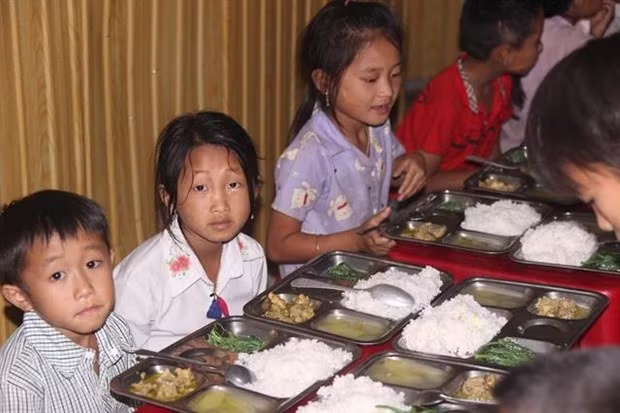
Students enjoy a meal at Huoi Tu 2 Primary School in central Nghe An province's Ky Son district. (Photo:VNS)

Students enjoy a meal at Huoi Tu 2 Primary School in central Nghe An province's Ky Son district. (Photo:VNS)

School has gotten that little bit better for disadvantaged children in the central province of Nghe An. In a bid to help them concentrate on their studies, the ethnic minority students are given meals and places to sleep.

It has helped improve social skills and make them feel more attached to the school, teachers and friends.

Huoi Tu 2 Primary School in Ky Son District, is more than 300 kilometres away from Vinh City and one of the most disadvantaged areas of the province.

At 5pm from Monday to Friday, students, mostly Mong ethnic minorities, gather at the kitchen of the school to get their tray of food.

On the tray, there are four dishes, including rice, vegetables, meat and broth, which ensures nutrition for students after a long day of study.

After dinner, students and teachers will have time for entertainment activities learning folk games, new songs and stories before going to bed. The routine has been implemented at the school for the past three years.

Nguyen The Vinh, principal of Huoi Tu 2 Primary School said the school applied the boarding school model, which provided meals and sleeping places for students since the academic year of 2016-2017.

The model eased the difficulties of teaching and studying of both teachers and students.

Vinh said two thirds of pupils were from poor households and lived tens of kilometers away from the school.

Previously, these students had to study at five different temporary classrooms, which was made from bamboo and ill-equipped. Both teachers and students had to walk on mountainous muddy roads to get to class.

That’s why the number of students dropping out of school remained high.

Figures from the Ministry of Education and Training in the academic year of 2016-2017 showed up to 510,000 students dropped out of school after two weeks of the new academic year. There were more than 765,220 students studying at 1,575 schools in the province. 

Vinh said since the school applied the model, fewer students were absent from class after the weekends.

The cost of the meals has been supported by the central province’s State budget and by parents.

Teachers would take turns to go to the market to buy food and cook meals. They even planted vegetable, raised chickens and pigs to vary the menu.

Apart from lessons, students would learn how to socialize, enlarge their social knowledge and become self-confident.

These activities would help change outdated customs and lifestyles while preserving and promoting the national cultural identity for students, Vinh said.

Thai and Kho Mu students at Ta Ca ethnic boarding school enjoy the same routine. Cut Thi Thuy, principal of Ta Ca ethnic boarding school said there were 71 students staying at the school.

The school had been facing many difficulties when implementing the model as there were no electricity and a shortage of standard toilets and basic items.

However, Thuy said the model helped parents feel secure about their children’s study.

Thuy said she had encouraged parents to donate basic items such as beds, pillows and blankets for students, but it still wasn’t enough.

Teachers said the model had increased study time and helped improve interaction between teachers and students. Teachers could take care of students both physically and spiritually.

As many as 12 out of 29 schools in Ky Son District have applied the model.

Phan Van Thiet, head of Ky Son District’s Education and Training Division, said the office asked the schools to pick up more students from temporary classrooms to stay at the schools this month, so students would get better care.

Five schools have managed to persuade students from third to fifth grades to stay at school. 

The model would create better condition to organize the teaching of IT and English for them following the new curriculum in the future, he said.

VNA

Other News

Vietnam steps up implementation of ethnic affairs strategy through 2030

Vietnam steps up implementation of ethnic affairs strategy through 2030

To accelerate the implementation of the the Ethnic Affairs Strategy by 2030, with a vision toward 2045, the Prime Minister requested ministries, agencies and local authorities to continue thoroughly carrying out the Party and State’s policies on ethnic affairs, enhancing the effectiveness of State management and strengthening oversight of policy implementation.

Security preparations reviewed for APEC 2027 in Phu Quoc

Security preparations reviewed for APEC 2027 in Phu Quoc

The team examined the APEC 2027 Convention Centre, where main conference activities are scheduled; Sun Serenia Hospital, designated to provide healthcare and emergency medical services for delegates; provincial road DT.975, which connects Phu Quoc International Airport to the convention centre; and the area surrounding Phu Quoc International Airport.

Hanoi accelerates seven Red River bridge projects, many exceed 70% completion

Hanoi accelerates seven Red River bridge projects, many exceed 70% completion

According to the municipal Transport Construction Investment Project Management Board, the city is simultaneously implementing seven projects, namely Tu Lien, Ngoc Hoi, Tran Hung Dao, Thuong Cat, Van Phuc, Hong Ha and Me So bridges. Construction is being carried out on multiple fronts, focusing on bored piles, pile caps, piers and superstructure works.

Dien Bien battlefield legacy powers tourism revival

Dien Bien battlefield legacy powers tourism revival

Seventy-two years after the Dien Bien Phu Victory, its legacy still reverberates. The unity, self-reliance, and resilience forged in that historic triumph remain a powerful internal engine, now propelling Dien Bien toward fast and sustainable development.

Hanoi accelerates shift to green buses, targets 100% by 2030

Hanoi accelerates shift to green buses, targets 100% by 2030

In the 2027–2030 period, the city will accelerate the transition towards the complete phase-out of fossil fuel-powered buses. The share of electric and green energy-fueled buses is projected to reach 79–89% by 2029 and 100% by 2030.

36 fishermen safely rescued after boat breaks down near Truong Sa

36 fishermen safely rescued after boat breaks down near Truong Sa

At 8:00 the same day, KN475 began towing the disabled fishing boat toward Da Tay A island. The towing operation was carried out safely, and by 18:30 both the vessel and its crew had arrived at the island without incident, where repairs and additional support procedures were arranged.

Vietnamese language contest in Laos strengthens youth ties, bilateral friendship

Vietnamese language contest in Laos strengthens youth ties, bilateral friendship

Held in response to the launch of the Vietnamese Language Day among overseas Vietnamese communities, the event aimed to enhance the quality of Vietnamese language teaching and learning in Laos while contributing to the great friendship, special solidarity, comprehensive cooperation and strategic cohesion between the two countries.

Vietnamese language contest in Laos strengthens youth ties, bilateral friendship

Vietnamese language contest in Laos strengthens youth ties, bilateral friendship

Held in response to the launch of the Vietnamese Language Day among overseas Vietnamese communities, the event aimed to enhance the quality of Vietnamese language teaching and learning in Laos while contributing to the great friendship, special solidarity, comprehensive cooperation and strategic cohesion between the two countries.

Hanoi launches 10 electric bus routes from April 1

Hanoi launches 10 electric bus routes from April 1

By the end of April, the number of buses using electricity and other green energy sources in the city is expected to reach 822, including 683 electric buses and 139 compressed natural gas (CNG) buses, representing 42.1% of the total number of vehicles.