- Trump, Modi seek rapport despite friction on trade, immigration
- Syria says U.S. chemical attack warning untrue, aims to justify new attack
Simone Veil, a French survivor of the Holocaust who became one of her country’s most influential stateswomen, shepherding the 1975 law that allowed abortion in France, pushing prison reform and other social causes, and promoting continental unity as the first female president of the European Parliament, died June 30. She was 89.
Her death was announced by French President Emmanuel Macron. French media reported that she died at her home in Paris. The cause was not immediately available.
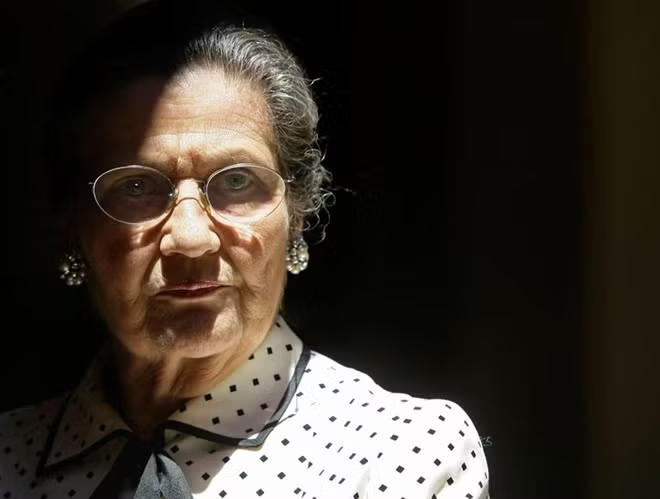 |
| Mrs. Simone Veil. Photo: Reuters. |
Mrs. Veil (pronounced “vay”) stood at the center of French politics for more than four decades, ever since President Valéry Giscard d’Estaing elevated her from the civil service to become health minister from 1974 to 1979. It was in that role that she overcame political obstacles and, at times, personal insults to establish abortion rights with the provision still today commonly called “the Veil law.”
She led the European Parliament from 1979 to 1982 — a role that made her, along with Prime Ministers Margaret Thatcher of Britain and Indira Gandhi of India, among the highest-ranking elected women in the world at the time. She returned to serve again as health minister from 1993 to 1995 under Prime Minister Édouard Balladur.
Mrs. Veil’s titles, however vaunted, were insufficient to convey her importance in French and European society. She rose to political power at a time when most governments, including her own, were dominated by men.
It was also a time of reckoning, as much of Europe confronted the slaughter of 6 million Jews that had taken place during the Holocaust. The process was particularly searing in France, where the Vichy regime had collaborated with Nazi Germany.
Mrs. Veil, who was Jewish, had been deported at 16 to Auschwitz, the Nazi death camp located in Poland, with much of her family. She represented “the reconciliation both of French and West Germans and of European Christians and Jews,” a Washington Post reporter wrote when Mrs. Veil became parliament president.
Her experiences during the war years informed her political positions, particularly her efforts to improve the lives of prisoners, with whom she said she identified, and to defend children and the mentally ill, two classes among those targeted by the Nazis.
She spoke compellingly of the need to never forget the crimes of the Holocaust. But it was often noted that she tended to wear long sleeves to cover the number, 78651, that had been tattooed on her forearm when she arrived at Auschwitz. It was perhaps a too-constant reminder of a darker Europe.
“The idea of war was for me something terrible,” she told the Associated Press in 2007. “The only possible option was to make peace.”
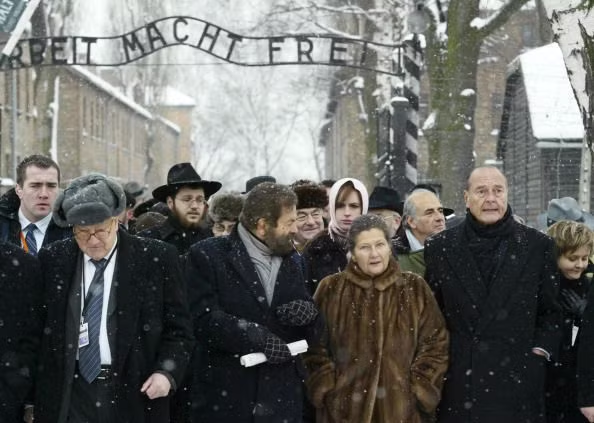 |
| French President Jacques Chirac (R), former Auschwitz prisoner and former French Health Minister Simone Veil (2nd R), and French writer Marek Halter (C) pass the entry of the Auschwitz Nazi death camp, January 27, 2005. Photo: GettyImages. |
Simone Annie Jacob was born in Nice, on the French Riviera, on July 13, 1927. Her father was an architect but was expelled from the profession by anti-Semitic Vichy regulations.
Simone, her parents, a sister and a brother were arrested in 1944. The women were deported to Auschwitz and later transferred to Bergen-Belsen in Germany, where Simone’s mother died shortly before the camp was liberated in 1945. Simone’s sister survived, as did another sister who had served in the Resistance and was interned at Ravensbrück in Germany. Their father and brother were sent elsewhere and did not return.
“I found myself thrown into a universe of death, humiliation and barbarism,” she once wrote. “I am still haunted by the images, the odors, the screams, the humiliation, the blows and the sky, ashen with the smoke from the crematoriums.”
After the war, she studied law at the Institute for Political Studies in Paris, where she met Antoine Veil, a future businessman, whom she married in 1946. She raised their three sons while pursuing her career, first as a magistrate and then in the civil service. She was an unexpected choice for Giscard’s cabinet but quickly established herself as a powerful centrist force.
She helped increase access to contraception before addressing the matter of abortion. It was an explosive issue in France, which is largely Roman Catholic, engendering often explosive rhetoric.
A French lawmaker, quoted by the New York Times, demanded of Mrs. Veil, “So, Madame Minister, do you want to send children to the ovens?” Mrs. Veil was said to have welled up in tears.
The law — the first legalizing abortion in a Catholic country — passed the National Assembly by a vote of 284 to 189. It allowed the procedure in the first 10 weeks of pregnancy, mandating that it be performed in a medical facility and that minors obtain parental permission.
“Abortion is never a victory,” Mrs. Veil told the Times when the law passed. “I would rather say this is progress.”
In foreign affairs, Mrs. Veil used her moral authority to speak out on behalf of victims of communist oppression in the Soviet Union, rightist oppression in Latin America and the boat people of Vietnam.
She confessed to having faced challenges as a woman in public life, referring to political parties in France as “men’s clubs.”
“It’s difficult for a woman to be a figure of authority,” she told The Post in 1980, “because the very thing people admire in men becomes a point of criticism in women.”
She nonetheless continued to hold high posts, serving for nearly a decade on France’s Constitutional Council, until her retirement in 2007. In 2008, she joined the Académie Française, the French literary academy.
Her husband died in 2013. Their son Claude-Nicolas Veil died in 2002. Survivors include her two other sons, Jean Veil and Pierre-François Veil.
“As a Jew, as a concentration camp survivor, as . . . a woman, you feel very much that you belong to a minority that has been bullied for a long time,” Mrs. Veil told the Associated Press when she became president of the European Parliament.
“As for the deportation, what remains with you most is the memory of humiliation, and that’s a feeling many women have too, of trampled dignity,” she continued. “If this Parliament has a Jew, a woman, for its president, it means everyone has the same rights. That means a lot to me.”