- Czech expert lauds changes in Vietnam’s foreign investment attraction policy
- 226 European diplomats, businesspeople arrive in Vietnam for investment activities
- US businesses keen on investment opportunities in Vietnam

In the first seven months of 2020, Singapore remained the top overseas investor in Vietnam with the total investment capital at more than US$6.44 billion, occupying 34.1% of the total foreign investment capital into the country.
Developers from the city-state have been leading the way in the property market here for the last 20 years, as demonstrated by a range of large-scale property projects from the likes of CapitaLand, Keppel Land, City Development, GuocoLand, Mapletree, Kusto Home, Sembcorp, and Ascendas.
Mapletree is one such developer in Vietnam. As of March 31, Mapletree owned and managed S$60.5 billion (US$43.7 billion) of office, retail, logistics, industrial, data centre, residential, and lodging properties. To date, Mapletree’s investments in Vietnam have exceeded S$1 billion (US$727 million) with assets across Hanoi, Ho Chi Minh City, Binh Duong, and Bac Ninh, as well as eight warehouse assets.
CapitaLand meanwhile has been one of the leading property developers here for a quarter of a century. Today, CapitaLand’s residential portfolio in Vietnam comprises close to 8,600 quality homes across 15 residential developments in Hanoi and Ho Chi Minh City.
The growth of its portfolio in Vietnam will continue to be driven by CapitaLand’s lodging business unit, The Ascott Limited. In Vietnam, Ascott has close to 7,000 lodging units across 27 properties.
Last year CapitaLand Ltd. completed a transaction with Temasek and acquired all issued shares from Ascendas Pte. Ltd., and Singbridge Pte., creating one of Asia’s largest diversified real estate groups with over S$123 billion of assets under management.
Lim Hua Tiong, CEO of Frasers Property Vietnam, told VIR that thanks to the country’s strong and relatively stable economic fundamentals, the country’s real estate market is growing healthily and remains attractive to investors, especially to those from abroad.
“Real estate has always been ranked within the top two sectors in terms of registered foreign direct investment (FDI). Also, there are more and more reputable developers joining the property market and setting Vietnam as their major region to develop,” Tiong said.
“The pandemic, of course, has had an effect on commercial and hospitality sectors. However, we believe it will bounce back faster than its peers. The strong urbanisation story keeps the residential market stable while robust economic fundamentals support the huge demand on the industrial front,” he added.
Activities new and old
In addition, Singapore also is one of the biggest investors in Vietnam’s industrial property development.
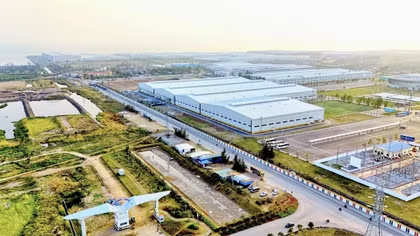
A consortium led by Sembcorp Development has joined with domestic Becamex IDC Corporation to develop a network of industrial parks in Vietnam.
This joint venture, named Vietnam-Singapore Industrial Park (VSIP), is now operating seven parks located in Binh Duong, Bac Ninh, Haiphong, Quang Ngai, Hai Duong, and Nghe An as well as five other urban development areas located alongside the parks.
So far its network has attracted US$15 billion investment capital from more than 880 tenant companies from 30 countries and territories.
Meanwhile, Ascendas is running a 500-hectare tech park, Ascendas-Protrade Singapore, with domestic partner Protrade in the southern province of Binh Duong and another US$130 million OneHub Saigon development in Saigon Hi-tech Park.
So far this year, despite the heavy impact of COVID-19 worldwide, Singaporean newcomers have kept their eyes on the Vietnamese market with a range of new investment plans.
A KKR-led consortium including Temasek – one of the biggest conglomerates from Singapore – acquired a minority stake in Vinhomes JSC for a total of VND15.1 trillion (US$650 million) in June.
Previously APAC Realty, one of the leading real estate service providers, which operates a market-leading real estate brokerage in Singapore, in February acquired a 38% stake in ERA Vietnam for US$1.5 million, to take its first step into the domestic market.
ERA Vietnam has a brokerage network in a range of cities such as Danang, Binh Duong, and Dalat. APAC Realty also committed for a preferential interest rate equal to US$2 million for ERA Vietnam.
According to Jack Chua, chairman and CEO of APAC Realty, Vietnam is a high-potential market with the third-largest population in Southeast Asia. “The real estate market is expected to grow exponentially alongside its expanding middle class, especially in Ho Chi Minh City and Hanoi,” Chua said.
Apart from that, another consortium of Singaporean developers led by Sakae Corporate Advisory and including Surbana Jurong, Fission, Centra Realty Group, and YCH Group is also participating in planning and zoning activities of cities and projects of Vietnam.
Potential and risk
In the last 10 years, FDI in Vietnam has been continuously increasing. Due to the current coronavirus pandemic, this flow has been slower since the beginning of the year. However, if the pandemic is contained, this source can be resumed by the end of 2020.
Khanh Nguyen, senior director of capital markets at JLL Vietnam, said that the Vietnamese real estate market has seen many positive signs brought about by its active integration to multilateral free trade agreements, which are encouraging foreign investors into the country.
The relaxation of regulations to permit foreigners to buy homes in Vietnam is also expected to increase the liquidity of high-end real estate products in the market.
According to Boston Consulting Group, the middle and affluent classes of Vietnam has been rapidly developing. It expected that by the end of 2020, more than 33 million Vietnamese will be in the level of middle and affluent classes, occupying 43% of the total population.
The growth of middle and affluent classes in Vietnam was estimated at 12.9% – the highest increase rate in the region. This will be great movement for the increase of high value assets including properties.
Meanwhile, the group explained, Vietnamese real estate also discloses its risks to investors as an emerging market. The foremost disadvantage is the non-synchronous legal framework which is causing confusion to both foreign investors and buyers.
Lack of transparency in the market is also an issue. Even though Vietnam has moved ahead from non-transparent to transparent position in JLL’s Transparency Index 2020 of the worldwide real estate, the country still needs to improve on this position in the coming time.
Last but not least, according to Boston Consulting, is the complicated procedures and slow approval of new projects that are pushing them into long delays and discouraging financiers and buyers from abroad.