Soldiers bring lush greenery to islands

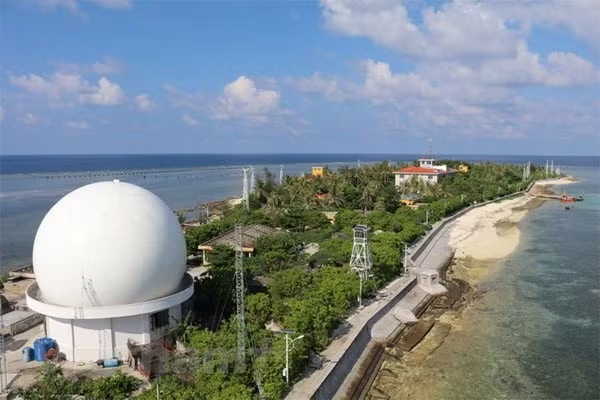
Visitors to the Spratly Islands are often welcomed by the calming colour of green trees.
Green trees on Nam Yet Island, one of the greenest of the Spratly Islands. — VNA/VNS Photo Huu Chien
Green trees on Nam Yet Island, one of the greenest of the Spratly Islands. — VNA/VNS Photo Huu Chien 

Despite the scarcity of fresh water and harsh weather, it’s been a tradition for generations of marine soldiers on these islands to grow different types of trees.

It has been a ‘rule’ on Son Ca Island that each soldier plants a tree on the island before ending their term and going back to the mainland. Thanks to this tradition, the sand island now has more than a thousand trees.

Soldiers on Spratly Island plant 400-500 new trees per year and provide seedlings for several other islands. Tree pruning teams have been formed to take care of the trees after every Lunar New Year holiday.

Nam Yet Island is one of the greenest, with thousands of trees, including a 350-year-old fish poison tree that was recognised as a ‘Heritage Tree’ by the Viet Nam Heritage Tree Council in 2014.

The island’s soldiers often exhaust their fresh water supply to take care of the trees, said Dao Van Kha, deputy commander of Nam Yet Island.

"They keep the water after washing clothes and vegetables for the trees, and use livestock’s manure as fertiliser,” he said.

“We are pretty pleased with what we have now, but we still want more trees so that there will be more shade to shield us from the harsh summer sun,” he said.

Many of the trees were given to the island by people from the mainland, Kha added.

Young trees are often delivered to the islands by ships which depart from the Naval Zone 4 in the central province of Cam Ranh, he said.

As for people who want to hand deliver trees to the islands, the process is a little trickier.

Phan Van Bon, a veteran from Vinh Phuc Province in the Red River Delta, overcame much hassle to bring five young herbal plants to the Son Ca, Da Lat and Spratly islands.

Not allowed to carry the trees on the plane during his flight to Cam Ranh Province, he had to put them in his checked baggage. Then on his cruise ship to the islands, being cautious, he kept the trees in his cabin to avoid direct sunlight and splashes of seawater.

“I want to give the soldiers these herbal plants so that they have tea to drink every day,” he said. “They will also leave an endearing mark of the mainland on the islands.”

There are also trees that travel back to the mainland from the islands. Spratly Island gave some 200-300 fish poison trees to its visitors at the beginning of each year.

A working group from the People’s Police Academy received some fish poison trees during a recent trip to the Son Ca Island to bring back to their campus in Hanoi.

The presence of the trees on campus helps remind military students to appreciate the country’s current peacetime, said Bui Quoc Tuan, head of the working group.

“The fish poison tree is a symbol of the invincible spirit, bravery and vitality of the Spratly Islands,” he said. “They serve as a reminder of all the sacrifices that our late Spratly soldiers made to protect the country.”

VNS

Other News

Hanoi ready to implement Capital Law 2026, unlocking new development momentum

Hanoi ready to implement Capital Law 2026, unlocking new development momentum

The effectiveness of the Capital Law 2026 will be measured not by the number of legal documents issued but by tangible improvements in governance and public administration, better services for people and businesses, faster administrative procedures, stronger investment attraction and higher economic growth.

Vietnamese students earn honours at ROBOG Asia Cup 2026

Vietnamese students earn honours at ROBOG Asia Cup 2026

Three teams from Chu Van An Secondary School in Vietnam’s Thai Nguyen province have earned First Prize honours and advanced to the quarterfinals at the ROBOG Asia Cup 2026, a regional robotics and artificial intelligence (AI) competition for students held in Hong Kong, China.

Hanoi sets out new investment blueprint with century-long development vision

Hanoi sets out new investment blueprint with century-long development vision

As of early June, Hanoi had attracted 74.6 billion USD in foreign direct investment (FDI) through more than 9,250 valid projects. FDI inflows in the first six months were projected at 3.2 billion USD, surpassing the annual target by 116%, while nearly 16,000 new businesses were established in the first five months, up 34.4% year-on-year.

Vietnam promotes legal cooperation and rule of law at global forum

Vietnam promotes legal cooperation and rule of law at global forum

Vietnam’s development and international integration have gone hand in hand with the improvement of its legal system, the incorporation of international commitments into domestic legislation, and legal reforms aimed at fostering development, openness and global integration. The country regards international law as an essential instrument for building fair, mutually beneficial relations among nations.

Hanoi to hold investment promotion event on June 29

Hanoi to hold investment promotion event on June 29

At the event, Hanoi authorities plan to grant investment policy decisions and investment registration certificates to 20 exemplary projects in the fields of transportation infrastructure, industrial parks, urban development, social housing, environment, science and technology, and foreign investment attraction.

Hanoi's Red River urban area development draws widespread attention

Hanoi's Red River urban area development draws widespread attention

Located south of the Red River and extending from the historic inner city to newly developing areas in the south and the west, the central urban area along Red River’s right bank covers approximately 45,317 hectares and is projected to accommodate around 6.365 million residents by 2045 and 6.455 million by 2065.

Hanoi's Red River urban area development draws widespread attention

Hanoi's Red River urban area development draws widespread attention

Located south of the Red River and extending from the historic inner city to newly developing areas in the south and the west, the central urban area along Red River’s right bank covers approximately 45,317 hectares and is projected to accommodate around 6.365 million residents by 2045 and 6.455 million by 2065.

Regional cooperation strengthened to combat cross-border drug crime

Regional cooperation strengthened to combat cross-border drug crime

Vietnam, China, Laos and Myanmar face common challenges as drug syndicates increasingly exploit the Mekong River, cross-border transport networks, e-commerce platforms, international logistics services, cyberspace and cryptocurrencies to organise drug transactions and smuggling operations.