 |
| Environmental groups have called for financial institutions to stop funding coal power |
Just four years ago, the small Dien Vong river provided a livelihood for hundreds of households in Ha Khanh, part of Ha Long city in the northeastern province of Quang Ninh. The river was also an ideal habitat for many types of fishes and aquatic animals.
However, this has already become a thing of the past.
“Since the full operation of the coal-fired Quang Ninh power plant began in 2014, our lives have totally changed,” said Nguyen Van Bao, 62, whose family has been living in Ha Khanh for hundreds of years.
“The plant is discharging hot water, which has killed all fish and shrimp, as well as many other organisms,” Bao said. “We don’t need the plant, we need the river.”
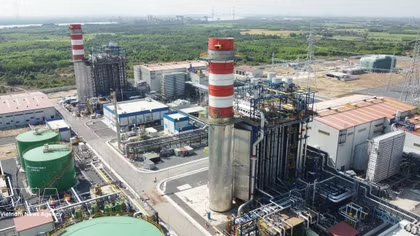
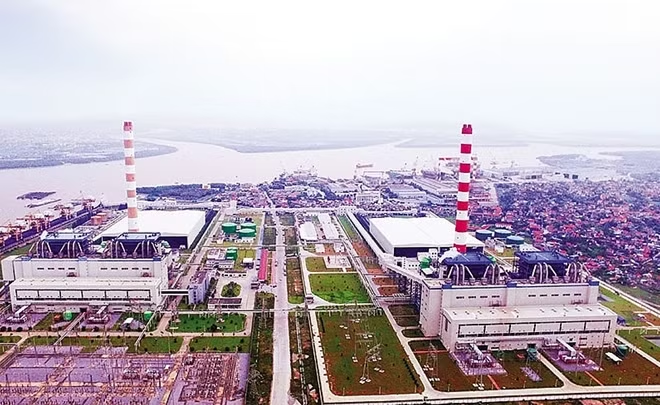
The 1,200 megawatt (MW) Quang Ninh Thermal Power Plant was constructed by Shanghai Electric Group Co., Ltd.. It covers 50 hectares, with total investment capital of about VND19 trillion ($863.63 million).
“This plant is one of the major causes behind heavy pollution in Ha Khanh and many other areas near the plant,” said Dang Ngoc Vinh, director of the Centre for Sustainable Development for Water Resources and Climate Change Adaptation (CEWAREC).
“The plight can also be seen in many other coal-fired power plants nationwide, which are damaging the environment and human health due to their old technologies,” Vinh told VIR.
Aftermath
In March 2016, the government adopted the Revised Seventh Power Plan, with the reduction of 20,000MW of coal-fired power, and a rise of 14,000MW of renewable energy. This, however, means coal-fired power still remains a significant source for the national power mix.
Currently Vietnam has over 20 operational coal-fired power plants, with a total capacity of over 13,000MW, accounting for one third of the national power mix. It is expected that by 2030, the number of these plants will triple, raising the total coal-fired power capacity to more than 55,000MW, occupying 42.6 per cent of the country’s total power capacity.
However, besides providing power for the economy, many of the plants also provide heavy water pollution.
According to the Green Innovation and Development Centre (GreenID) – a Vietnamese non-profit organisation promoting sustainable energy sector development – coal-fired power plants require a huge volume of water for their cooling systems. Averagely, every 3.5 minutes, a 500MW plant has to use 2,500 cubic metres of water – equivalent to the volume of an Olympic-sized swimming pool. After being used for cooling in the plants, the water is discharged to the environment, at a temperature 5.6-11 degrees Celsius higher than its initial input. This can destroy the habitats of fish and surrounding wildlife.
“Waste from coal-fired power production like coal sludge and slag – containing many types of heavy metals such as lead, mercury, nickel, tin, and arsenic – is quite dangerous to human health and aquatic animals,” said a GreenID report on the impact of coal-fired power plants on Vietnam’s environment.
CEWAREC also announced a survey on the impact of the Quang Ninh and Haiphong coal-fired power plants on water resources and the livelihoods of residents.
Results of surveys conducted over 103 households in Quang Ninh showed that the surrounding water sources were heavily contaminated by many types of pollutants, with the water discharged from the Quang Ninh plant often at temperatures of 38.1-38.9 degrees Celsius. This was 7.9-12.9 degrees higher than the initial temperature of the water before it is used by the plant.
Respondents surveyed said several water sources for daily needs were also polluted. The waterways were seriously polluted. Water was often black and viscid, with a terrible smell. Many streams have also become exhausted. “Residents ascribed the bad situation to coal exploitation and washing activities for the power plants,” Vinh said. “The quality of water from wells used by local households is extremely poor, often stinking as the water is mixed with coal dust.”
Under the GreenID report, the proportion of residents with the view that coal-fired power plants “remarkably contribute to pollution in their localities” are at 74.6 and 28 per cent respectively for the Haiphong and Quang Ninh plants.
Moreover, the rates of those agreeing that coal-fired power plants “remarkably affect their health” are 72.7, 45, and 48 per cent for the Duyen Hai, Vung Ang, and Haiphong plants respectively.
GreenID added that the problem of the plants’ leftover ash and slag remains unsolved in Vietnam.
Currently, coal-fired power plants nationwide annually discharge about 15 million tonnes of ash and slag. A prime example of this is the Vinh Tan II plant, discharging 4,000 tonnes of ash and slag per year. Authorities are mulling over solutions to tackle this issue.
A study published by researchers at Harvard University in 2017 estimates that by 2030 coal pollution alone will contribute to 19,220 deaths annually in Vietnam.
Hostility to coal financing
According to experts, there are a myriad of reasons as to why coal-fired power development is still needed in Vietnam – despite huge investment capital required. Currently Vietnam has mobilised about $40 billion to build its coal-fired power plants, and another $46 billion will be needed to complete the country’s coal-fired power development until 2030. Of the $40 billion used to-date, about $20.5 billion was from foreign investment, including $4.5 billion from individual foreign investors, and $16 billion from 23 international financial organisations.
“China is the biggest investor in coal-fired power plants in Vietnam, accounting for 48 per cent or $8.3 billion of Vietnam’s total foreign coal finance funding, followed by Japan (25 per cent or $3.7 billion), and South Korea (15 per cent or $3 billion),” GreenID executive director Nguy Thi Khanh told VIR.
Such loans for Vietnam are often provided via bilateral agreements, and via loans for private investors to implement these projects in Vietnam.
However, over the past few years, the tables have turned as several big players have decided to leave the game. Key public financers such as the US, the UK, OECD, and the World Bank have all adopted policies to restrict coal finance.
Movements like this may have come a long way, but they still have a long way to go as commercial banks have not phased out indirect finance for coal.
In early February, a coalition of 14 leading environmental groups worldwide called on Singapore’s major banks – including DBS Bank, OCBC Bank, and United Overseas Bank – to end the financing of highly pollutant coal-fired power stations in Southeast Asia.
The groups include Greenpeace, Walhi, Friends of the Earth, Change Vietnam, Market Forces, BankTrack, and GreenID.
One month ago, DBS Bank released a new climate policy which completely failed to rule out any of the “Unlucky Seven” coal-fired power stations it plans to finance in Indonesia and Vietnam. The seven proposed plants would generate 1.5 billion tonnes of carbon dioxide over their lifetime, equivalent to 30 years of Singapore’s annual emissions.
“The fact that DBS is preparing to finance a major new polluting coal-fired power plant in Vietnam, the Nghi Son 2 station, just weeks after releasing this policy, shows how ineffectual it is,” said Julien Vincent, executive director of Market Forces.
“DBS seems to think Europeans deserve clean air and power, while people in Vietnam and Indonesia get pollution and outdated fossil fuel technology. These double-standards are an insult to those of us who want the chance to develop cleanly and bypass the dirty energy blunders of the Western world,” Change Vietnam’s executive director Hoang Hong said.
Elsewhere, in November 2017, 23 leading environmental groups worldwide issued a document urging the Export-Import Bank of the US to reject financing for the 1,200MW Long Phu 1 coal plant in Vietnam.
“Long Phu 1 violates a broad set of environmental and social policies,” said the document. “For example, even though Long Phu 1 will produce 6.3 million tonnes of carbon dioxide annually, the project sponsor failed to examine alternatives. Long Phu 1’s project sponsor also fails to adhere to Vietnam’s national climate and energy policy, known as the Green Growth Strategy; provide baseline information; and identify cumulative and associated risks and impacts.”
The US-based Natural Resources Defence Council released a report in December 2017, stating that G20 nations may provide Vietnam with loans worth $3.9 billion for its 12 coal power gigawatts, of which $2.5 billion may come from Japan.
However, Nguyen Van Bao, from Ha Khanh in Quang Ninh province does not understand too much about such financing. “But we think before doing anything. They [financiers] must think of the community’s interests, not damaging the environment as they are doing now. What we need the most now is a clean river, not a dirty river as it is now,” he said.