- Promoting digital economy in context of Industry 4.0
- Vietnam’s textile-garment industry hopes for breakthroughs in 2019
- Vietnam’s auto industry in need of a kick start
With an array of facilities nationwide, Samsung has stated that its investment into Vietnam is not simply a short-term vision for immediate benefit, but has long-term goals.
“We are constantly looking for potential Vietnamese enterprises to participate in our business consulting programmes alongside South Korean experts. This programme can be considered a crucial step for them to strengthen their capacity to compete and join in our global supply chain,” said a Samsung statement.
“The programme was first launched in 2015, and after each session, there has been a significant increase of over 30 per cent in productivity of the enterprises taking part, on average. We will continue to promote this programme on a larger scale throughout Vietnam.”

Compared to 35 per cent in 2014, Samsung’s current localisation rate is 58 per cent. In addition, the number of Vietnamese enterprises which are Samsung’s Tier 1 vendors has greatly increased, from four in 2014 to 35 now, which is expected to grow to 50 by 2020. This target is gradually being realised through continuous efforts with the Vietnamese government in the development of supporting industries.
Urgent needs and potential market
At a recent forum on solutions for promoting the development of supporting industries in Vietnam, Prime Minister Nguyen Xuan Phuc stressed that the nation should become a production base for multinational corporations (MNCs). The Ministry of Industry and Trade (MoIT) and other government agencies are being encouraged to incorporate this into their development strategies.
The MoIT has pointed out that the country’s supporting industries remains weak, having to import nearly 80 per cent of raw materials, spare parts, and components needed for production. This means a low localisation rate, even in industries with great potential, such as automobiles and textiles.
Vietnam is aiming to have a highly competitive supporting industry by 2020, meeting 45 per cent of demand for production and local consumption.
Suttisak Wilanan, deputy managing director of Reed Tradex, said supporting industries are considered the foundation for major industries through their supply of parts, components, and technical processes. “Supporting industries should be considered a key part in national industries in the age of global economic integration. The national industry simply cannot grow without a flourishing supporting industry. They determine the production costs, and enhance the added value and competitiveness of final products,” he said.
Chairman of the Vietnam Association of Mechanical Industry Nguyen Van Thu said that leading foreign-invested enterprises (FIEs) like Samsung, Intel, and Canon need relevant policies if they are to increase the local content of their products. They should set standards for the products that they need, order supporting industry companies to make them, and then commit to buying those products. By doing so, they will allow the businesses to grow and develop.
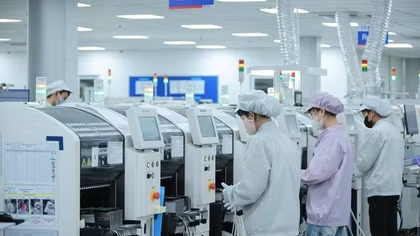
The country’s electronic industry has moved ahead drastically in the past few years, attracting investment from international giants such as Panasonic, Fujitsu, LG, Bosch, and Nokia.
“From our point of view, it is critical to have supporting industries such as the electronics components industry in order for manufacturing to flourish. Local supporting industries play a key role in the overall sustainability and competitiveness of the electronics manufacturing sector,” Ling Sing Kok, assistant director of Panasonic’s Sales and Service Division, told VIR. “But more importantly, a strong presence of supporting industries such as electrical components would enable us to respond to the needs of our customers with speed and flexibility, thus creating customer value.”
“Panasonic is definitely keen to expand its presence in Vietnam. As to why domestic manufacturers of electronic components are rare, such businesses require substantial technology and investment which at this stage does not seem viable in the Vietnamese market,” he added.
Getting involved in supply chain
Meanwhile, according to FIEs, if supporting industries are not developed, a heavy dependence on material imports is unavoidable, which will weaken its competitiveness and make it hard for the country to sustain economic growth. Vietnamese supporting industry businesses are now competing not only with rivals from South Korea but also other parts of the world.
Some manufacturers have taken the bull by the horns and are determined to become suppliers of multinational groups in Vietnam.
Chau Ba Long, general director of Minh Nguyen Support Industry JSC, one of Samsung’s Tier 1 vendors, said his company was established with a determination of becoming a leading parts supplier as well as growing into a trusted brand in the region.
Established in 2015, his company now produces millions of spare parts for home appliance products, digital products, mould making, car parts, refrigerator products, vacuum cleaners, washing machines, and televisions for Samsung.
“One of the reasons for our success is human resources. The company in recent years has spent a great deal employing highly skilled workers and foreign experts with long-term experience at multinational groups to ensure sustainable development,” Long said.
Truong Thi Chi Binh, vice chairwoman and general secretary of the Vietnam Association of Supporting Industries, remarked that Samsung has always been open to Vietnamese businesses ready to join their global supply chain. The common characteristics of Samsung’s Tier 1 vendors are that they are prepared to invest in improving upon their production and human resources.
“Vietnam’s support industries are young but have huge hidden potential. We strongly believe that with the Vietnamese government’s practical policies and incentives, FIEs and domestic suppliers will have much more opportunities to learn about each other, discuss, and co-operate to promote supporting industries,” commented Wilanan from Reed Tradex.
“We think that within the next five to 10 years, the nation’s electronic manufacturing business will continue to grow with more foreign direct investment from the economies such as South Korea, China, and Taiwan. We can already see that corporations are choosing to set up their factories in Vietnam,” he added.
From the angle of businesses, Binh said local businesses should have long-term strategies in place. “We took Vietnamese businesses to the EU and Japan to seek partners and received orders. Small companies which are unable to do big things should do their job well. If they are able to do big things, their orders will increase,” she said.
Pham Minh Thang, director of P&Q Solutions Co., Ltd., believed that within the next few years there may be an upswing for the country’s supporting industries, and local businesses need to prepare accordingly.
According to Minister of Industry and Trade Tran Tuan Anh, in addition to supporting policies for the industry, his ministry would clarify some key sectors which should be prioritised in order to bring about breakthrough developments. Some sectors which have potential include electronics, automobiles, garments and textiles, leather shoes, and energy. The minister said that he had asked the prime minister to allow the establishment of research and development centres for supporting industries.