Thailand to adjust 20-year national strategy

The National Economic and Social Development Council (NESDC) of Thailand has been ordered to revise the 20-year national strategy (2018-2037) and the 12th national economic and social development plan (2017-2021) to catch up with changing social and economic trends caused by the global economic slowdown and the COVID-19 pandemic.
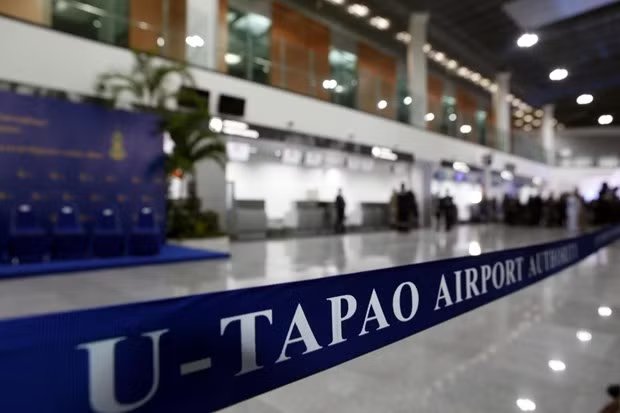
Transforming U-tapao airport into an aviation hub is among the projects supported under the 20-year national strategy plan (Source:Bangkokpost.com)

Transforming U-tapao airport into an aviation hub is among the projects supported under the 20-year national strategy plan (Source:Bangkokpost.com)

The National Economic and Social Development Council (NESDC) of Thailand has been ordered to revise the 20-year national strategy (2018-2037) and the 12th national economic and social development plan (2017-2021) to catch up with changing social and economic trends caused by the global economic slowdown and the COVID-19 pandemic.

At the latest meeting of the National Strategy Committee, Prime Minister Prayut Chan-o-cha requested the NESDC to revise the master plan for the first five years (2019-2023) under the 20-year national development strategy.

The national strategy, which came into force on October 13, 2018, has 23 master plans. Under those plans, there are 15 urgent flagship projects that must be implemented during 2019-23.

The first five years (2019-23) of development are based on requirements set under the national strategic plan. Gross national income per capita is targeted to increase by an average of 70,000 (2,100 USD) baht a year to reach 360,000 baht (10,100 USD) in 2023, up from 290,000 baht in 2019.

Growth in agriculture, industry and services is targeted at 3.8 percent, 4.6 percent and 5.4 percent, respectively, in the 12th national plan.

NESDC Secretary-General Thosaporn Sirisamphand said the council is scheduled to propose a revised plan by September.

Danucha Pichayanan, NESDC deputy secretary-general, said the 20-year strategic plan already took into account the possible impact of new diseases such as Severe Acute Respiratory Syndrome (SARS) and Middle East Respiratory Syndrome (MERS).

However, the impact of the COVID-19 is deeper and projected to last a long time, causing problems much more complicated than those of SARS and MERS, he stated.

COVID-19 also struck while the global economy was already slowing down. Therefore, rehabilitating the economy may take a while, and some business sectors may encounter more difficulty resuming their previous healthy growth, especially automotive, aviation and tourism, he added.
VNA

Other News

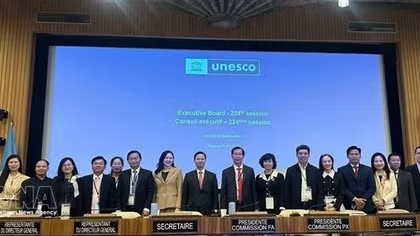
Vietnam supports UNESCO's people-centred approach, multilateral cooperation: official

Vietnam supports UNESCO's people-centred approach, multilateral cooperation: official

Van affirmed Vietnam’s support for the UNESCO80 reform roadmap, focusing on the organisation’s core mandate, priority areas, interdisciplinary approach, and the special status of the Vietnam National Commission for UNESCO, and UNESCO representative offices, alongside efforts to diversify resources and strengthen global partnerships to enhance the organisation’s effectiveness.

Regional media highlight significant step in Vietnam’s leadership structure

Regional media highlight significant step in Vietnam’s leadership structure

Under General Secretary and President Lam’s leadership, Vietnam is expected to maintain a balanced foreign policy, strengthen its regional standing and accelerate economic development, thereby improving living standards and creating new opportunities for international investors, according to the India-based platform Devdiscourse.

Laos identifies 10 key tasks to build independent, self-reliant economy

Laos identifies 10 key tasks to build independent, self-reliant economy

Laos will step up agricultural production to ensure food security, meet domestic demand and expand exports; encourage the development of agro-processing industries, including those related to rubber, aquatic products, cassava and sugarcane, as well as fertiliser and animal feed production, in order to increase added value and create jobs in rural areas.

Malaysia steps up cyber security resilience

Malaysia steps up cyber security resilience

To ensure accountability, Malaysia plans to finalise the Cybercrime Bill this year which addresses both cyber-dependent and cyber-enabled offences, introducing stricter penalties and prison terms to enhance deterrence.

US public opinion positive about PM Pham Minh Chinh’s visit

US public opinion positive about PM Pham Minh Chinh’s visit

Public opinion in the US is generally positive about Vietnamese Prime Minister Pham Minh Chinh’s trip to the US from September 17-23 to attend the 78th session of the United Nations General Assembly, which took place immediately after the upgrading of the Vietnam - US relations to a comprehensive strategic partnership on the occasion of US President Joe Biden’s official visit to Vietnam.