Well aware of the goal to wage a struggle to gain national independence, the Party and President Ho Chi Minh considered the task of national liberation the top priority and had a sound and timely redirection of strategy. Therefore, as the golden opportunity came, President Ho Chi Minh immediately convened a National Party Meeting (from August 13 - 15, 1945) to issue the decision on leading the entire people to launch the general uprising nationwide to gain power before the Allies’ troops entered the country.
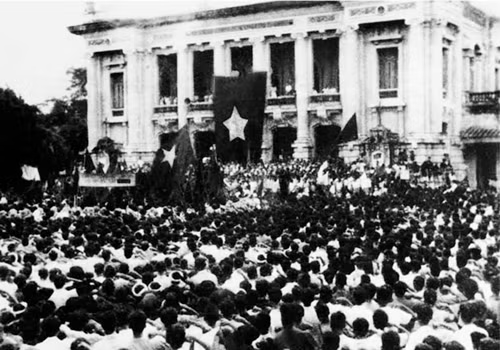 |
| Archived photo: The uprising in Hanoi on August 19, 1945 |
The Party and President Ho Chi Minh directed the whole nation, including people of all walks of life, businessmen, intellects and people of different ethnic groups and religions with the core forces being the working class and the peasantry across the country, to stand up for power. All the forces in the general uprising were organized into large-scale armed and political units led by the National Uprising Committee and local Party organizations. The units uniformly implemented the uprising under three principles: Focusing forces on main targets; uniting political and military fronts as well as commands and actions; organizing simultaneous actions to avoid missing the opportunity. As a result, the Party successfully promoted the strength of the great national unity to conduct partial uprising in a widespread fashion, leading to the general uprising on the national scale with the great synergy that overwhelmed the enemy.
Under the leadership of the Central Party Committee, the general uprising took place across the country in diverse and rich forms. As the order for the general uprising of the Central Party Committee was issued on August 13, 1945, people in many localities, with the support of armed teams, stood up and took over power. In some localities, though having yet to receive the general uprising order, their Party organizations followed and implemented the Directive “Japanese and French at war and our actions” issued on March 12, 1945 by the Standing Committee of the Central Party Committee by leading the masses with the support of armed self-defense teams to stand up for power in their localities. Out of the 65 provinces, cities and special zones, local Party organizations in 36 provinces and cities started the uprising from the commune to the district then ended at the provincial level and from the outskirt to the center areas of the cities; 15 others started the uprising at the provincial capitals and then spread to the districts; and 11 provinces and special zones organized the insurrection in both urban and rural areas at the same time, overthrowing the ruling governments of the enemy, taking over power in one day.
One of the highlights in the art of direction and organization in the general uprising is that the Party and President Ho Chi Minh closely combined the political and military forces. That could be seen in most of the provinces and cities nationwide. The uprising was organized under the close combination of the powerful political force of the masses and the military force, including the Vietnam Liberation Army units, local armed forces. The widespread political struggle was combined with the support of military blows. In the uprising, the political force played the decisive role while the military force suppressed the enemy, applying flexible tactics to gradually isolate and neutralize the fascists and their henchmen, causing them to fluctuate and unable to counter-attack. Therefore, victory was gained quickly with little loss throughout provinces and cities nationwide. Especially, the uprising in Hanoi (August 19), Hue (August 23) and Saigon (August 25) dissolved the resistance of the Japanese forces and their henchmen, sending a strong effect on the uprising in other provinces. On August 30, a delegation of the provisional Government of the Democratic Republic of Vietnam reached Hue city to witness the abdication of King Bao Dai. By this point, the general uprising to take over power in the whole country basically completed.
The victory of the August Revolution in 1945 represents the Party's and President Ho Chi Minh's statecraft in leading and organizating the uprising. It resulted from the frequent and careful observance of the world and domestic situation, the timely and accurate direction as well as the careful preparation of forces, the catch of the right opportunity, the active organization and promotion of the power of the national great unity, the close combination of the political and military forces in rural, urban, mountainous, midland and lowland areas throughout the country. The military force, with its core and forward role, actively supported the political force, creating an overwhelming advantage over the enemy, quickly taking over power on a national scale. The Democratic Republic of Vietnam was then born, ushering the nation in an era of independence and socialism.