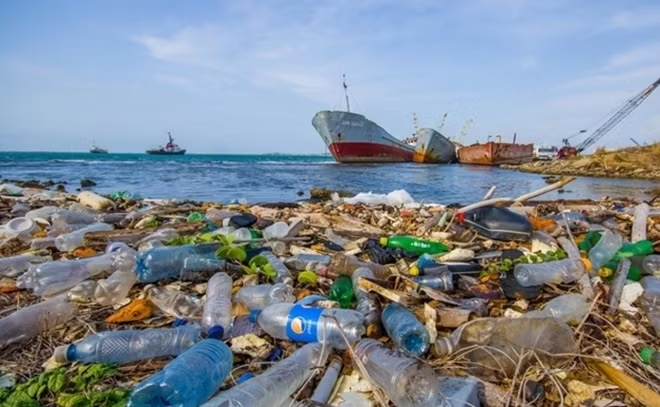
The nation set to be a pioneer in reducing ocean plastic waste

Vietnam is redoubling efforts to develop into a regional pioneer in terms of reducing ocean plastic waste, according to a recent online meeting held among environmental officials of Vietnam, Germany, Ecuador, and Ghana.

During the event, participants discussed the holding of a Ministerial Conference which is set for September as members try to reach a global strategy aimed at ending marine litter and plastic pollution, with the ultimate goal of ensuring a future with clean seas.

Ta Dinh Thi, director general of the Vietnam Administration of Seas and Islands (VASI) under the Ministry of Natural Resources and Environment, emphasised that now is the time for countries to unite to develop a cohesive global framework. Indeed, this should feature clear milestones, stakeholder roles, and responsibilities along with progress indicators to tackle trans-boundary marine litter and plastic pollution issues.

“Southeast Asia is in a unique position with a significant role to play here, and a new global agreement will provide the essential boost to our regional and national actions against the global plastic crisis," he stated.

Due to these challenges, the nation has adopted a development strategy to promote the marine-based economy whilst simultaneously protecting maritime environment and ecosystems. As such, "Preventing, controlling and significantly mitigating marine environmental pollution; being a regional pioneer in reducing ocean plastic waste" is now amongst the country’s objectives ahead for 2030.

Inger Andersen, executive director of the United Nations Environment Program (UNEP), has therefore called for transformational action to be implemented in an effort to put the brakes on plastic pollution.

She affirmed the UNEP’s readiness to support discussions among member states towards stronger global action on single-use plastics, while also calling on them and other relevant parties to perform the task of eliminating single-use plastics where possible.

According to organizers, a global agreement is needed in order to reach a consensus on the threat of marine litter. This should be done in a bid to unlock funding and provide the framework and impetus for action and change at local, national, regional, and international levels.

Over 120 countries globally have some form of legislation in place to regulate or ban the use of single-use plastics. In Africa a total of 34 out of 54 nations have instituted bans on single-use plastics, while the EU has also introduced a ban single-use plastics along with an export ban on unsorted plastic waste.

Despite these efforts, the flow of plastic into the ocean continues to occur and is predicted to nearly triple by 2040.

VOV

Other News

Hanoi ready to implement Capital Law 2026, unlocking new development momentum

Hanoi ready to implement Capital Law 2026, unlocking new development momentum

The effectiveness of the Capital Law 2026 will be measured not by the number of legal documents issued but by tangible improvements in governance and public administration, better services for people and businesses, faster administrative procedures, stronger investment attraction and higher economic growth.

Vietnamese students earn honours at ROBOG Asia Cup 2026

Vietnamese students earn honours at ROBOG Asia Cup 2026

Three teams from Chu Van An Secondary School in Vietnam’s Thai Nguyen province have earned First Prize honours and advanced to the quarterfinals at the ROBOG Asia Cup 2026, a regional robotics and artificial intelligence (AI) competition for students held in Hong Kong, China.

Hanoi sets out new investment blueprint with century-long development vision

Hanoi sets out new investment blueprint with century-long development vision

As of early June, Hanoi had attracted 74.6 billion USD in foreign direct investment (FDI) through more than 9,250 valid projects. FDI inflows in the first six months were projected at 3.2 billion USD, surpassing the annual target by 116%, while nearly 16,000 new businesses were established in the first five months, up 34.4% year-on-year.

Vietnam promotes legal cooperation and rule of law at global forum

Vietnam promotes legal cooperation and rule of law at global forum

Vietnam’s development and international integration have gone hand in hand with the improvement of its legal system, the incorporation of international commitments into domestic legislation, and legal reforms aimed at fostering development, openness and global integration. The country regards international law as an essential instrument for building fair, mutually beneficial relations among nations.

Hanoi to hold investment promotion event on June 29

Hanoi to hold investment promotion event on June 29

At the event, Hanoi authorities plan to grant investment policy decisions and investment registration certificates to 20 exemplary projects in the fields of transportation infrastructure, industrial parks, urban development, social housing, environment, science and technology, and foreign investment attraction.

Hanoi's Red River urban area development draws widespread attention

Hanoi's Red River urban area development draws widespread attention

Located south of the Red River and extending from the historic inner city to newly developing areas in the south and the west, the central urban area along Red River’s right bank covers approximately 45,317 hectares and is projected to accommodate around 6.365 million residents by 2045 and 6.455 million by 2065.

Hanoi's Red River urban area development draws widespread attention

Hanoi's Red River urban area development draws widespread attention

Located south of the Red River and extending from the historic inner city to newly developing areas in the south and the west, the central urban area along Red River’s right bank covers approximately 45,317 hectares and is projected to accommodate around 6.365 million residents by 2045 and 6.455 million by 2065.

Regional cooperation strengthened to combat cross-border drug crime

Regional cooperation strengthened to combat cross-border drug crime

Vietnam, China, Laos and Myanmar face common challenges as drug syndicates increasingly exploit the Mekong River, cross-border transport networks, e-commerce platforms, international logistics services, cyberspace and cryptocurrencies to organise drug transactions and smuggling operations.