As Vietnam ignites the entrepreneurial spirit in its young generation, the country is ushering in a new era of ground-breaking innovations and youthful zeal for business success.
 |
A quest for creativity
Vietnam’s hottest buzzword for 2016 must have been startups, as never before have millions of young Vietnamese been so warmly encouraged to innovate and start their own business. To show its commitment to young entrepreneurs, the Vietnamese government named 2016 as ‘the year of startups’.
Under the spotlight, the passion young Vietnamese have for innovation is more evident than ever. In just a few years, these ambitious minds have come up with creative solutions for various industries within Vietnam, and brought some fresh ideas to seemingly ‘boring’ sectors.
Take financial technology (fintech) as an example. According to the World Bank, 70% of the Vietnamese population remains unbanked, while the rising middle-class has more sophisticated financial needs than ever before. Vietnam Banking Forum also estimates that 38% of the Vietnamese population owns a smartphone.
Young entrepreneurs have immediately identified opportunities regarding these trends, and 30 fintech startups have been launched within the last four years. Unlike banks, which tend to be conservative and formal, fintech startups are user-friendly and trendy in design.
Among them is MoMo, which implements the novel idea of making cashless payments via point-of-sale terminals in urban and rural areas. Via mobile technology, the startup aims to make e-payments easier, even for those living in remote areas without a bank account.
“To gain customers’ trust, MoMo has built a two-level security system for e-wallet users. We launched fingerprint identification and acquired the PCI DSS security certificate. 2016 has been a wildly successful year for us, as we currently have 4.5 million users, 2.5 million of whom have registered for the e-wallet,” MoMo deputy chairman Nguyen Ba Diep said.
Besides fintech, Vietnamese entrepreneurs have used their creativity to tap into other traditional sectors such as agriculture and medical care, although returns may take longer. For example, Le Anh Duc, the owner of Lee Farm, beamed with excitement when talking about his 10,000 sq.m organic farm in Binh Phuoc Province.
“I realised that as Vietnamese customers become more health-conscious, the demand for organic produce will surpass supply. As a fruit and vegetable lover myself, I’ve seized this opportunity by adopting a Thai-based greenhouse farming module and a drip irrigation system from Israel. This combination for organic farming is the first of its kind in Vietnam,” Duc said. In 2017, he plans to double the size of his farm and apply for a business licence.
In medical care technology, eDoctor is a mobile app that allows people to access healthcare information and connect with doctors, hospitals, and pharmacies via smartphones. And it all started with a simple observation, the founders noted that people in the countryside have to travel long distances to get medical care in the city, which is costly and time-consuming.
“Using eDoctor, people can find and connect with their doctors through calls and in-app messages. If they need to see a specialist, they can even use the app to book a visit to the closest clinic. People are also able to save and track their own health records, as well as records of family members and dependents,” said the firm’s CEO Vu Thanh Long. As of December 2016, eDoctor had reached 210,000 users. A target of one million users is set for the end of 2017.
The legal roadblock
With the wide range of examples above, it is not hard to see that Vietnamese entrepreneurs are bursting with creativity. However, just like a young bird that is excited to fly, Vietnamese startups still need more assistance to reach the distant horizon.
One of the major issues is Vietnam’s legal system, which lags behind the fast-changing world of startups, and creates confusion that frustrates entrepreneurs. In July 2016, controversy broke out over Article 292 of the revised Criminal Law, which stated that all businesses must acquire permission before offering online services.
As processing paperwork in Vietnam can take longer than in countries like Singapore, many startups have called on the government to install more progressive rules. In response to the uproar, last October lawmakers proposed to eliminate Article 292 and assured that it would not hurt startups’ activities.
Diep of MoMo hoped that the legal framework would be more responsive to new services and products made by startups. For instance, the State Bank of Vietnam has released guidelines on intermediary payment but not peer-to-peer lending or crowdfunding.
“The government has paid due attention to creating a startup ecosystem on a national scale, to attract investors as well as entrepreneurs. The legal producers, however, are somehow much more complicated than in neighbouring places like Singapore or Hong Kong, posing a major hurdle for investors who want to reach out to local startups,” said CEO of Liti Florist Krystine Nguyen.
Meanwhile, Long of eDoctor acknowledged recent efforts made by the Ho Chi Minh City People’s Committee to promote entrepreneurship, but called for more detailed rules on preferential taxes and bank credits for startups. He also feels a stronger startup ecosystem in Vietnam is necessary.
Vu Tuan Anh, head of the Community Startup Division at Hoa Sen Group and founder of Vietnam Institute of Management, suggested that the government dedicates a certain amount of seed money for startups and provide training for entrepreneurs-essentially acting as an angel investor. He called this “a startup value chain” that can groom young students into business-savvy entrepreneurs within five years.
Helping from outside and in
The government is indeed listening to the suggestions of startups as part of its master plan to turn Vietnam into a startup nation. Prime Minister Nguyen Xuan Phuc, during a meeting with university students in Hanoi last November, remarked on his belief that Vietnam must do everything it can to push the entrepreneurial spirit in young people.
“The young generation in Vietnam is very creative, and yet among 90 million Vietnamese, there are only 600,000 businesses. I request relevant ministries, the Youth Association and universities to help young entrepreneurs create new value for society and move the country forward,” he said.
In response to the prime minister’s request, the authorities have rolled out various programmes to assist startups. Last month, the Ho Chi Minh City Department of Science and Technology commenced Speedup 2017, under which entrepreneurs can receive up to VND2 billion (US$88,500) in capital from the department and participating investors. Startups will receive training and networking opportunities as well.
The Ho Chi Minh City People’s Committee has also launched a Business Startup Support Centre as an incubator for startups to raise capital, learn management skills, and network. Similarly, the Hanoi People’s Committee established an incubator for IT startups last November.
Besides clarifying the issue with Article 292 of the revised Criminal Law, lawmakers are pushing the entrepreneurship agenda in their meetings. The National Assembly has added startups into the proposed Law on Supporting Small-and Medium-sized Enterprises, which will be up for further debate in 2017.
Various companies such as FPT Corporation, Hoa Sen Group, Lotte Group, and AIA have announced plans to support Vietnamese startups, in the form of capital or knowledge sharing.
However, it is vital that startups themselves have enough confidence, drive, and talent to serve their community. In his meeting with university students, the prime minister reminded aspiring entrepreneurs that their innovations do not have to be grand or exotic-it can begin with a need to solve a common, everyday problem.
“Sometimes new ideas aren’t accepted by the market yet, but that’s fine-young startups should not let failures block their way to success,” Phuc said.
“Please remember that as long as you follow your dream, you’re contributing to the future of Vietnam. I suggest that you focus on your studies, participate in community activities, and intern at companies to understand what Vietnamese society needs and build your product offerings around that.”
Similarly, CEO of FPT Corporation Truong Gia Binh advised young entrepreneurs to start small and focus on serving the needs of their community. Binh himself built FPT Corporation in 1988 to give Vietnamese people access to technological breakthroughs, such as internet, TV, and computer software.
“When we started FPT Corporation we struggled a lot. It’s true that nine out of 10 startups will fail, but it also means one chance of success-and I think young entrepreneurs should go for that. I believe this is a great time to start a business in Vietnam as the country is growing, the majority of the population is young, and the average income level is rising,” said Binh at a recent startup event in Ho Chi Minh City.
Anh from Hoa Sen Group noted that new startups should also reach out to a wider variety of sectors, such as education, tourism, niche e-commerce, or the overseas export of Vietnamese traditional specialities.
Of course, as Vietnam is new to the startup landscape, more debates will follow. For now however, Vietnam will enjoy a young generation full of innovative ideas, a drive to succeed, and a national campaign to push them forward. And hopefully, this spirit will bring on a new chapter for Vietnam.



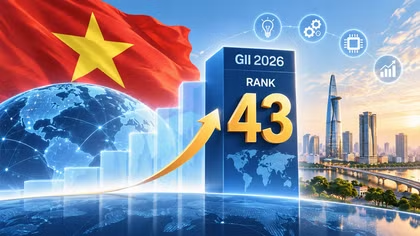
By 2030, Vietnam aims to rank among the world’s top 40 in the GII; raise total social investment in R&D to at least 2% of GDP, with non-State funding accounting for over 60%; increase international scientific publications by an average of 10% annually; and raise the number of patent applications and granted patents by an average of 16-18% annually.

The State Bank of Vietnam set the daily reference exchange rate at 25,624 VND/USD on October1, down 3 VND from the previous day.
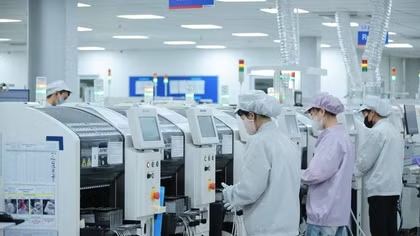
Quang Ninh's GRDP grew 15.04% in the third quarter, also leading the country.

Vietnam needs flexible incentives and specialised green financial instruments, stronger inter-sectoral coordination, improved local governance capacity and a more complete MRV data system, said Ramla Khalidi, Resident Representative of the United Nations Development Programme (UNDP) in Vietnam.
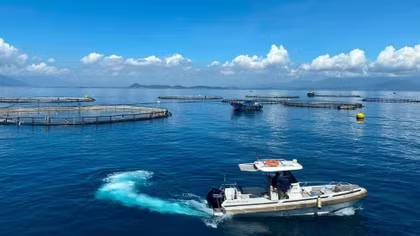
As the country enters a new development phase with greater demands for stronger marine-economy growth, institutional bottlenecks have emerged and need to be addressed.
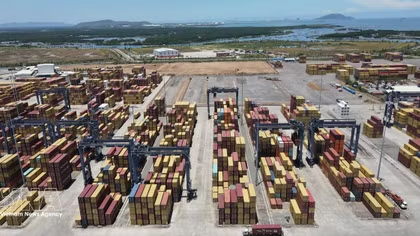
Experts from the Institute of Vietnam and World Economy under the Vietnam Academy of Social Sciences noted the quality of recent growth as the high growth rate has been recorded against an increasingly higher comparative base.

Vietnam's Halal exports remain modest at around 900 million USD a year, accounting for less than 1% of the global market. Most exports are still raw agricultural and seafood products. Only around 1,000–1,300 Vietnamese businesses obtained or maintained Halal certification during 2024–2026.
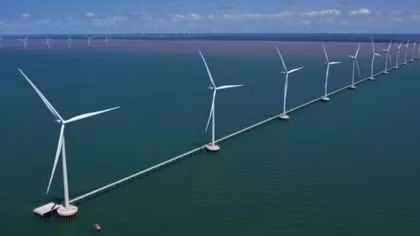
Vietnam needs a comprehensive policy framework to remove legal and procedural bottlenecks and create conditions for offshore wind power projects to access long-term investment capital, helping to unlock the country’s substantial offshore wind potential, said insiders.
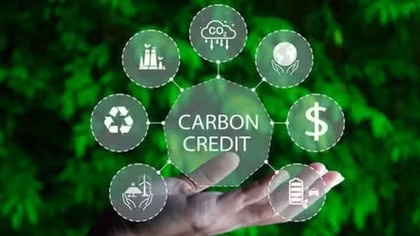
Under a decision of the municipal People’s Committee on establishing an inter-agency working group, departments and agencies are responsible for identifying facilities subject to greenhouse gas inventories, developing emissions-reduction plans and studying projects capable of generating carbon credits.
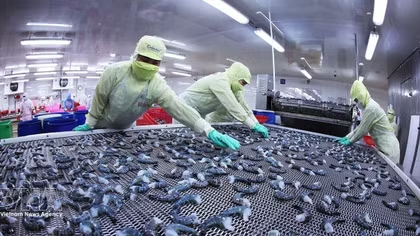
According to data from the Vietnam Customs cited by the Vietnam Association of Seafood Exporters and Producers (VASEP), shrimp exports reached 478.5 million USD in August, up 4.2% from the same month last year. The eight-month total stood at 3.3 billion USD, representing a year-on-year increase of 12%.

Vietnam is seen as a potential market, with considerable room for growth in real estate, particularly commercial property, compared with some regional markets. Strong Vietnam-Russia ties and opportunities to establish foreign-invested enterprises are also considered favourable for Russian investors.

For 2021-2030, the Civil Aviation Authority of Vietnam proposed bringing forward the investment in a parallel taxiway system and a connecting taxiway north of Runway No. 2 at Phu Quoc International Airport, in order to connect with the aircraft maintenance and repair facility (hangar) planned for the northern area of the airport.

For LNG-fired power to fulfill its role in Vietnam’s energy transition, bottlenecks in institutions, infrastructure, electricity pricing, PPAs, power dispatch and financing must be addressed together.
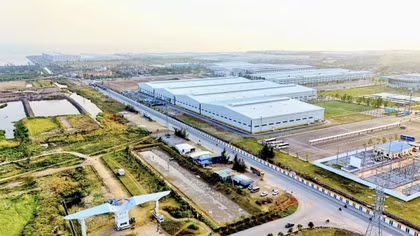
From policy and infrastructure to industrial real estate, Vietnam’s FDI advantages are broadening towards a more integrated production ecosystem, offering investors a stronger combination of conditions for high-value, technology-intensive and long-term projects.
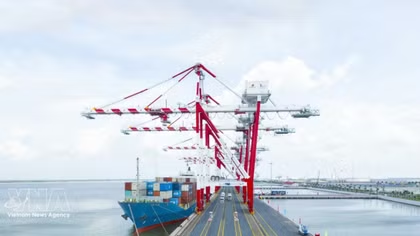
As trade expands, systemic bottlenecks across transport networks, warehousing, ports, border gates, and industrial zones are becoming more apparent. Experts emphasise the need to shift from a fragmented, project-by-project approach toward strategic management structured around trade corridors and integrated supply chains.

The company will buy non-performing loans from credit institutions and foreign bank branches, recover and dispose of debts and collateral, restructure loans and support lenders in resolving bad debts.
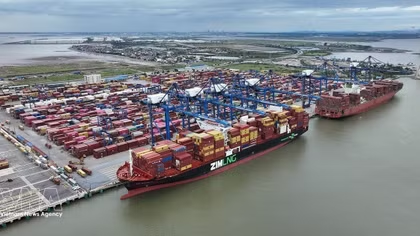
Do Ngoc Hung, Trade Counsellor and head of the Vietnam Trade Office in the US, said what stands out is not only the growth in trade volume but also the increasingly deep economic ties between the two countries.
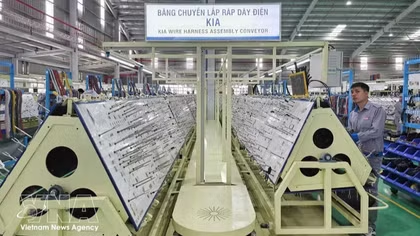
According to the Ministry of Finance, State budget revenue in the first eight months of 2026 was estimated at 2.02 quadrillion VND (77.7 billion USD), equivalent to 80% of the annual estimate and up 16% year-on-year. Domestic revenue reached 1.75 quadrillion VND, accounting for 86.6% of total revenue and rising 16.6%.
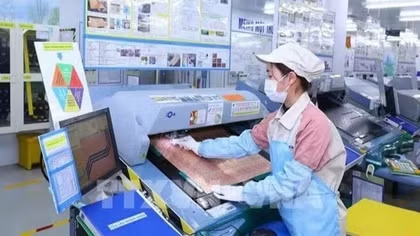
Hanoi aims to achieve average annual export growth of at least 12% during 2026-30, with the city seeking to diversify export markets, boost high-tech and value-added products and reduce reliance on traditional markets.
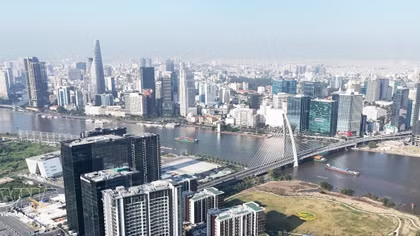
Great reliance on the state budget and conventional bank lending could put considerable pressure on the financial system, making it necessary to develop new and sustainable sources of funding from both domestic and international capital markets.