Training skillful workers is of utmost importance: Deputy PM

Vocational training must be at the center of the labor, invalids, and social affairs sector’s focus in order to meet the demands for high-quality human resources in the country, Deputy Prime Minister Vu Duc Dam has said.
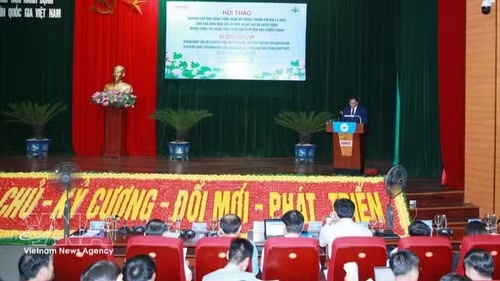
Deputy Prime Minister Vu Duc Dam speaks at the teleconference. (Photo: VNA)

Deputy Prime Minister Vu Duc Dam speaks at the teleconference. (Photo: VNA)

“Vietnamese laborers must be well-prepared so that they are able to work in more complex industries and earn higher incomes”, Deputy PM Dam underlined while attending a teleconference to launch tasks of the Ministry of Labour, Invalids and Social Affairs (MoLISA) on January 18.

In particular, training highly skilled workers is an important step as Vietnam moves towards a more open and connected world following on from the Fourth Industrial Revolution, he added.

Together with human resources training, Dam noted that the sector should work to fulfill missions in 2019 as entrusted by the National Assembly and Government, including reducing the unemployment rate in urban area to under 4 percent, keeping the percentage of trained laborers at a minimum of 60-62 percent, and cutting the rate of impoverished households by 1-1.5 percent (in line with the multi-dimensional poverty measurement method).

He also hailed the robust achievements attained by the sector in 2018, saying that they made significant contributions to completing the NA and Government’s 12 socio-economic criteria set for the year. 

Some 2.21 million people received vocational training in 2018, or 100.5 percent of the estimated figure. Nearly 1.65 million of them went on to obtain jobs within the year, of which over 1.5 million were recruited in domestic firms, and more than 141,000 worked overseas, the highest figure recorded.

Thanks to the sector’s efforts to expand social insurance coverage, some 14.7 million people joined the scheme, accounting for 30.4 percent of the workforce in the country.

It is estimated that 99 percent of the families who had rendered their services to the nation had a higher or equal living standard as compared to the average of their residential areas, all social policy beneficiaries received monthly allowance, 83 percent of people with disabilities received rehabilitation treatment, and 88 percent of children with special circumstances received support.

Regarding the poverty rate, the average figure in the country was 5.35 percent by the end of 2018, 1.35 percent lower than the same period in 2017.

Joining the nation’s efforts to promote administrative reform, the ministry cut 60 out of 107 business conditions, and reduced and simplified 19 out of 31 products that were subject to specialized inspection.

Participants at the event pointed out some limitations of the ministry, including the weak connection between supply and demand, the poor quality of vocational training in some training centers, an unsustainable poverty alleviation program, and public concern over social insurance frauds that caused social anxiety.


VNA

Other News

Hanoi ready to implement Capital Law 2026, unlocking new development momentum

Hanoi ready to implement Capital Law 2026, unlocking new development momentum

The effectiveness of the Capital Law 2026 will be measured not by the number of legal documents issued but by tangible improvements in governance and public administration, better services for people and businesses, faster administrative procedures, stronger investment attraction and higher economic growth.

Vietnamese students earn honours at ROBOG Asia Cup 2026

Vietnamese students earn honours at ROBOG Asia Cup 2026

Three teams from Chu Van An Secondary School in Vietnam’s Thai Nguyen province have earned First Prize honours and advanced to the quarterfinals at the ROBOG Asia Cup 2026, a regional robotics and artificial intelligence (AI) competition for students held in Hong Kong, China.

Hanoi sets out new investment blueprint with century-long development vision

Hanoi sets out new investment blueprint with century-long development vision

As of early June, Hanoi had attracted 74.6 billion USD in foreign direct investment (FDI) through more than 9,250 valid projects. FDI inflows in the first six months were projected at 3.2 billion USD, surpassing the annual target by 116%, while nearly 16,000 new businesses were established in the first five months, up 34.4% year-on-year.

Vietnam promotes legal cooperation and rule of law at global forum

Vietnam promotes legal cooperation and rule of law at global forum

Vietnam’s development and international integration have gone hand in hand with the improvement of its legal system, the incorporation of international commitments into domestic legislation, and legal reforms aimed at fostering development, openness and global integration. The country regards international law as an essential instrument for building fair, mutually beneficial relations among nations.

Hanoi to hold investment promotion event on June 29

Hanoi to hold investment promotion event on June 29

At the event, Hanoi authorities plan to grant investment policy decisions and investment registration certificates to 20 exemplary projects in the fields of transportation infrastructure, industrial parks, urban development, social housing, environment, science and technology, and foreign investment attraction.

Hanoi's Red River urban area development draws widespread attention

Hanoi's Red River urban area development draws widespread attention

Located south of the Red River and extending from the historic inner city to newly developing areas in the south and the west, the central urban area along Red River’s right bank covers approximately 45,317 hectares and is projected to accommodate around 6.365 million residents by 2045 and 6.455 million by 2065.

Hanoi's Red River urban area development draws widespread attention

Hanoi's Red River urban area development draws widespread attention

Located south of the Red River and extending from the historic inner city to newly developing areas in the south and the west, the central urban area along Red River’s right bank covers approximately 45,317 hectares and is projected to accommodate around 6.365 million residents by 2045 and 6.455 million by 2065.

Regional cooperation strengthened to combat cross-border drug crime

Regional cooperation strengthened to combat cross-border drug crime

Vietnam, China, Laos and Myanmar face common challenges as drug syndicates increasingly exploit the Mekong River, cross-border transport networks, e-commerce platforms, international logistics services, cyberspace and cryptocurrencies to organise drug transactions and smuggling operations.