At the close of their second summit in Hanoi on Wednesday and Thursday, the leaders are expected to adopt a declaration that many anticipate will put their countries' checkered relationship on an uncharted yet promising trajectory.
The focus of this week's meeting will be how to flesh out the vague agreement that Trump and Kim signed in their historic first meeting in Singapore last June.
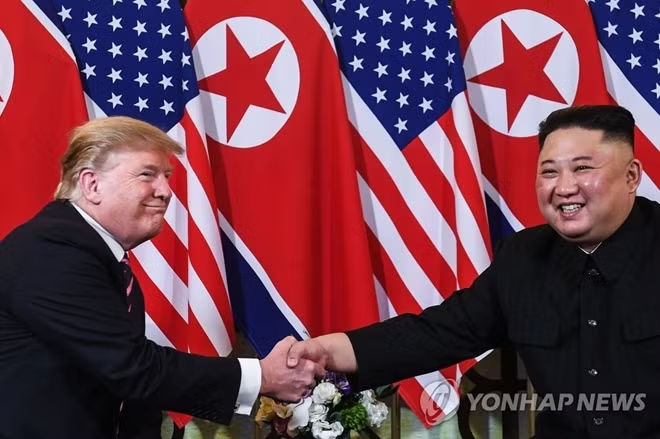 |
| North Korean leader Kim Jong-un (R) shaking hands with U.S. President Donald Trump at a Hanoi hotel on Feb. 27, 2019. (Yonhap) |
At the Singapore talks, they agreed to work toward the "complete denuclearization" of the Korean Peninsula, establish "new" bilateral relations and make joint efforts to build a "lasting and stable peace regime" on the divided peninsula.
Central to the Hanoi declaration are likely to be specifics on how Pyongyang and Washington can make progress on the denuclearization front.
Speculation has been growing that the North's pledge to freeze or dismantle key facilities of its mainstay Yongbyon nuclear complex -- or forgo its "future" nuclear arms -- could make it into the declaration.
Pyongyang could also agree to a declaration of its nuclear facilities or fissile materials -- a U.S. demand that it balked at on the grounds that it would be tantamount to turning in a list of targets for attacks on North Korea.
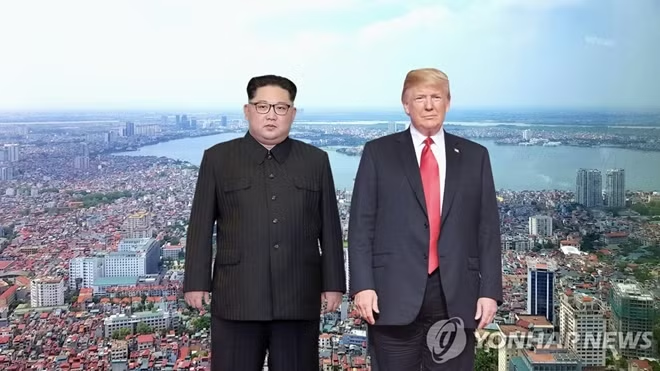 |
| This image, provided by Yonhap News TV, shows U.S. President Donald Trump (R) and North Korean leader Kim Jong-un. (Yonhap) |
Citing three sources familiar with the nuclear talks, the U.S.-based media outlet Vox reported that the North tentatively agreed to stop producing materials for nuclear bombs at the Yongbyon complex. In return, the U.S. agreed to offer partial sanctions relief so that inter-Korean economic projects can move forward, the report said.
In his New Year's Day address, the North's leader called for resuming long-stalled tours to Mount Kumgang on the North's east coast and reopening the now-shuttered joint industrial complex in the North's border city of Kaesong.
Moon Chung-in, special foreign policy adviser for South Korean President Moon Jae-in, said Tuesday that if Pyongyang agrees to permanently dismantle the Yongbyon complex, it would "sufficiently" deserve the partial lifting of sanctions.
"(Washington) may well give (partial sanctions relief) if (the North) permanently dismantles the Yongbyon complex ... because it is the first step towards an irreversible (denuclearization) phase," Moon told reporters after a forum in Washington, D.C.
But he said full-scale sanctions relief may be "difficult."
Other U.S. concessions may include increased humanitarian aid and an easing of restrictions on its citizens' travel to the North.
On the "new relations" part, the Hanoi declaration could include an agreement to install a U.S. liaison office in Pyongyang and a North Korean one in Washington. The establishment of such offices is seen as an initial process toward normalizing bilateral ties.
As for the peace regime segment, Vox reported that the two countries tentatively agreed to sign a peace declaration to symbolically end the 1950-53 Korean War. The Cold War conflict ended in an Armistice Agreement rather than a peace treaty.
Earlier this week, South Korea's presidential office Cheong Wa Dae raised the possibility of Trump and Kim declaring an end to the war under a bilateral deal.
Instead of a peace declaration, Trump and Kim could also agree to launch multilateral consultations for a peace treaty to replace the armistice.
As another concession, the North may agree to repatriate more remains of U.S. troops who died during the Korean War, according to Vox. Last year, the North returned the remains of 55 American service members.