 |
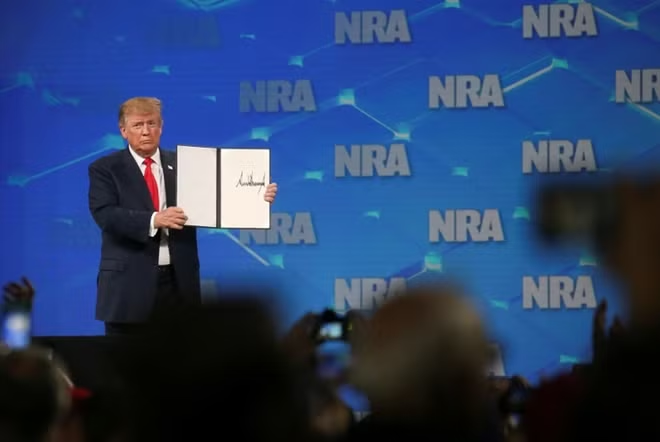
| U.S. President Donald Trump holds up an executive order with his signature as he announces that the United States will drop out of an international arms treaty during a speech at the National Rifle Association-Institute for Legislative Action's (NRA-ILA) 148th annual meeting in Indianapolis, Indiana, U.S., April 26, 2019. REUTERS |
Trump told members of the gun lobby at an annual meeting he intends to revoke the status of the United States as a signatory to the Arms Trade Treaty, which was never ratified by the U.S. Senate.
“We’re taking our signature back,” Trump said to thousands of cheering attendees, many wearing red hats emblazoned with the Republican president’s “Make America Great Again” slogan.
On Twitter, Trump called the decision a defense of “American sovereignty.” In reversing the U.S. position on the pact, he wrote, “We will never allow foreign bureaucrats to trample on your Second Amendment freedoms.”
The NRA has long opposed the treaty, which regulates the $70 billion business in conventional arms and seeks to keep weapons out of the hands of human rights abusers. The lobbying group argues it would undermine domestic gun rights, a view the Obama administration rejected.
The agreement covers weapons exports, ranging from small firearms to tanks, but not domestic sales.
Trump said the United Nations would soon receive formal notice of the withdrawal.
U.N. spokesman Stephane Dujarric called the treaty “a landmark achievement in the efforts to ensure responsibility in international arms transfers.” U.N. officials said they were unaware Trump had been planning to revoke the U.S. signature.
The NRA spent $30.3 million in support of Trump’s 2016 presidential campaign, according to the Center for Responsive Politics, a group that tracks campaign spending.
The 193-nation U.N. General Assembly overwhelmingly approved the pact in April 2013 and the United States, the world’s No. 1 arms exporter, voted in favor of it despite fierce opposition from the NRA.
Dropping out of the treaty is part of a broader Trump administration overhaul of arms export policies to bolster a domestic industry that already dominates global weapons trade.
Trump’s action drew an immediate rebuke from international human rights groups.
“The United States will now lock arms with Iran, North Korea and Syria as non-signatories to this historic treaty whose sole purpose is to protect innocent people from deadly weapons,” said Oxfam America President Abby Maxman.
So far 101 countries have formally joined onto the treaty. Another 29, including the United States, signed it, but have not yet formally joined.
Ted Bromund, senior research fellow at the conservative Heritage Foundation, said the treaty “can only have the perverse effects of driving potential importers to buy from China or Russia” and other nations that are not party to the agreement.
Rachel Stohl, director of the conventional defense program at the Stimson Center think-tank in Washington, said U.S. firearms makers could benefit, including Smith & Wesson owner American Outdoor Brands Corp, Sturm Ruger and Vista Outdoor, as well as Remington Outdoor Co, which owns Bushmaster, a brand of AR-15 assault rifle.
Trump was joined on his trip to the NRA’s meeting in Indianapolis by White House national security adviser John Bolton, an advocate of withdrawing the United States from international treaties out of concern they might undermine U.S. authority.
With Friday’s announcement, Trump continued his drive to roll back Obama-era initiatives.
Nearly two years ago, Trump announced that the United States would withdraw from the Paris Climate Agreement, which aims to reduce global carbon emissions that scientists link to harmful climate change. Republicans argue the U.S. economy would suffer if it met the deal’s carbon-reduction goals.
In May, 2018, Trump pulled the United States out of a 2015 international deal that eased sanctions on Iran in exchange for strict limits being placed on Iran’s nuclear activities. The United States has since reimposed some sanctions that had been suspended under the deal.
Friday’s speech marked the third consecutive year Trump has spoken to the annual meeting of the NRA. Since his election, he has been a vocal proponent of gun rights, a position that plays well with his political base.
Trump banned “bump stocks” - rapid-fire gun attachments used in the October 2017 mass shooting that killed 58 people at a country music festival in Las Vegas. But he has sidestepped tough restrictions he considered after the February 2018 shooting at a high school in Parkland, Florida, in which 17 people were killed and embraced an NRA proposal for arming teachers to defend schools.