Trump says U.S. to exit nuclear treaty, Russia warns of retaliation

President Donald Trump said Washington will exit the Cold-War era treaty that eliminated a class of nuclear weapons due to Russian violations, triggering a warning of retaliatory measures from Moscow.
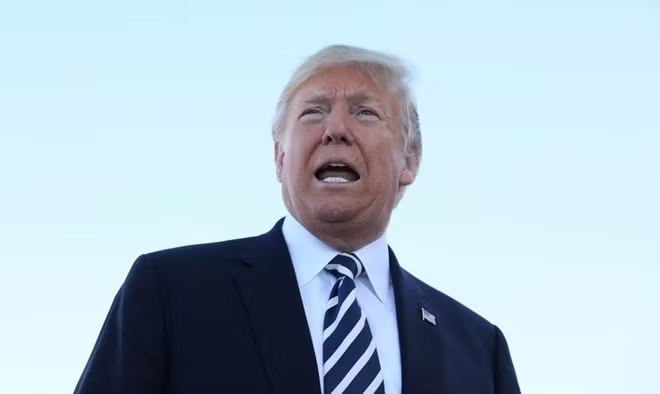
U.S. President Donald Trump speaks with reporters before departure from Elko Regional Airport in Elko, Nevada, U.S., October 20, 2018. REUTERS.

U.S. President Donald Trump speaks with reporters before departure from Elko Regional Airport in Elko, Nevada, U.S., October 20, 2018. REUTERS.

The Intermediate-Range Nuclear Forces Treaty, negotiated by then-President Ronald Reagan and Soviet leader Mikhail Gorbachev in 1987, required elimination of short-range and intermediate-range nuclear and conventional missiles by both countries.

“Russia has not, unfortunately, honored the agreement so we’re going to terminate the agreement and we’re going to pull out,” Trump told reporters on Saturday after a rally in Nevada.

Russian Deputy Foreign Minister Sergei Ryabkov said on Sunday that a unilateral U.S. withdrawal would be “very dangerous” and lead to a “military-technical” retaliation.

U.S. authorities believe Moscow is developing and has deployed a ground-launched system in breach of the INF treaty that could allow it to launch a nuclear strike on Europe at short notice. Russia has consistently denied any such violation.

Trump’s national security adviser, John Bolton, will visit Moscow next week.

Ryabkov, in comments reported by state-controlled RIA news agency, said if the United States withdrew, Russia would have no choice but to retaliate, including taking unspecified measures of a “military-technical nature”.

“But we would rather things did not get that far,” RIA quoted him as saying.

TASS news agency quoted him as saying withdrawal “would be a very dangerous step”, and it was Washington and not Moscow that was failing to comply with the treaty.

He said the Trump administration was using the treaty in an attempt to blackmail the Kremlin, putting global security at risk. “...We will, of course, accept no ultimatums or blackmail methods,” Interfax quoted him as saying.

British defense minister Gavin Williamson, in comments reported by the Financial Times, said London stood “resolute” behind Washington over the issue, and that the Kremlin was making a mockery of the agreement.
Reuters

Other News

Vietnam supports UNESCO's people-centred approach, multilateral cooperation: official

Vietnam supports UNESCO's people-centred approach, multilateral cooperation: official

Van affirmed Vietnam’s support for the UNESCO80 reform roadmap, focusing on the organisation’s core mandate, priority areas, interdisciplinary approach, and the special status of the Vietnam National Commission for UNESCO, and UNESCO representative offices, alongside efforts to diversify resources and strengthen global partnerships to enhance the organisation’s effectiveness.

Regional media highlight significant step in Vietnam’s leadership structure

Regional media highlight significant step in Vietnam’s leadership structure

Under General Secretary and President Lam’s leadership, Vietnam is expected to maintain a balanced foreign policy, strengthen its regional standing and accelerate economic development, thereby improving living standards and creating new opportunities for international investors, according to the India-based platform Devdiscourse.

Laos identifies 10 key tasks to build independent, self-reliant economy

Laos identifies 10 key tasks to build independent, self-reliant economy

Laos will step up agricultural production to ensure food security, meet domestic demand and expand exports; encourage the development of agro-processing industries, including those related to rubber, aquatic products, cassava and sugarcane, as well as fertiliser and animal feed production, in order to increase added value and create jobs in rural areas.

Malaysia steps up cyber security resilience

Malaysia steps up cyber security resilience

To ensure accountability, Malaysia plans to finalise the Cybercrime Bill this year which addresses both cyber-dependent and cyber-enabled offences, introducing stricter penalties and prison terms to enhance deterrence.

US public opinion positive about PM Pham Minh Chinh’s visit

US public opinion positive about PM Pham Minh Chinh’s visit

Public opinion in the US is generally positive about Vietnamese Prime Minister Pham Minh Chinh’s trip to the US from September 17-23 to attend the 78th session of the United Nations General Assembly, which took place immediately after the upgrading of the Vietnam - US relations to a comprehensive strategic partnership on the occasion of US President Joe Biden’s official visit to Vietnam.