Truong Sa lighthouses affirm Vietnam's sovereignty over seas and islands

In addition to ensuring maritime safety in the surrounding territorial waters, lighthouses on islands of Truong Sa (Spratly) archipelago in Truong Sa district of the south central province of Khanh Hoa, have also affirmed Vietnam's sovereignty over seas and islands.
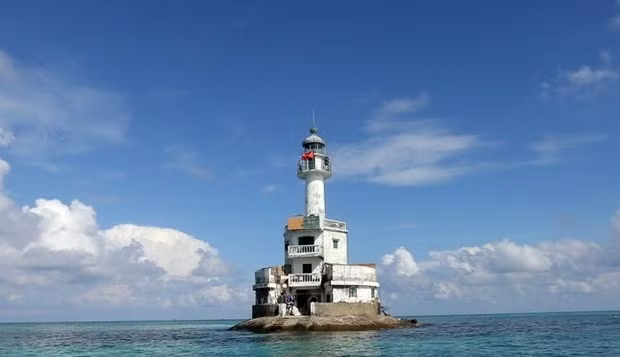
The lighthouse on Da Tay B Reef (Photo: VNA)

The lighthouse on Da Tay B Reef (Photo: VNA)

In addition to ensuring maritime safety in the surrounding territorial waters, lighthouses on islands of Truong Sa (Spratly) archipelago in Truong Sa district of the south central province of Khanh Hoa, have also affirmed Vietnam's sovereignty over seas and islands.

There are currently nine lighthouses on Truong Sa archipelago's islands, namely Son Ca, Nam Yet, Sinh Ton, Da Lat, Da Tay, An Bang, Song Tu Tay, Tien Nu and Truong Sa Lon.

Managed and operated by the East Sea and Islands Maritime Safety Company, the lighthouses are considered as "sovereignty markers" and diligently shine every night to assist and guide ships passing through the area.

The lighthouse on Song Tu Tay was the first to be built in Truong Sa archipelago in 1993.

According to Lieutenant Colonel Nguyen Xuan Truong, Vice Commander and Chief of Staff of Song Tu Tay island, the lighthouse has helped to ensure safe movements of vessels, asserted Vietnam's sovereignty over seas and islands and made it easier for rescue and search activities at sea.
 
Meanwhile, the lighthouse on Son Ca island was put into operation in August 2010. Head of the Son Ca lighthouse Tran Van Chien said that the lighthouse operates from 5:30pm to 5:30am on the next day.

In any circumstance, the lighthouse is not permitted to stop working as it is not only a guiding point for vessels in the surrounding waters but also the light of national sovereignty at sea, he said.

The lighthouses use electricity sourced from solar power and automatically turn on when it is dark, but there are standby power generators to ensure the lighthouses' operations in any circumstance, especially in prolonged storms or rains. The checking and maintenance of equipment of the lighthouses are conducted regularly.  

The lighthouses are not allowed to stop working – this is an order from the hearts of officials and staff at the lighthouses and naval soldiers on duty at sea and on islands.

Head of the lighthouse on Sinh Ton island Bui Van Son, who has 20 years of experience and 10 years working in lighthouses in Truong Sa island district, said that despite poor working and living conditions on the islands, he has managed to complete his missions with love and responsibility for Vietnam's sovereignty over its sky, seas and islands.

Lieutenant Colonel Nguyen Nhu Tuyen, Political Commissar of Son Ca island, said that officials and staff of the Son Ca lighthouse have actively engaged in drills on island protection, contributing to strengthening the combat readiness of the island.

The lighthouse operators in Truong Sa archipelago have worked hard day and night, devoting their youth to ensure that the lighthouses never stop working.

VNA

Other News

Hanoi ready to implement Capital Law 2026, unlocking new development momentum

Hanoi ready to implement Capital Law 2026, unlocking new development momentum

The effectiveness of the Capital Law 2026 will be measured not by the number of legal documents issued but by tangible improvements in governance and public administration, better services for people and businesses, faster administrative procedures, stronger investment attraction and higher economic growth.

Vietnamese students earn honours at ROBOG Asia Cup 2026

Vietnamese students earn honours at ROBOG Asia Cup 2026

Three teams from Chu Van An Secondary School in Vietnam’s Thai Nguyen province have earned First Prize honours and advanced to the quarterfinals at the ROBOG Asia Cup 2026, a regional robotics and artificial intelligence (AI) competition for students held in Hong Kong, China.

Hanoi sets out new investment blueprint with century-long development vision

Hanoi sets out new investment blueprint with century-long development vision

As of early June, Hanoi had attracted 74.6 billion USD in foreign direct investment (FDI) through more than 9,250 valid projects. FDI inflows in the first six months were projected at 3.2 billion USD, surpassing the annual target by 116%, while nearly 16,000 new businesses were established in the first five months, up 34.4% year-on-year.

Vietnam promotes legal cooperation and rule of law at global forum

Vietnam promotes legal cooperation and rule of law at global forum

Vietnam’s development and international integration have gone hand in hand with the improvement of its legal system, the incorporation of international commitments into domestic legislation, and legal reforms aimed at fostering development, openness and global integration. The country regards international law as an essential instrument for building fair, mutually beneficial relations among nations.

Hanoi to hold investment promotion event on June 29

Hanoi to hold investment promotion event on June 29

At the event, Hanoi authorities plan to grant investment policy decisions and investment registration certificates to 20 exemplary projects in the fields of transportation infrastructure, industrial parks, urban development, social housing, environment, science and technology, and foreign investment attraction.

Hanoi's Red River urban area development draws widespread attention

Hanoi's Red River urban area development draws widespread attention

Located south of the Red River and extending from the historic inner city to newly developing areas in the south and the west, the central urban area along Red River’s right bank covers approximately 45,317 hectares and is projected to accommodate around 6.365 million residents by 2045 and 6.455 million by 2065.

Hanoi's Red River urban area development draws widespread attention

Hanoi's Red River urban area development draws widespread attention

Located south of the Red River and extending from the historic inner city to newly developing areas in the south and the west, the central urban area along Red River’s right bank covers approximately 45,317 hectares and is projected to accommodate around 6.365 million residents by 2045 and 6.455 million by 2065.

Regional cooperation strengthened to combat cross-border drug crime

Regional cooperation strengthened to combat cross-border drug crime

Vietnam, China, Laos and Myanmar face common challenges as drug syndicates increasingly exploit the Mekong River, cross-border transport networks, e-commerce platforms, international logistics services, cyberspace and cryptocurrencies to organise drug transactions and smuggling operations.