Tsunami hits Japan after strong quake, nuclear plant briefly disrupted

A powerful earthquake rocked northern Japan on Tuesday, briefly disrupting cooling functions at a nuclear plant and generating a tsunami that hit the same region devastated by a massive quake, tsunami and nuclear disaster in 2011.

The earthquake, which was felt in Tokyo, had a magnitude of 7.4, the Japan Meteorological Service said, and was centered off the coast of Fukushima prefecture at a depth of about 10 km (6 miles).

There were no reports of deaths or serious injuries several hours after the quake hit at 5:59 a.m. (2059 GMT Monday).
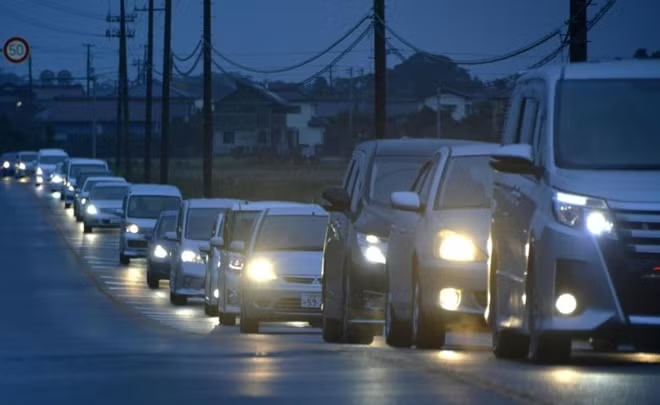
A traffic jam is seen as people evacuate after tsunami advisories were issued following an earthquake, in Iwaki, Fukushima prefecture, Japan, in this photo taken by Kyodo November 22, 2016. (Photo: Reuters)

A tsunami of up to 1.4 meters (4.5 feet) had been observed around Sendai, about 70 km (45 miles) north of Fukushima, with smaller waves hitting ports elsewhere along the coast, public broadcaster NHK said.

Television footage showed ships moving out to sea from harbors as tsunami warning signals wailed, after warnings of waves of up to 3 meters (10 feet) were issued.

"We saw high waves but nothing that went over the tidal barriers," a man in the city of Iwaki told NTV television network.

The Pacific Tsunami Warning Center in Hawaii said the tsunami threat had now largely passed.

"Sea level fluctuations may continue along some coasts of Japan over the next few hours," it said.

The U.S. Geological Survey measured Tuesday's quake at magnitude 6.9, down from an initial 7.3.

All Japan's nuclear power plants on the coast threatened by the tsunami are shut down in the wake of the March 2011 disaster, which knocked out Tokyo Electric Power Co's Fukushima Daiichi nuclear plant, spilling radiation into the air and sea.

A spokeswoman for Tokyo Electric Power, known as Tepco, said the cooling system for a storage pool for spent nuclear fuel at the reactor at its Fukushima Daini Plant had been halted. A spokesman said the cooling system had restarted soon after.

No other damage from the quake has been confirmed at any of its power plants, although there have been blackouts in some areas, the spokeswoman said.

Only two reactors are operating in Japan, both in the southwest. Even when in shutdown, nuclear plants need cooling systems operating to keep spent fuel cool.

Tohoku Electric Power Co said there was no damage to its Onagawa nuclear plant, while the Kyodo news agency reported there were no irregularities at the Tokai Daini nuclear plant in Ibaraki prefecture.


Reuters

Other News

Vietnam supports UNESCO's people-centred approach, multilateral cooperation: official

Vietnam supports UNESCO's people-centred approach, multilateral cooperation: official

Van affirmed Vietnam’s support for the UNESCO80 reform roadmap, focusing on the organisation’s core mandate, priority areas, interdisciplinary approach, and the special status of the Vietnam National Commission for UNESCO, and UNESCO representative offices, alongside efforts to diversify resources and strengthen global partnerships to enhance the organisation’s effectiveness.

Regional media highlight significant step in Vietnam’s leadership structure

Regional media highlight significant step in Vietnam’s leadership structure

Under General Secretary and President Lam’s leadership, Vietnam is expected to maintain a balanced foreign policy, strengthen its regional standing and accelerate economic development, thereby improving living standards and creating new opportunities for international investors, according to the India-based platform Devdiscourse.

Laos identifies 10 key tasks to build independent, self-reliant economy

Laos identifies 10 key tasks to build independent, self-reliant economy

Laos will step up agricultural production to ensure food security, meet domestic demand and expand exports; encourage the development of agro-processing industries, including those related to rubber, aquatic products, cassava and sugarcane, as well as fertiliser and animal feed production, in order to increase added value and create jobs in rural areas.

Malaysia steps up cyber security resilience

Malaysia steps up cyber security resilience

To ensure accountability, Malaysia plans to finalise the Cybercrime Bill this year which addresses both cyber-dependent and cyber-enabled offences, introducing stricter penalties and prison terms to enhance deterrence.

US public opinion positive about PM Pham Minh Chinh’s visit

US public opinion positive about PM Pham Minh Chinh’s visit

Public opinion in the US is generally positive about Vietnamese Prime Minister Pham Minh Chinh’s trip to the US from September 17-23 to attend the 78th session of the United Nations General Assembly, which took place immediately after the upgrading of the Vietnam - US relations to a comprehensive strategic partnership on the occasion of US President Joe Biden’s official visit to Vietnam.