- Russia accuses U.S. of pretending to fight Islamic State in Syria, Iraq
- White House accuses media of playing down inauguration crowds
- Trump accuses U.S. spy agencies of Nazi practices over 'phony' Russia dossier
- Iraq war veteran accused of killing five at Ft. Lauderdale airport
- U.S. accuses Russian spies of 2016 election hacking
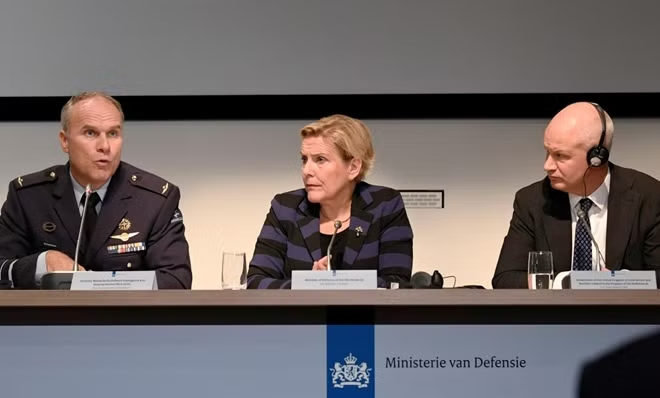 |
| Dutch Minister of Defence Ank Bijleveld, general Onno Eichelsheim, director of Netherlands Defence Intelligence and Security Service and British Ambassador to the Netherlands Peter Wilson attend a news conference in The Hague, Netherlands, October 4, 2018. REUTERS/Piroschka van de Wouw |
Moscow denied what its Foreign Ministry spokeswoman called a “diabolical perfume cocktail” of allegations by someone with a “rich imagination”. But the accusations will deepen Moscow’s isolation at a time when its diplomatic ties with the West have been downgraded over the poisoning of a spy in England and it is under U.S. and European sanctions over its actions in Ukraine.
Dutch authorities said they had disrupted an attempt to hack into the Hague-based Organization for the Prohibition of Chemical Weapons (OPCW) in April. At the time, the U.N. watchdog was investigating the poison used to attack an ex-spy in Britain and chemical weapons which the West says were used in Syria by Russia’s ally President Bashar al-Assad.
Dutch Defence Minister Ank Bijleveld called on Russia to cease its cyber activities aimed at “undermining” Western democracies.
According to a presentation by the head of the Netherlands’ military intelligence agency, four Russians arrived in the Netherlands on April 10 and were caught with spying equipment at a hotel located next to the OPCW headquarters.
The four Russians in the Netherlands were detained on April 13 and expelled to Russia, Dutch Major General Onno Eichelsheim said. They had planned to travel on to a laboratory in Spiez, Switzerland used by the OPCW to analyze samples, he said.
Russian military intelligence “is active here in the Netherlands ... where a lot of international organizations are (based),” Eichelsheim said.
AGGRESSOR
Earlier on Thursday, Britain released an assessment based on work by its National Cyber Security Centre (NCSC), which cast Russia’s GRU military intelligence agency as a cyber aggressor which used a network of hackers to sow worldwide discord.
The GRU, Britain said, was almost certainly behind the BadRabbit and World Anti-Doping Agency attacks of 2017, the hack of the U.S. Democratic National Committee (DNC) in 2016 and the theft of emails from a UK-based TV station in 2015.
“The GRU’s actions are reckless and indiscriminate: they try to undermine and interfere in elections in other countries,” said British Foreign Secretary Jeremy Hunt.
“Our message is clear - together with our allies, we will expose and respond to the GRU’s attempts to undermine international stability,” Hunt said.
The GRU, now officially known in Russia by a shorter acronym GU, is also the agency Britain has blamed in the past for sending two agents to England to poison former spy Sergei Skripal with a chemical weapon sprayed in his door.
Skripal, his daughter and a police officer fell seriously ill; a woman later died after her partner found the poison in a discarded perfume bottle. Russia says the two men Britain blames for the attack were tourists who twice visited Skripal’s home town during a weekend trip to England, a story Britain says is so far-fetched as to prove Moscow’s culpability.
After the Skripal poisoning, dozens of Western countries launched the biggest expulsion of Russian spies working under diplomatic cover since the height of the Cold War. Moscow replied with tit-for-tat expulsions of Westerners.
Russian President Vladimir Putin, himself a former KGB spy, said on Wednesday that Skripal, a GRU officer who betrayed dozens of agents to Britain’s MI6 foreign spy service, was a “scumbag” who had betrayed Russia.
Britain said the GRU was associated with a host of hackers including APT 28, Fancy Bear, Sofacy, Pawnstorm, Sednit, CyberCaliphate, Cyber Berkut, Voodoo Bear and BlackEnergy Actors.
“This pattern of behavior demonstrates their desire to operate without regard to international law or established norms and to do so with a feeling of impunity and without consequences,” Hunt said.
The United States sanctioned GRU officers including its chief, Igor Korobov, in 2016 and 2018 for attempted interference in the 2016 U.S. election and cyber attacks.
Australia and New Zealand backed the United Kingdom’s findings on the GRU.
“Cyberspace is not the Wild West. The International Community – including Russia – has agreed that international law and norms of responsible state behavior apply in cyberspace,” Australia’s Prime Minister Scott Morrison said.
“By embarking on a pattern of malicious cyber behavior, Russia has shown a total disregard for the agreements it helped to negotiate,” Morrison said.