Johnson, who tested positive nearly two weeks ago, was admitted to St Thomas’ hospital on Sunday evening with a persistent high temperature and cough but his condition deteriorated and he was rushed into an intensive care unit.
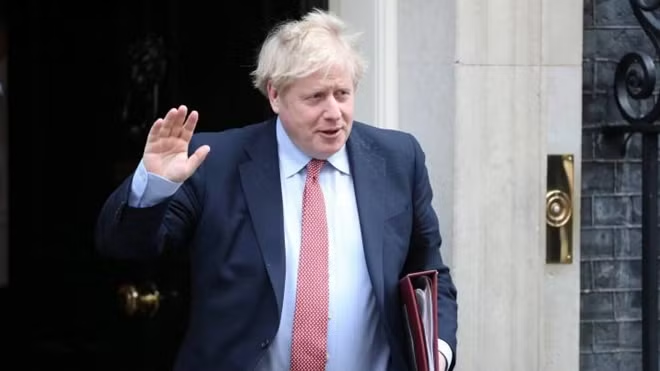 |
| British Prime Minister Boris Johnson |
The 55-year-old British leader has received oxygen support but was not put on a ventilator and his designated deputy, Foreign Secretary Dominic Raab, said he would soon be back at the helm as the world faces one of its gravest public health crisis in a century.
“He is comfortable, he’s stable, he’s in good spirits,” Edward Argar, a junior health minister, said on Wednesday. “While he’s had oxygen, he hasn’t been on a ventilator.
As Johnson battled the novel coronavirus in hospital, the United Kingdom was entering what scientists said was the deadliest phase of the outbreak and grappling with the question of when to lift the lockdown.
Inside the government, ministers were debating how long the world’s fifth-largest economy could afford to be shut down, and the long-term implications of one of the most stringent set of emergency controls in peacetime history.
The United Kingdom’s total hospital deaths from COVID-19 rose by a record 786 to 6,159 as of 1600 GMT on April 6, the latest publicly available death toll, though just 213,181 people out of the population of around 68 million have been tested.
Britain was in no position to lift the shutdown as the peak of the outbreak was still over a week away, London Mayor Sadiq Khan said.
“We are nowhere near lifting the lockdown,” Khan said.
ACTING PM RAAB?
Johnson was breathing without any assistance and had not required respiratory support, said Raab, who said the prime minister, whom he described as “a fighter”, remained in charge.
There are few precedents in British history of a prime minister being incapacitated at a time of major crisis, though Winston Churchill suffered a stroke while in office in 1953 and Tony Blair twice underwent heart treatment in the 2000s.
Johnson has delegated some authority to Raab, who was appointed foreign minister less than a year ago, though any major decisions - such as when to lift the lockdown - would in effect need the blessing of Johnson’s cabinet.
Britain’s uncodified constitution - an unwieldy collection of sometimes ancient and contradictory precedents - offers no clear, formal “Plan B”. In essence, it is the prime minister’s call and, if he is incapacitated, then up to cabinet to decide.
Raab said ministers had “very clear directions, very clear instructions” from Johnson but it was not clear what would happen if crucial decisions needed to be made which strayed from the approved plan.
Michael Heseltine, who served as deputy prime minister to John Major in the 1990s, told the Telegraph Raab’s position needed to be clarified.
Former Foreign Secretary Malcolm Rifkind said most major decisions over the coronavirus strategy had been taken with the important exception of whether or not to ease the lockdown, a call that will need to be made in the next week or soon after.
“That is not just a medical judgement. It has to be a balance between the medical considerations and the consequences of leaving the whole economy shut down,” Rifkind told BBC TV.