- North Korea says new nuclear-capable missile test successful
- North Korea fires unidentified projectile into sea: South Korea military
- North Korea Works on New Long Endurance Drones
- Nuclear weapons – the strategic card of North Korea
Pyongyang's ballistic missile firing on Sunday was its first direct challenge to the international community since U.S. President Donald Trump took office on Jan. 20.
At a news conference on Monday, Trump said: "Obviously North Korea is a big, big problem and we will deal with that very strongly."
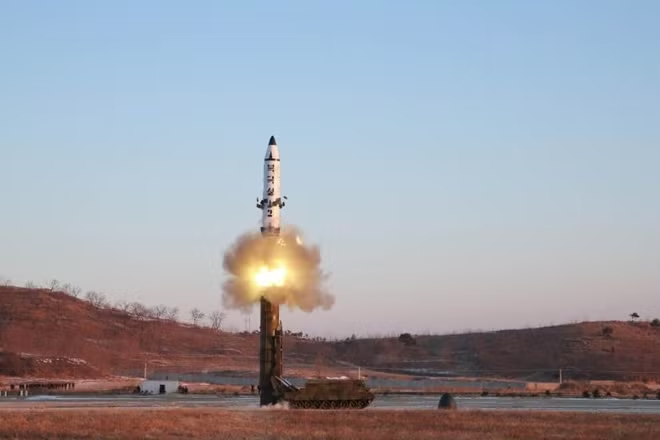 |
| A view of the test-fire of Pukguksong-2 guided by North Korean leader Kim Jong Un, in this undated photo released by North Korea's Korean Central News Agency. KCNA/Handout via Reuters |
U.S., Japanese and South Korean military officials held a teleconference on Monday in which they condemned the launch as "a clear violation" of multiple Security Council resolutions. The United States "reaffirmed its ironclad security commitments" to South Korea and Japan, the Pentagon said.
The Security Council did not specify what steps might be taken beyond the U.N.-sponsored sanctions regime imposed on North Korea since 2006 over its nuclear and ballistic missile tests.
"The members of the Security Council deplore all the Democratic People’s Republic of Korea ballistic missile activities, including these launches," the council said in a statement that also referred to North Korea's missile launch on Oct. 19.
The statement "called upon all member states to redouble their efforts to implement fully the measures imposed on the Democratic People’s Republic of Korea by the Security Council."
Japan, which called for the emergency meeting of the Security Council along with the United States and South Korea, said it was pleased with the council's resolve in discussing North Korea's latest missile firing.
"There was unanimity in condemning the launch and an expression of concern about the situation," said Koro Bessho, the Japanese ambassador to the world body. "Obviously we have to implement the very robust strong resolution that we already have. That is a starting point."
In December, the Security Council adopted a resolution in response to North Korea's nuclear test in September. The resolution aimed to slash North Korea's exports of coal and other metal exports, designed to cost it $800 million a year.
The U.S. ambassador to the United Nations, Nikki Haley, had tough words for North Korea after the Security Council meeting on Monday.
"It is time to hold North Korea accountable – not with our words, but with our actions,” Haley said in a statement.
STRATEGIC ASSETS
Late on Monday, the South Korean Defense Ministry said the United States and South Korea would deploy U.S. strategic assets during their annual joint exercise - in what appeared to be a response to the missile launch.
Japanese Prime Minister Shinzo Abe said on Monday that he expected the Trump administration would adopt a tougher stance against North Korea.
"I believe that the stance of the United States towards North Korea will become much tougher, that is clear," Abe said on a NHK public broadcasting news program after returning from meetings with Trump in the United States.
North Korea has said any sanctions against its missile or nuclear programs are a violation of its sovereignty and right to self-defense.
North and South Korea are technically still at war because their 1950-1953 conflict ended in a truce, not a peace treaty. The North regularly threatens to destroy the South and the South's main ally, the United States.