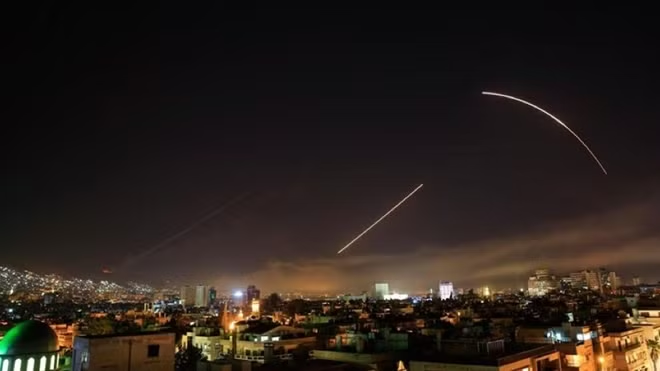
U.S. President Donald Trump announced the military action from the White House. As he spoke, explosions rocked Damascus.
British Prime Minister Theresa May and French President Emmanuel Macron said their forces had joined in the attack.
With more than 100 missiles fired from ships and manned aircraft, the allies struck three of Syria’s main chemical weapons facilities, U.S. Defense Secretary Jim Mattis and Joint Chiefs of Staff Chairman General Joseph Dunford said.
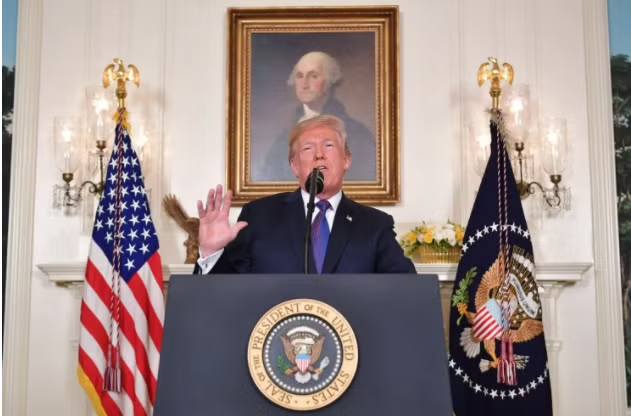 |
| U.S. President Donald Trump announcing the military action from the White House. Photo: Getty |
Mattis called the strikes a “one time shot,” but Trump raised the prospect of further strikes if Assad’s government again uses chemical weapons.
“We are prepared to sustain this response until the Syrian regime stops its use of prohibited chemical agents,” the U.S. president said in a televised address.
The Syrian conflict pits a complex myriad of parties against each other with Russia and Iran giving Assad military and political help while fractured opposition forces have had varying levels of support at different times from the West, Arab states and Turkey.
The strikes risked raising tension in an already combustible region but appeared designed not to trigger a military response from Russia and Iran.
 |
Nevertheless, Assad’s government and Russia both responded angrily.
“Again, we are being threatened. We warned that such actions will not be left without consequences,” Anatomy Anton, Russia’s ambassador to the United States, said on Twitter.
Syrian state media said the attack would fail and called it a “flagrant violation of international law.”
It was unclear if the strikes will deter Assad from again using chemical weapons.
They seemed unlikely to have much impact on the balance of power in Syria’s seven-year-old civil war, in which Assad’s government has steadily gained the upper hand against armed opponents since Russia intervened in 2015.
Trump had tough words for Assad and his suspected role in last week’s chemical weapons attack. “These are not the actions of a man. They are crimes of a monster,” he said.
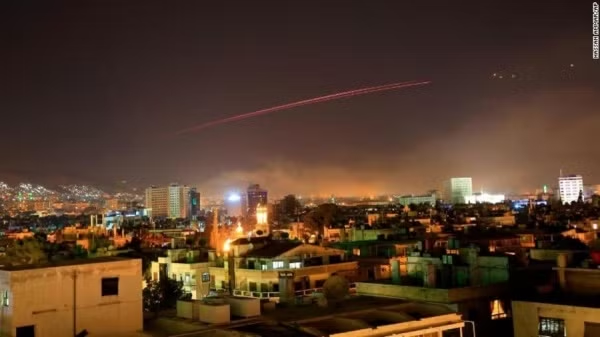 |
At least six loud explosions were heard in Damascus and smoke was seen rising over the city, a Reuters witness said. A second witness said the Barzah district of Damascus had been hit in the strikes. Barzah is the location of a major Syrian scientific research center.
A senior official in a regional alliance that backs Damascus told Reuters that said the Syrian government and its allies had “absorbed” the attack, and that targeted sites were evacuated days ago thanks to a warning from Russia.
State-controlled Syrian TV said Syrian air defenses shot down 13 missiles fired in the U.S.-led attack. The Russian defense ministry said none of the rockets launched had entered zones where Russian air defense systems are protecting facilities in Tartus and Hmeimim.
The combined U.S., British and French assault appeared to be more intense than a similar strike Trump ordered almost exactly a year ago against a Syrian air base in retaliation for an earlier chemical weapons attack that Washington attributed to Assad.
The targets included a Syrian center in the greater Damascus area for the research, development, production and testing of chemical and biological weaponry as well as a chemical weapons storage facility near the city of Homs. A third target, also near Homs, contained both a chemical weapons equipment storage facility and a command post.
At a Pentagon briefing, Dunford said the air strikes on Saturday were planned to minimize the risk of casualties among Russia’s forces in Syria.
Mattis acknowledged that the United States conducted the air strikes only with conclusive evidence that chlorine gas was used in the April 7 attack in Syria. Evidence that the nerve agent sarin also was used is inconclusive, he said.
Allegations of Assad’s chlorine use are frequent in Syria’s conflict, raising questions about whether Washington had lowered the threshold for military action in Syria by now deciding to strike after a chlorine gas attack.
Mattis, who U.S. officials said had earlier warned in internal debates that too large an attack would risk confrontation with Russia, described the strikes as a one-off to dissuade Assad from “doing this again.”
But a U.S. official familiar with the military planning said there could be more air strikes if the intelligence indicates that Assad has not stopped manufacturing, importing, storing or using chemical weapons, including weaponized chlorine.
The official acknowledged that could require a more sustained U.S. air and naval presence in the region, as well as intensified satellite and other surveillance of Syria.