- Climate change action 'unstoppable' despite Trump: U.N.'s Ban
- Trump will get wake-up call when he takes office, Obama says
- 'Trump Thump' whacks bond market for $1 trillion loss
Corporate lobbying groups, some chief executives and pro-trade lawmakers also say they eventually even hope to persuade Trump that free-trade agreements can help grow the U.S. economy and create jobs.
For now, these groups are bracing for higher trade tensions with China and potential changes to the 22-year-old North American Free Trade agreement with Canada and Mexico.
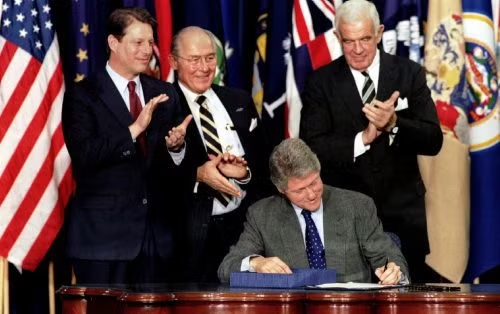 |
| President Clinton signing the North American Free Trade Agreement, December 1993. (Photo: Reuters) |
Trump has said he would quit NAFTA unless it is renegotiated to his satisfaction and that he would declare China a currency manipulator to force negotiations for better trade terms. His suggestions that his administration could impose 45 percent across-the-board tariffs on goods from China have drawn threats of retaliation by Chinese state media against U.S. soybeans and companies such as Boeing Co and Apple Inc.
"I think it's easy to paint this is a trade war versus nothing," said Scott Paul, president of the Alliance for American Manufacturing, a group representing steel and other basic industries that has argued in favor of tougher trade remedies to combat Chinese imports.
"I'm of the belief that there is a lot of space between our current policy and an all-out trade war," Paul said, adding that he would like to see Trump be more proactive on enforcing existing trade rules.
While U.S. steelmakers have been successful in anti-dumping and anti-subsidy cases against Chinese competitors that have led to substantial U.S. duties, consumer products makers often are reluctant to pursue such cases due to the cost, complexity and potential retaliation.
The Commerce Department under the Trump administration could launch more of investigations on its own of targeted U.S. industries, Paul said.
Paul and Business Roundtable President John Engler, who represents chief executive officers of the largest U.S. companies, said they would like to see Trump take steps to boost U.S. growth by reforming taxes and embark on a negotiating effort similar to that of Ronald Reagan in the 1980s to stem the tide of imports.
The 1985 Plaza Accord brought down the highflying dollar's value against currencies from Japan, Germany and other major trading partners, helping to quell protectionist sentiment in Congress and encouraging foreign producers to build more factories in the United States.
In renegotiating NAFTA, manufacturing groups had a clear message to the Trump team: first, do no harm to American exports.
"There are 2 million manufacturing jobs in this country that are dependent on our trade relationship with Canada and Mexico," said Linda Dempsey, vice president of international affairs for the National Association of Manufacturers. "And so as we go forward, we certainly don't want to put those jobs in jeopardy."
Ford Motor Co CEO Mark Fields said on Tuesday that the automaker would proceed with plans to shift production of its Focus small car to Mexico, a move that drew fire from Trump during the campaign.
"We've laid out our corporate strategy based on the trade agreements," Fields told CNBC, adding that a 35 percent tariff on imports from Mexico would hurt the entire U.S. auto industry.
"Obviously Congress and the president could always look at everything, but they have to keep in mind both the production and the supply chains are deeply integrated into the three countries and that integration also supports a lot of American jobs," Fields said.
In a message to employees after Trump's victory last week, General Electric Co CEO Jeff Immelt said: "We believe in the importance of globalization and investment."