US Presidential Election- A dramatic race

On November 8, more than 100 million American voters will cast their ballots to elect the 45th US President. This is the biggest political event of the year in the US. The race to the White House has been dramatic until its last minute.

The race to the While House has entered the last minutes with the two candidates renewing their attacks on their rivals. Over the past year, Republican candidate Donald Trump has spectacularly narrowed gap with his Democratic rival Hillary Clinton to become a candidate representing the Republic party and a redoubtable rival of Hillary Clinton in the US election. 
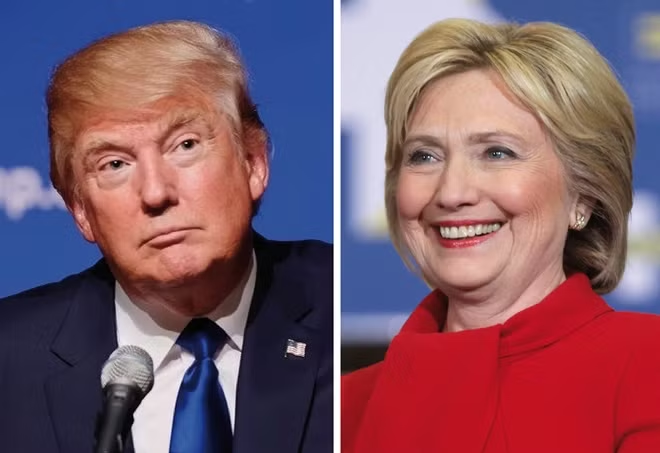
Donald Trump and Hilary Clinton.

But chances to realize his dream of becoming the US President have become fragile following Trump’s controversial arguments on women and sexual abuse allegations. The incident enabled Clinton to lead 9 points ahead of Trump in mid-October.

But, it has been not an easy race for Clinton, either, especially after the Federal Bureau of Investigation (FBI) decided to reopen investigations on her use of private emails. The consequences of FBI’s decision were huge. A poll by the ABC/Washington Post on November 1 showed 46% of potential voters supported the Republican candidate. From being left 12 points behind Clinton a week earlier, Trump has taken the fragile lead of 1 point ahead of Clinton.

Recent polls show that Donald Trump has narrowed gap with his rival and has the same rate of support with Clinton 45%/45%. But Clinton remains a more favorite candidate on betting websites with the bet at 4/11 compared to 2/11 for Trump.

But the US election system operates in a very different manner. The winning of a candidate doesn’t reflect the votes that he or she receives from the Congress’ members or support from the public. Each state among the 50 states in the US as well as Columbia have electors that each candidate needs to win votes from. 

Each of the states casts as many electoral votes as the total number of Senators and House of Representatives in Congress. Most states except for Maine and Nebraska establish a winner-take-all system wherein the ticket that wins a plurality of votes wins all of that state's allocated electoral votes. This means winning in populous states like California, New York, Texas, and Florida is very important.

Either Donald Trump or Hillary Clinton, who can win 270 electoral votes, will become the new US President.
VOV5

Other News

Vietnamese community in Venezuela backs rescue team on humanitarian mission

Vietnamese community in Venezuela backs rescue team on humanitarian mission

All members of the Vietnamese rescue team in Venezuela have maintained strict discipline, a strong sense of responsibility and unwavering focus when carrying out search, rescue and disaster recovery tasks, with the determination to successfully fulfil the international humanitarian mission entrusted by the Party, State and military.

Key issues ex high agenda at the ASEAN Future Forum 2026

Key issues ex high agenda at the ASEAN Future Forum 2026

PSNews - Nearly six decades after its founding, ASEAN is entering a new phase of transformation. Geopolitical turbulence, intensifying competition among major powers, non-traditional security challenges, and rapid technological change are raising fundamental questions about the region’s future trajectory. In this context, the ASEAN Future Forum (AFF) 2026 is more than a platform for regional countries to discuss current issues; it is designed to identify strategic pathways for ASEAN in the years ahead.

Malaysia bans social media accounts for children under 16

Malaysia bans social media accounts for children under 16

Under the new rules, social media platforms are required to implement age-verification systems and prevent users under 16 from creating accounts. The regulations apply to platforms with at least eight million users in Malaysia, including Facebook, Instagram, TikTok and YouTube.

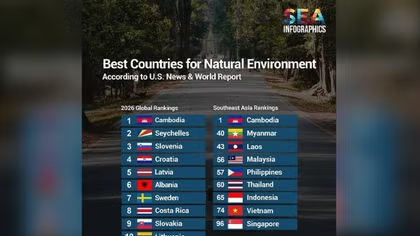
Cambodia ranked world's top country for natural environment in 2026

Cambodia ranked world's top country for natural environment in 2026

Cambodia currently manages 73 protected natural areas covering more than seven million hectares, equivalent to about 41% of the country’s total land area. These protected areas play a vital role in forest conservation, wildlife habitat protection and biodiversity preservation through stricter law enforcement and conservation measures.

ASEAN chief spotlights Vietnam’s role in shaping bloc’s future

ASEAN chief spotlights Vietnam’s role in shaping bloc’s future

Vietnam is expected to maintain active contributions across ASEAN’s three pillars - the political-security community, the economic community, and the socio-cultural community; while further enhancing regional connectivity through infrastructure projects and stronger economic linkages.

Vietnam supports UNESCO's people-centred approach, multilateral cooperation: official

Vietnam supports UNESCO's people-centred approach, multilateral cooperation: official

Van affirmed Vietnam’s support for the UNESCO80 reform roadmap, focusing on the organisation’s core mandate, priority areas, interdisciplinary approach, and the special status of the Vietnam National Commission for UNESCO, and UNESCO representative offices, alongside efforts to diversify resources and strengthen global partnerships to enhance the organisation’s effectiveness.

Regional media highlight significant step in Vietnam’s leadership structure

Regional media highlight significant step in Vietnam’s leadership structure

Under General Secretary and President Lam’s leadership, Vietnam is expected to maintain a balanced foreign policy, strengthen its regional standing and accelerate economic development, thereby improving living standards and creating new opportunities for international investors, according to the India-based platform Devdiscourse.

Laos identifies 10 key tasks to build independent, self-reliant economy

Laos identifies 10 key tasks to build independent, self-reliant economy

Laos will step up agricultural production to ensure food security, meet domestic demand and expand exports; encourage the development of agro-processing industries, including those related to rubber, aquatic products, cassava and sugarcane, as well as fertiliser and animal feed production, in order to increase added value and create jobs in rural areas.