U.S. to designate elite Iranian force as terrorist organization

The United States is expected to designate Iran’s elite Revolutionary Guards Corps a foreign terrorist organization, three U.S. officials told Reuters, marking the first time Washington has formally labeled another country’s military a terrorist group.

The decision, which critics warn could open U.S. military and intelligence officials to similar actions by unfriendly governments abroad, is expected to be announced by the U.S. State Department, perhaps as early as Monday, the officials said. It has been rumored for years.
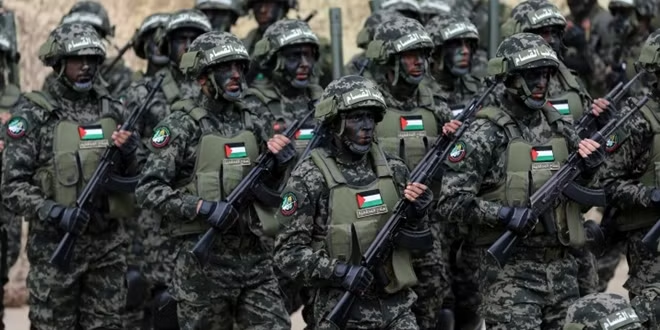
U.S. to designate elite Iranian force as terrorist organization.

The Pentagon declined comment and referred queries to the State Department. The State Department and White House also declined to comment.

The Iranian mission to the United Nations did not immediately respond to a request for comment.

U.S. Secretary of State Mike Pompeo, a strident Iran hawk, has advocated for the change in U.S. policy as part of the Trump administration’s tough posture toward Tehran.

The announcement would come ahead of the first anniversary of President Donald Trump’s decision to pull out of a 2015 nuclear deal with Tehran and to reimpose sanctions that had crippled Iran’s economy.

The administration’s decision to make the designation was first reported by the Wall Street Journal.

The United States has already blacklisted dozens of entities and people for affiliations with the IRGC, but the organization as a whole is not.

In 2007, the U.S. Treasury designated the IRGC’s Quds Force, its unit in charge of operations abroad, “for its support of terrorism,” and has described it as Iran’s “primary arm for executing its policy of supporting terrorist and insurgent groups.”

Iran has warned of a “crushing” response should the United States go ahead with the designation.

IRGC commander Mohammad Ali Jafari warned in 2017 that if Trump went ahead with the move “then the Revolutionary Guards will consider the American army to be like Islamic State all around the world.”

Such threats are particularly ominous for U.S. forces in places such as Iraq, where Iran-aligned Shi’ite militia are located in close proximity to U.S. troops.

Republican Senator Ben Sasse said the move would be an important step in America’s maximum pressure campaign against Tehran. “A formal designation and its consequences may be new, but these IRGC butchers have been terrorists for a long time,” Sasse said in a statement.

Former Under-Secretary of State and lead Iran negotiator, Wendy Sherman, said she worried about implications for U.S. forces.

“One might even suggest, since it’s hard to see why this is in our interest, if the president isn’t looking for a basis for a conflict,” said Sherman, who is director of the Center for Public Leadership at the Harvard Kennedy School. “The IRGC is already fully sanctioned and this escalation absolutely endangers our troops in the region.”

IRGC’S REACH

Set up after the 1979 Islamic Revolution to protect the Shi’ite clerical ruling system, the IRGC is Iran’s most powerful security organization.

The IRGC is in charge of Iran’s ballistic missiles and nuclear programs. Tehran has warned that it has missiles with a range of up to 2,000 km (1,242 miles), putting Israel and U.S. military bases in the region within reach.

The IRGC has an estimated 125,000-strong military with army, navy and air units and answers to Supreme Leader Ayatollah Ali Khamenei.

It is unclear what impact the U.S. designation of the IRGC as a terrorist organization might have on America’s activities in countries that have ties with Tehran, including in Iraq.

Baghdad has deep cultural and economic ties with Iran and Oman, where the United States recently clinched a strategic ports deal.
Reuters

Other News

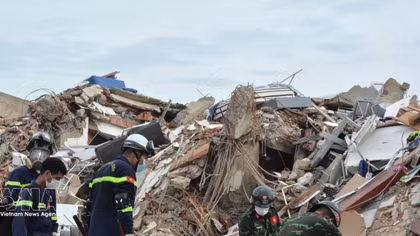
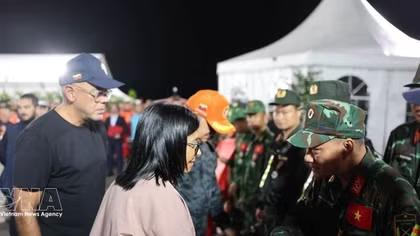
Vietnamese community in Venezuela backs rescue team on humanitarian mission

Vietnamese community in Venezuela backs rescue team on humanitarian mission

All members of the Vietnamese rescue team in Venezuela have maintained strict discipline, a strong sense of responsibility and unwavering focus when carrying out search, rescue and disaster recovery tasks, with the determination to successfully fulfil the international humanitarian mission entrusted by the Party, State and military.

Key issues ex high agenda at the ASEAN Future Forum 2026

Key issues ex high agenda at the ASEAN Future Forum 2026

PSNews - Nearly six decades after its founding, ASEAN is entering a new phase of transformation. Geopolitical turbulence, intensifying competition among major powers, non-traditional security challenges, and rapid technological change are raising fundamental questions about the region’s future trajectory. In this context, the ASEAN Future Forum (AFF) 2026 is more than a platform for regional countries to discuss current issues; it is designed to identify strategic pathways for ASEAN in the years ahead.

Malaysia bans social media accounts for children under 16

Malaysia bans social media accounts for children under 16

Under the new rules, social media platforms are required to implement age-verification systems and prevent users under 16 from creating accounts. The regulations apply to platforms with at least eight million users in Malaysia, including Facebook, Instagram, TikTok and YouTube.

Cambodia ranked world's top country for natural environment in 2026

Cambodia ranked world's top country for natural environment in 2026

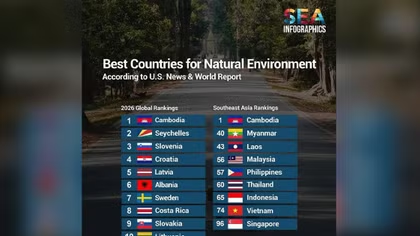
Cambodia currently manages 73 protected natural areas covering more than seven million hectares, equivalent to about 41% of the country’s total land area. These protected areas play a vital role in forest conservation, wildlife habitat protection and biodiversity preservation through stricter law enforcement and conservation measures.

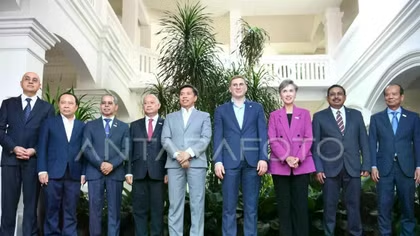
ASEAN chief spotlights Vietnam’s role in shaping bloc’s future

ASEAN chief spotlights Vietnam’s role in shaping bloc’s future

Vietnam is expected to maintain active contributions across ASEAN’s three pillars - the political-security community, the economic community, and the socio-cultural community; while further enhancing regional connectivity through infrastructure projects and stronger economic linkages.

Vietnam supports UNESCO's people-centred approach, multilateral cooperation: official

Vietnam supports UNESCO's people-centred approach, multilateral cooperation: official

Van affirmed Vietnam’s support for the UNESCO80 reform roadmap, focusing on the organisation’s core mandate, priority areas, interdisciplinary approach, and the special status of the Vietnam National Commission for UNESCO, and UNESCO representative offices, alongside efforts to diversify resources and strengthen global partnerships to enhance the organisation’s effectiveness.

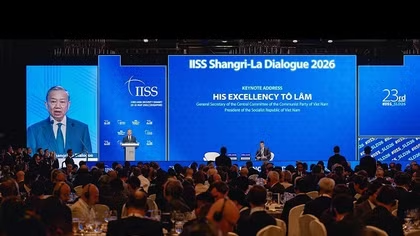
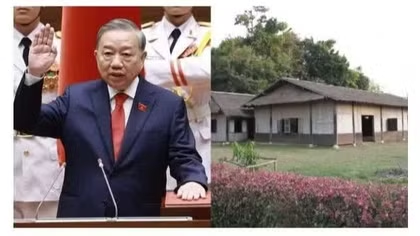
Regional media highlight significant step in Vietnam’s leadership structure

Regional media highlight significant step in Vietnam’s leadership structure

Under General Secretary and President Lam’s leadership, Vietnam is expected to maintain a balanced foreign policy, strengthen its regional standing and accelerate economic development, thereby improving living standards and creating new opportunities for international investors, according to the India-based platform Devdiscourse.

Laos identifies 10 key tasks to build independent, self-reliant economy

Laos identifies 10 key tasks to build independent, self-reliant economy

Laos will step up agricultural production to ensure food security, meet domestic demand and expand exports; encourage the development of agro-processing industries, including those related to rubber, aquatic products, cassava and sugarcane, as well as fertiliser and animal feed production, in order to increase added value and create jobs in rural areas.