USAID-funded project helps reduce harm of plastic pollution on public health

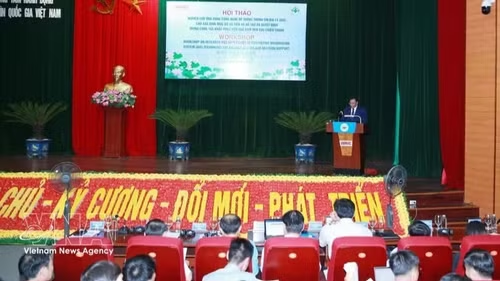
The Institute of Strategy and Policy on Natural Resources and Environment (ISPONRE) in coordination with the United States Agency for International Development recently launched the “Plastic and Health Action Partnership” (PHA) for the purpose of reducing impact of plastic wastes on public health.

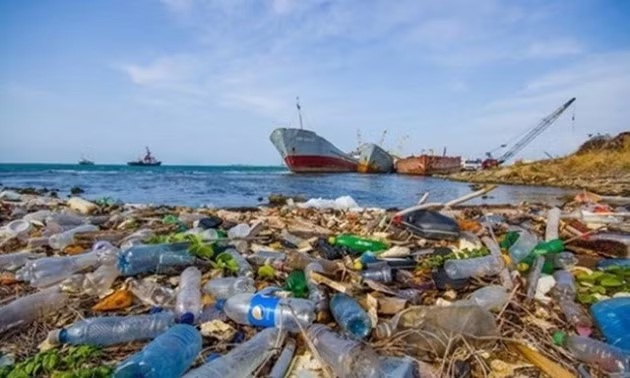
It is estimated that there is 25 million tonnes of solid domestic waste each year in Vietnam, and 10-20% of it is plastic.

It is estimated that there is 25 million tonnes of solid domestic waste each year in Vietnam, and 10-20% of it is plastic.

The PHA is part of progress made by the Local Solution for Plastic Pollution (LSPP) sponsored by the United States Agency for International Development (USAID) and Center for Supporting Green Development (GreenHub), co-operating with three other partners.

It is estimated that there is 25 million tonnes of solid domestic waste produced each year in the nation, with up to 20% of it being plastic.The percentage of plastic waste and single-use nylon bags in the country’s urban areas has also witnessed a rapid increase, accounting for between 10% and 20% of domestic solid waste.Dealing with issues relating to plastic pollution requires the combined efforts of many parties, such as Governmental bodies, international organisations, NGOs, research institutes, universities, and businesses, said Nguyen Trung Thang, deputy director of ISPONRE , during the launch ceremony.Establishing PHA can be viewed as an opportunity in order to attract the greater participation of all related groups in order to help reduce harm caused by plastic pollution on human health, he added.According to Christine Gandomi, USAID acting director of the office of Environment and Energy, the partnership would mark the beginning of a fresh era of collaboration, along with boosting the exchange of knowledge and good practices around plastic pollution challenges.The PHA would be among the first partnerships primarily focusing on plastic and its impacts on human health, she said.“This exchange and dialogue will help us address pressing development challenges in Vietnam,” she stated.The PHA has mobilised 18 organisations nationwide, including partners from international organisations, Government, NGOs, research institutes, and universities.In the future, the PHA will support departments and localities all over the country to carry out policy advocacy activities related to plastic and health. This will be done whilst building and contributing to a data centre, boosting communication activities, raising awareness on the relationship between plastic and health, and deploying pilot models to reduce plastic pollution throughout the nation.

VNA

Other News

Hanoi ready to implement Capital Law 2026, unlocking new development momentum

Hanoi ready to implement Capital Law 2026, unlocking new development momentum

The effectiveness of the Capital Law 2026 will be measured not by the number of legal documents issued but by tangible improvements in governance and public administration, better services for people and businesses, faster administrative procedures, stronger investment attraction and higher economic growth.

Vietnamese students earn honours at ROBOG Asia Cup 2026

Vietnamese students earn honours at ROBOG Asia Cup 2026

Three teams from Chu Van An Secondary School in Vietnam’s Thai Nguyen province have earned First Prize honours and advanced to the quarterfinals at the ROBOG Asia Cup 2026, a regional robotics and artificial intelligence (AI) competition for students held in Hong Kong, China.

Hanoi sets out new investment blueprint with century-long development vision

Hanoi sets out new investment blueprint with century-long development vision

As of early June, Hanoi had attracted 74.6 billion USD in foreign direct investment (FDI) through more than 9,250 valid projects. FDI inflows in the first six months were projected at 3.2 billion USD, surpassing the annual target by 116%, while nearly 16,000 new businesses were established in the first five months, up 34.4% year-on-year.

Vietnam promotes legal cooperation and rule of law at global forum

Vietnam promotes legal cooperation and rule of law at global forum

Vietnam’s development and international integration have gone hand in hand with the improvement of its legal system, the incorporation of international commitments into domestic legislation, and legal reforms aimed at fostering development, openness and global integration. The country regards international law as an essential instrument for building fair, mutually beneficial relations among nations.

Hanoi to hold investment promotion event on June 29

Hanoi to hold investment promotion event on June 29

At the event, Hanoi authorities plan to grant investment policy decisions and investment registration certificates to 20 exemplary projects in the fields of transportation infrastructure, industrial parks, urban development, social housing, environment, science and technology, and foreign investment attraction.

Hanoi's Red River urban area development draws widespread attention

Hanoi's Red River urban area development draws widespread attention

Located south of the Red River and extending from the historic inner city to newly developing areas in the south and the west, the central urban area along Red River’s right bank covers approximately 45,317 hectares and is projected to accommodate around 6.365 million residents by 2045 and 6.455 million by 2065.

Hanoi's Red River urban area development draws widespread attention

Hanoi's Red River urban area development draws widespread attention

Located south of the Red River and extending from the historic inner city to newly developing areas in the south and the west, the central urban area along Red River’s right bank covers approximately 45,317 hectares and is projected to accommodate around 6.365 million residents by 2045 and 6.455 million by 2065.

Regional cooperation strengthened to combat cross-border drug crime

Regional cooperation strengthened to combat cross-border drug crime

Vietnam, China, Laos and Myanmar face common challenges as drug syndicates increasingly exploit the Mekong River, cross-border transport networks, e-commerce platforms, international logistics services, cyberspace and cryptocurrencies to organise drug transactions and smuggling operations.