A Vietnamese delegation led by Deputy Minister of Agriculture and Rural Development Tran Thanh Nam is attending the 11th Global Agriculture Leadership Summit in New Delhi, India from November 24-25.
The annual summit is providing policymakers, managers, scientists, experts and leading Indian firms with a chance to share experience and seek business opportunities.
Speaking at the event, Vietnamese Ambassador to India Pham Sanh Chau said from its humble beginning as a food importer, Vietnam has become the largest exporter of rice, coffee and pepper after three decades of renewal.

Vietnam wants to acquire new technology and seek investment to further improve product quality and export, he said, adding that the global community needs to maintain a comprehensive, fair and open trade system while countries need to deliver on commitments in free trade agreements they joined.
From October 25-27, the first World Agriculture Prize 2018, the All India Progressive Farmers’ Convention, 12 international seminars on agriculture, 40 global trade dialogues, and six business forums between India and Africa, ASEAN, Latin America, the US, Japan and Germany will be also held.
At the India International Agro Trade and Technology Fair 2018 to be held at the Indian Agricultural Research Institute, machinery, equipment, services in manufacturing, processing, packaging and preservation of farm produce, seafood and processed food will be put on display.
Nearly 1,000 State agencies, research institutes, Indian and foreign enterprises will join the event which is expected to attract about 10,000 visitors.

Under Document No. 10065/VPCP-KGVX, the Deputy PM agreed with proposals by the Ministry of Home Affairs for a one-day holiday for Vietnamese Culture Day in 2026, and a seven-day Tet holiday and a four-day National Day holiday in 2027.
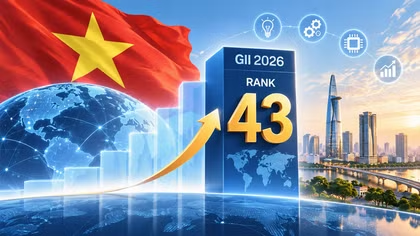
By 2030, Vietnam aims to rank among the world’s top 40 in the GII; raise total social investment in R&D to at least 2% of GDP, with non-State funding accounting for over 60%; increase international scientific publications by an average of 10% annually; and raise the number of patent applications and granted patents by an average of 16-18% annually.
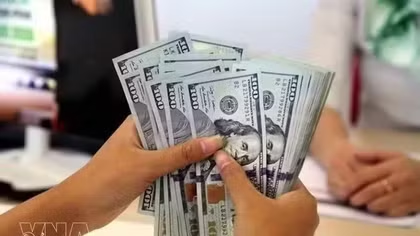
The State Bank of Vietnam set the daily reference exchange rate at 25,624 VND/USD on October1, down 3 VND from the previous day.
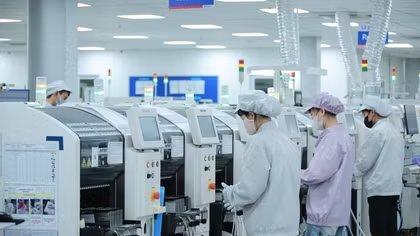
Quang Ninh's GRDP grew 15.04% in the third quarter, also leading the country.
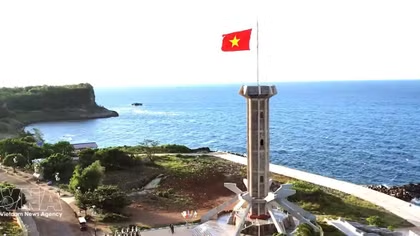
Vietnam needs flexible incentives and specialised green financial instruments, stronger inter-sectoral coordination, improved local governance capacity and a more complete MRV data system, said Ramla Khalidi, Resident Representative of the United Nations Development Programme (UNDP) in Vietnam.
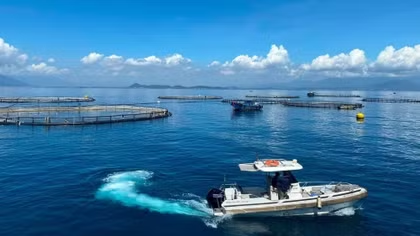
As the country enters a new development phase with greater demands for stronger marine-economy growth, institutional bottlenecks have emerged and need to be addressed.
Experts from the Institute of Vietnam and World Economy under the Vietnam Academy of Social Sciences noted the quality of recent growth as the high growth rate has been recorded against an increasingly higher comparative base.

Vietnam's Halal exports remain modest at around 900 million USD a year, accounting for less than 1% of the global market. Most exports are still raw agricultural and seafood products. Only around 1,000–1,300 Vietnamese businesses obtained or maintained Halal certification during 2024–2026.
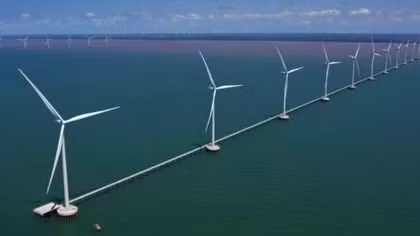
Vietnam needs a comprehensive policy framework to remove legal and procedural bottlenecks and create conditions for offshore wind power projects to access long-term investment capital, helping to unlock the country’s substantial offshore wind potential, said insiders.
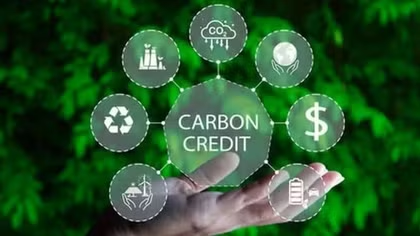
Under a decision of the municipal People’s Committee on establishing an inter-agency working group, departments and agencies are responsible for identifying facilities subject to greenhouse gas inventories, developing emissions-reduction plans and studying projects capable of generating carbon credits.
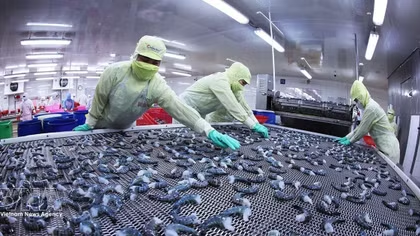
According to data from the Vietnam Customs cited by the Vietnam Association of Seafood Exporters and Producers (VASEP), shrimp exports reached 478.5 million USD in August, up 4.2% from the same month last year. The eight-month total stood at 3.3 billion USD, representing a year-on-year increase of 12%.
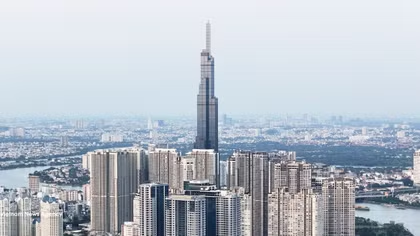
Vietnam is seen as a potential market, with considerable room for growth in real estate, particularly commercial property, compared with some regional markets. Strong Vietnam-Russia ties and opportunities to establish foreign-invested enterprises are also considered favourable for Russian investors.
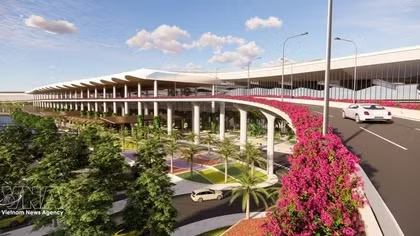
For 2021-2030, the Civil Aviation Authority of Vietnam proposed bringing forward the investment in a parallel taxiway system and a connecting taxiway north of Runway No. 2 at Phu Quoc International Airport, in order to connect with the aircraft maintenance and repair facility (hangar) planned for the northern area of the airport.
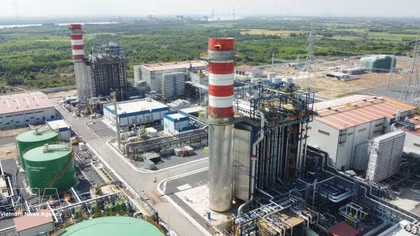
For LNG-fired power to fulfill its role in Vietnam’s energy transition, bottlenecks in institutions, infrastructure, electricity pricing, PPAs, power dispatch and financing must be addressed together.
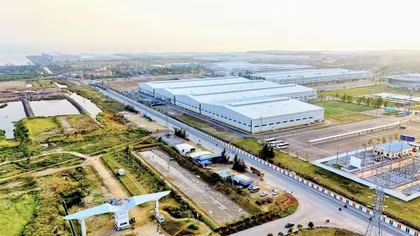
From policy and infrastructure to industrial real estate, Vietnam’s FDI advantages are broadening towards a more integrated production ecosystem, offering investors a stronger combination of conditions for high-value, technology-intensive and long-term projects.
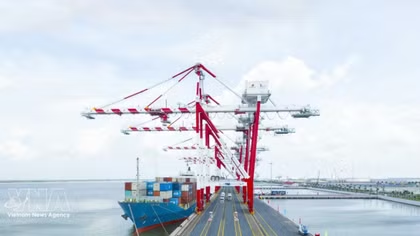
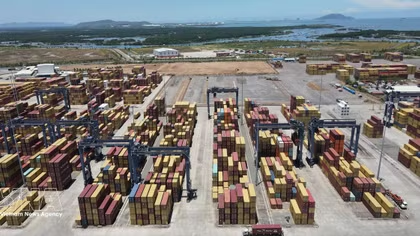
As trade expands, systemic bottlenecks across transport networks, warehousing, ports, border gates, and industrial zones are becoming more apparent. Experts emphasise the need to shift from a fragmented, project-by-project approach toward strategic management structured around trade corridors and integrated supply chains.
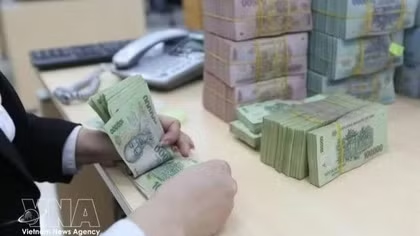
The company will buy non-performing loans from credit institutions and foreign bank branches, recover and dispose of debts and collateral, restructure loans and support lenders in resolving bad debts.
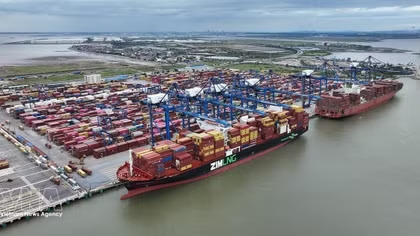
Do Ngoc Hung, Trade Counsellor and head of the Vietnam Trade Office in the US, said what stands out is not only the growth in trade volume but also the increasingly deep economic ties between the two countries.
According to the Ministry of Finance, State budget revenue in the first eight months of 2026 was estimated at 2.02 quadrillion VND (77.7 billion USD), equivalent to 80% of the annual estimate and up 16% year-on-year. Domestic revenue reached 1.75 quadrillion VND, accounting for 86.6% of total revenue and rising 16.6%.
Hanoi aims to achieve average annual export growth of at least 12% during 2026-30, with the city seeking to diversify export markets, boost high-tech and value-added products and reduce reliance on traditional markets.